Shrub · Apocynaceae
Star Jasmine
Trachelospermum jasminoides
Train it up a fence or wall and star jasmine pays you back with clouds of fragrant white flowers.
Full sun
Every 5–10 days
USDA 8–10
3–20 ft · 0.9–6.1 m
Overview
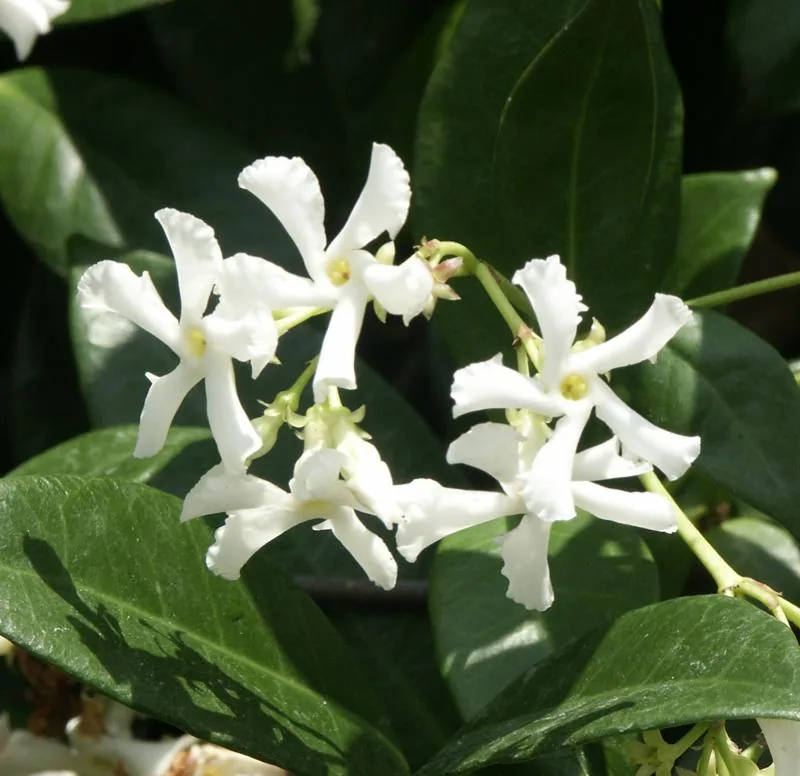
Star jasmine is an evergreen twining woody plant from the dogbane family, grown as a vine, a sprawling shrub, or a low groundcover depending on how you train it. The pinwheel-shaped white flowers open in late spring and carry a heady scent that drifts across a yard on a warm evening. The glossy dark leaves hold their color all year, so the plant earns its place even between flushes of bloom.
It climbs by twining rather than clinging, which means it needs a trellis, wire, or fence to wrap around. Left to ramble across the ground, it knits into a dense mat that smothers weeds. Either way it grows fast and reaches 3 to 20 feet (91 cm to 6 m) once it settles in.
For all that vigor, star jasmine is forgiving. It shrugs off most pests, takes a range of soils, and rides out short cold snaps in milder gardens. Give it sun, decent drainage, and something to climb, and it largely looks after itself.
Care
The short version: full sun for the best bloom, evenly moist but well-drained soil, and a support to twine up; once established it handles dry spells and asks for little.
Light
Star jasmine flowers best in full sun, though it takes partial shade and grows fine in bright indirect light indoors. The catch is that deep shade trades flowers for leggy green stems, so the sunnier the spot, the heavier the bloom.
Water
Keep the soil evenly moist while a young plant is settling in, watering roughly every 5 to 10 days. Once established it turns drought tolerant, so you only need to reach for the hose during real dry spells.
Soil
It likes fertile, well-drained loam with some leaf mold worked in, and it tolerates a fair range of soils. Aim for a pH between 6.0 and 7.5. The one thing it won't forgive is wet feet, so drainage matters more than anything.
Temperature
Star jasmine handles a wide swing, from about 10°F to 100°F (-12°C to 38°C). That cold tolerance is what lets it grow outdoors in zones 8 to 10, while gardeners in colder spots keep it in a pot to bring inside.
Humidity
Average humidity suits it, so there's no target number to hit. It adapts to ordinary indoor and outdoor air without any fuss.
Feeding
Feed once in spring with a balanced general-purpose fertilizer to fuel the season's growth. If the leaves yellow in alkaline ground, an iron supplement or acidifier sets the color right.
Pruning
Prune after flowering to keep the size and shape in check, and tuck the twining stems onto their support as they grow. The sap is a milky latex, so wipe your tools down once you've finished cutting.
Repotting
Container plants need a fresh pot every 2 to 3 years, or sooner if roots circle the base, water races straight through, or growth and bloom start to slow.
Size & spacing
Star jasmine runs from 3 to 20 feet (91 cm to 6 m) depending on whether you train it up or let it sprawl, spreading 3 to 6 feet (91 to 183 cm) wide. Give it room and a sturdy support to climb.
When to plant
Star jasmine is a warm-climate plant happiest in zones 8 to 10. Set new plants out in spring once the danger of frost has passed, and look for the main wave of fragrant flowers from late spring into early summer, with scattered bloom carrying on through the warmer months.
Northern hemisphere
Southern hemisphere
Typical months for a temperate climate: start earlier in warm zones, later where spring frosts linger.
- Plant: spring, after danger of frost has passed
- Harvest: late spring to early summer, with sporadic bloom into summer
Hardiness
USDA hardiness zones: 8–10
Temperature: down to -12°C
Troubleshooting
Star jasmine stays healthy with little fuss, so the few problems that crop up are easy to read. Most trace back to soil chemistry, a sap-sucking insect, or simply too little light. Match what you see below and fix it early.
Sticky leaves with a black coating and bumps on the stems
The bumps are scale insects or mealybugs, and the black film is sooty mold growing on the honeydew they leave behind. Wipe the stems clean with water and a little mild soap, then treat with horticultural oil or insecticidal soap. Cut out any stems that are badly overrun.
Fix:
- Wash off honeydew and sooty mold with water and mild soap
- Treat infestations with horticultural oil or insecticidal soap
- Prune out heavily infested stems
Yellow leaves with veins that stay green
This pattern is chlorosis, usually an iron shortage that shows up when the soil runs alkaline. Feed a chelated iron supplement or work in an acidifier, and mulch with leaf mold to keep the ground sweet. Check drainage too, since soggy roots can throw the same signal.
Fix:
- Apply a chelated iron supplement or soil acidifier
- Improve drainage and avoid overwatering
- Mulch with organic matter such as leaf mold
Thin, leggy growth and hardly any flowers
Star jasmine grown in too much shade puts out plenty of stem but little bloom. Move a container to a brighter spot or thin the canopy overhead. Full sun is what brings the heaviest flush of fragrant flowers.
Fix:
- Move container plants or relocate to a sunnier spot
- Thin overhead shade where possible
Toxicity
Good news for pet owners and parents: star jasmine is not toxic. The ASPCA lists it as safe for cats, dogs, and horses, and no toxic compounds are reported for other animals. The one thing to note is the milky sap that weeps from cut stems, which can leave sensitive skin a little itchy, so rinse your hands after pruning.
Safe for
People · Cats · Dogs · Horses · Rabbits · Livestock · Birds
Cats None
A curious cat can nibble the leaves without harm. The ASPCA lists star jasmine as non-toxic to cats.
Dogs None
Safe around dogs, with no toxic compounds reported. A pup that chews a trailing stem should be fine.
Horses None
Listed as non-toxic to horses, so it poses no grazing risk on a fence line or pasture edge.
Rabbits Safe
No toxins are reported for rabbits. The milky sap tastes bitter, which tends to put most off a second bite anyway.
Livestock Safe
Cattle, goats, and sheep can graze near it without trouble, since the plant carries no known toxic principle.
Birds Safe
Backyard and aviary birds are in no danger from the foliage or flowers.
People Safe
Handling and growing it is safe, though the milky sap can leave sensitive skin a little itchy, so rinse your hands after pruning.
Stems exude a milky latex sap when cut, which may cause mild skin irritation in sensitive people; wash hands and clean tools after pruning.
Varieties
A few selections and a close cousin turn up in nurseries, each with its own reason to grow it.
'Madison'
A tougher selection that takes more cold than the species and pushes its range into cooler gardens.
'Variegatum'
Grown for its leaves, which carry creamy-white margins that brighten a shaded wall or fence.
Asiatic jasmine (Trachelospermum asiaticum)
A close relative with smaller, darker leaves and tiny yellowish-white flowers that makes a tough, fast-spreading groundcover.
How to propagate
Star jasmine is easy to copy, and the way its stems twine and trail makes it suited to two simple methods that need no special gear.
Stem cuttingsEasy
Late spring to summer · Several weeks to a few months to root
Cuttings are the usual way to make more star jasmine. Take semi-ripe stem cuttings in late spring or summer, and they root over several weeks to a few months into plants identical to the parent.
LayeringEasy
Spring to summer · One season to root before separating
Layering trades on the way the stems already twine and trail. Pin a low stem to the soil in spring or summer, give it a full season to root, then cut it free from the parent as its own plant.
Myths
Star jasmine is a true jasmine.
The name and the sweet scent fool a lot of people, but this is not a real jasmine at all. It belongs to the dogbane family (Apocynaceae) as Trachelospermum jasminoides, a world apart from the genus Jasminum that gives us true jasmine.