Shrub · Rosaceae
Japanese Spirea
Spiraea japonica
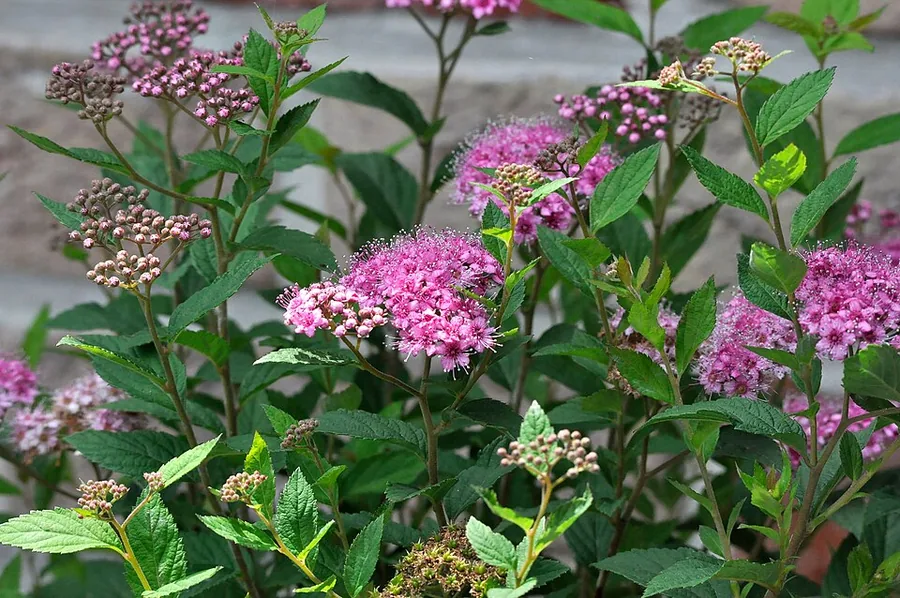
Tough, fast, and forgiving, Japanese spirea gives you flat pink flower clusters and shifting foliage color from spring to fall.
Full sun
Every 5–10 days
USDA 3–8
4–6 ft · 1.2–1.8 m
Overview
Japanese spirea is the kind of shrub that earns its place by asking for almost nothing. It's a deciduous member of the rose family that forms a low, rounded mound, runs from about 4 to 6 feet (122 to 183 cm) tall, and grows fast enough to fill a spot in a season or two. Flat-topped clusters of pink flowers open in early summer, and many cultivars carry foliage in gold, lime, bronze, or red on top of that.
Gardeners reach for it because it shrugs off cold down to zone 3, takes clay or rocky ground, and blooms on new wood, which makes pruning simple. It draws butterflies while it flowers and turns reddish before the leaves drop. Few shrubs give this much for this little work.
There is a real catch, though. Spiraea japonica self-seeds and suckers hard, and across much of the eastern and southeastern US it has escaped gardens and turned invasive, crowding out native plants. Where that's a concern, a sterile cultivar or a native shrub is the smarter pick.
Care
The short version: plant it in full sun in well-drained soil, water it through the first season and during dry spells after that, feed it lightly in spring, and prune in late winter so it blooms on the fresh growth.
Light
Spirea blooms best in full sun and holds its foliage color brightest there too. It will take partial shade, but expect fewer flowers and a looser, leggier shape in a shadier spot.
Water
Keep the soil evenly moist while a young shrub settles in, watering roughly every 5 to 10 days. Once established it handles short dry spells fine. The one thing to avoid is constantly wet ground, which rots the roots.
Soil
This shrub takes almost any soil, from clay to shallow rocky ground, which is part of its toughness. It does best in rich, well-drained loam with plenty of organic matter, and it's relaxed about pH anywhere from 6.0 to 8.0.
Temperature
Spirea is genuinely cold-hardy, riding out winters down to -35°F (-37°C) and summers up to 95°F (35°C). That range is what lets it grow across so much of the country without fuss.
Humidity
Outdoor humidity doesn't matter to this plant, so there's no figure to track. Air movement counts for more, since crowded, damp foliage is what invites leaf spot.
Feeding
A light hand is all it wants. Work in a balanced shrub fertilizer or some compost in early spring and leave it at that, because this is a low-feeding shrub that does poorly on rich diets.
Pruning
Spirea flowers on new wood, so make the main cut in late winter to early spring before growth starts. Shear off the faded flower clusters after the first bloom and you'll often coax a second flush the same year. Bumalda types need a gentler hand than the larger species.
Repotting
In the ground it never needs repotting. A container specimen can be potted up or root-pruned every 2 to 3 years, with circling roots and water running straight through the pot as your cue to act.
Size & spacing
Plan for a mounded shrub of 4 to 6 feet (122 to 183 cm) tall and a wider 5 to 7 feet (152 to 213 cm) across. Give it that room so air moves freely and leaf spot stays away.
When to plant
This is a plant for the open garden, hardy across USDA zones 3 to 8. Set out container or balled-and-burlapped shrubs in spring or fall, and the flat pink flower clusters arrive from June to July, with a lighter scattering of rebloom possible after.
Northern hemisphere
Southern hemisphere
Typical months for a temperate climate: start earlier in warm zones, later where spring frosts linger.
- Sow: Seed is rarely used by home gardeners; if started, sow indoors in late winter, though cultivars do not come true from seed.
- Plant: Plant container or balled-and-burlapped shrubs in spring or fall.
- Harvest: Showy pink (or white to red in some cultivars) flat-topped flower clusters from June to July, with sparse intermittent rebloom possible.
Hardiness
USDA hardiness zones: 3–8
Temperature: down to -40°C
Troubleshooting
Japanese spirea is hard to kill, and most of its troubles are minor and easy to read. Spring brings the odd pest, wet weather brings the odd spot, and soggy ground is the one thing that does real harm. Match what you see below and act early.
Wilting and dieback in a shrub sitting in wet ground
A spirea that wilts and fades while its soil stays soggy is fighting root rot, where waterlogged ground suffocates the roots until they turn brown and soft. Improve the drainage or move the shrub to a drier spot, and ease off the water. Once the roots are gone there's no saving a badly hit plant, so prevention is everything.
Fix:
- Improve drainage or relocate the shrub to a better-drained site
- Reduce watering and avoid wet, compacted soil
- Remove severely affected plants
Sticky, curled new growth covered in tiny insects
Those soft little bugs crowding the fresh shoots are aphids, and spring growth is their favorite target. Blast them off with a sharp jet of water, and reach for insecticidal soap only if a colony digs in. Lady beetles and lacewings will clear out the rest if you let them work.
Fix:
- Knock aphids off with a strong jet of water
- Treat heavier infestations with insecticidal soap or horticultural oil
- Encourage and preserve natural predators such as lady beetles and lacewings
Bordered spots on the leaves with early yellowing
Round spots with clean dark edges point to fungal leaf spot, which spreads when foliage stays wet and air sits still. Rake up the fallen leaves, thin any crowded stems to open the plant, and water at the base so the leaves dry fast. It looks worse than it is and rarely threatens the shrub.
Fix:
- Remove and dispose of fallen and heavily spotted leaves
- Improve air circulation by thinning crowded stems
- Water at the base to keep foliage dry
Toxicity
Good news for pet owners: Japanese spirea is not toxic. It doesn't appear on the ASPCA's poison list, and no harmful compound is on record, so cats, dogs, and livestock can share a garden with it safely. As with any non-food plant, a large mouthful might cause brief stomach upset, but nothing worse.
Safe for
People · Cats · Dogs · Horses · Rabbits · Livestock · Birds
Cats None
Spirea is safe for cats, with no toxic compound on record. A cat that nibbles a leaf out of boredom is fine, though a big mouthful of any plant can bring on a little drooling or a brief upset stomach.
Dogs None
Dogs can be around this shrub without worry. The most you'd expect from a curious chewer is some mild, passing tummy trouble from the roughage, not poisoning.
Horses Safe
No toxicity is documented for horses, so a planting near a paddock poses no real risk. As with any non-forage shrub, a horse that strips a large amount could get a touch of digestive upset.
Rabbits Safe
Rabbits won't be harmed by spirea. It carries no known toxin, though it isn't a food plant, so keep it to an occasional nibble rather than a regular browse.
Livestock Safe
Cattle, goats, and sheep can graze around spirea safely, since the plant holds no recognized poison. Heavy feeding on any woody shrub may unsettle the gut, but that's the limit of it.
Birds Safe
Spirea is harmless to birds, and its summer flowers actually draw butterflies and pollinators. Backyard hens can forage beneath it without concern.
People Safe
There's no toxic principle to worry about for people, so the shrub is safe to have around children. It still isn't grown for eating, so treat it as ornamental rather than a snack.
As with any non-food plant, ingestion of large amounts of plant material may cause mild, transient stomach upset; no specific toxic principle is documented.
Varieties
Most of the spirea you'll meet in a garden center are named cultivars chosen for foliage color as much as flower. These are the ones worth knowing.
Goldmound
A compact mounding form that pairs bright golden-yellow foliage with soft pink flowers.
Limemound
Carries lime-green to golden leaves on a low mound, turning reddish in fall above pink blooms.
Goldflame
Its new growth comes in bronze-red to orange before settling down, set against deep pink flowers.
Froebelii
A vigorous Bumalda type known for deep carmine-pink flowers and reddish new foliage.
Double Play Candy Corn
Opens candy-apple-red leaves that age to pineapple-yellow and then green, crowned with purple-red flowers.
How to propagate
Japanese spirea is almost too easy to multiply, which is part of why it spreads so well on its own. You can root cuttings, split suckering clumps, or sow seed, though seed rarely keeps a cultivar's looks.
Stem cuttingsEasy
Take softwood stem cuttings in late spring to early summer. · 4 to 8 weeks to root under suitable conditions.
Take softwood cuttings in late spring to early summer and they strike with ease, rooting in 4 to 8 weeks in the right conditions. That same readiness is part of why the plant spreads so freely in the wild.
DivisionEasy
Divide established clumps or rooted suckers in early spring or fall. · One growing season to become established.
Because spirea sends up suckers, you can lift and split rooted offshoots from an established clump in early spring or fall. Replant them and give them a full growing season to settle in.
SeedModerate
Sow seed in late winter to early spring. · Several months to a full season; seedlings of named cultivars do not come true to type.
Spirea self-seeds prolifically, which is exactly what feeds its invasive habit, so sown seed takes several months to a full season to make a plant. Named cultivars won't come true from seed, so propagate those vegetatively instead.
Myths
Japanese spirea is a safe, harmless ornamental you can plant anywhere in the eastern United States.
It's safe for pets, but that isn't the whole picture. Spiraea japonica self-seeds hard and has escaped gardens across the eastern and southeastern US, where it's classed as invasive and shoulders out native plants. In those regions a native shrub is the better choice.
Prune Japanese spirea in fall or right after it blooms to get more flowers next year.
This shrub flowers on new wood, so the main cut belongs in late winter to early spring before growth starts. Shearing off only the spent flower heads after bloom is what brings a second flush. Time the hard pruning wrong and you trade away the show.