Ornamental · Asteraceae
Shasta Daisy
Leucanthemum × superbum
Give it full sun and sharp drainage, and the Shasta daisy throws clean white blooms all summer long.
Full sun
Every 7–10 days
USDA 5–9
12–35 in · 30–90 cm
Overview
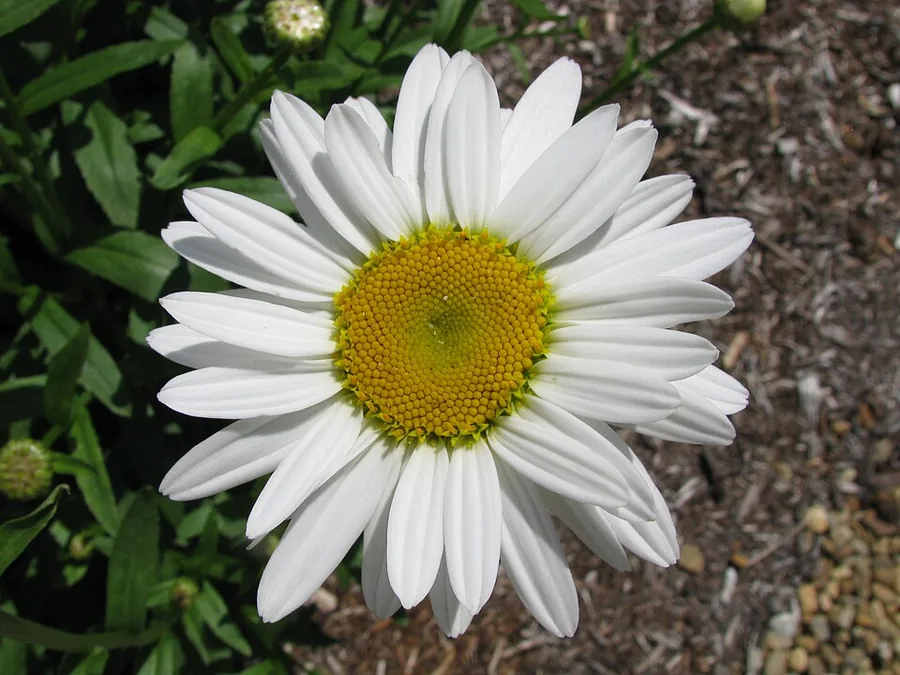
The Shasta daisy is the classic white daisy of the summer border, with bright golden-centered flowers held on upright stems above tidy dark green foliage. It is a garden hybrid in the aster family, bred to be tougher and showier than the wild oxeye daisy it descends from. Plant it once in the right spot and it returns year after year, blooming from June into September.
What it asks for is simple. Give it full sun and soil that drains well, and it shrugs off heat and dry spells with little fuss. The one thing it will not forgive is wet feet, since soggy ground over winter rots the crown and kills the plant.
Sizes run from knee-high front-of-border types to tall cut-flower cultivars. It is a short-lived perennial, so the clumps need splitting every couple of years to stay full and free-flowering, but that same habit hands you free plants each spring.
Care
The short version: full sun and sharp drainage above all else, water only when the top half of the soil dries, deadhead through summer, and divide the clump every 2 to 3 years to keep it vigorous.
Light
Shasta daisies bloom best in full sun, meaning six or more hours of direct light a day. They tolerate light afternoon shade, but too much shade gives you weak, floppy stems and far fewer flowers.
Water
Water when the top half of the soil dries out, roughly every 7 to 10 days, then let it dry again before the next drink. Once established the plant is genuinely drought tolerant, and the bigger danger is too much water rather than too little, especially over winter.
Soil
Give it average, well-drained soil, whether that leans toward loam, clay, or sand. It is easygoing about pH, happy anywhere from 6.0 to 8.0, but sharp drainage is non-negotiable since wet feet rot the crown.
Humidity
Ordinary outdoor humidity is fine and there is no number to chase. Good airflow matters far more, since crowded, damp foliage is what invites leaf spot and crown rot.
Feeding
This is not a hungry plant, so a light feed of balanced general-purpose fertilizer in spring is plenty. Rich soil and heavy feeding only push soft, floppy growth at the expense of strong stems.
Pruning
Deadhead spent flowers through the season to keep new buds coming. After the main flush fades, cut the stems back down to the low basal leaves to refresh the plant and stretch the life of this short-lived perennial.
Size & spacing
Plants stand 12 to 35 inches (30 to 90 cm) tall depending on the cultivar, spreading into a clump 12 to 24 inches (30 to 60 cm) wide. Give each one that much room so air moves freely and disease stays down.
When to plant
Shasta daisies follow the rhythm of a temperate spring. Start seeds indoors in late winter, set young plants out once hard frost has passed, and the flowers open from June into September. Early spring is also the window for lifting and dividing established clumps.
Northern hemisphere
Southern hemisphere
Typical months for a temperate climate: start earlier in warm zones, later where spring frosts linger.
- Sow: 6 to 8 weeks before the last spring frost
- Plant: Spring after danger of hard frost has passed
- Harvest: June to September
Hardiness
USDA hardiness zones: 5–9
Temperature: down to -29°C
Troubleshooting
Most Shasta daisy trouble traces back to drainage or a clump that has simply gotten too old. Read the early signs on the leaves and crown and you can usually step in before a plant is lost. Match what you see below, then act while it still helps.
Wilting and collapsing stems even though the soil is watered
When a daisy flags and falls over despite plenty of water, the trouble is usually underground. Verticillium wilt or crown and root rot sets in where drainage is poor, and once the crown turns soft and brown there is no saving it. Pull the failed plants, fix the drainage, and divide any healthy crowns into a better-drained spot.
Fix:
- Remove and discard severely affected plants
- Improve drainage and avoid overwatering
- Divide and replant healthy crowns in a better-drained site
A bare, dead center with flowers only around the rim
A clump that blooms only at its edges and dies out in the middle has simply outgrown its space. This is the plant asking to be split. Lift it in early spring, throw away the woody dead heart, and replant the vigorous outer pieces to bring the flowering back.
Fix:
- Divide the clump in early spring
- Replant vigorous outer divisions and discard the woody center
Brown or black spots peppering the leaves
Dark spots that spread in damp weather point to fungal or bacterial leaf spot, and they show up on the lower leaves first. The fix is simple. Strip off the marked foliage, keep water off the leaves, and open the planting up so air can move through.
Fix:
- Remove and destroy affected foliage
- Avoid overhead watering
- Improve air circulation
Twisted new growth, sticky leaves, or fine speckling
Curled tips and a sticky film usually mean aphids are feeding on the soft new growth. Mottled, stippled leaves or faint serpentine trails instead point to spider mites or leaf miners. Blast the aphids off with a hard jet of water, reach for insecticidal soap only if they take over, and pick off any mined leaves.
Fix:
- Hose off aphids with a strong stream of water
- Apply insecticidal soap if infestation is heavy
- Remove and destroy mined leaves
Toxicity
This is not a fully harmless plant for animals. As a cousin of the toxic chrysanthemum it carries pyrethrin-like sesquiterpenes, so a pet that chews the leaves or flowers may drool, vomit, or break out in a rash. The reaction is usually mild, and the bitter taste stops most animals before they eat much, but it is worth keeping curious pets and small children from making a meal of it.
Toxic to
Cats · Dogs · Horses · Rabbits · Livestock · Birds · People
Cats Mild
A curious cat that chews the leaves may drool, retch, or vomit, and the sap can leave the mouth or skin a little irritated. The bitter taste keeps most cats from eating enough to do real harm.
Dogs Mild
Dogs that bolt down a few flower heads can get an upset stomach with drooling and loose stools. Handling the cut stems sometimes brings on a mild, itchy rash on thin-skinned dogs.
Horses Mild
Horses rarely touch the bitter foliage, but a grazing mouthful can cause some drooling and a brief bout of digestive upset. Contact with the sap may leave the muzzle slightly irritated.
Rabbits Caution
The same pyrethrin-like compounds make this a poor choice for rabbits, so it is safest kept out of reach. Offer their usual greens instead of letting them graze the foliage.
Livestock Caution
Cattle, goats, and sheep almost always pass over the bitter plant, yet a hungry animal that eats a lot could end up with mild digestive upset. Keep it out of overgrazed paddocks to be safe.
Birds Caution
There is little reason for birds to eat it, and the irritant compounds make it wise to keep cage birds away from the cut flowers. Wild birds visiting the blooms for seed are not at risk.
People Caution
No part of a Shasta daisy is meant for eating, and the sap can leave sensitive skin red and itchy after handling. Keep small children from chewing the flowers, though a stray petal is nothing to panic over.
Most pets ignore the bitter foliage; a nibble may cause mild stomach upset or skin irritation rather than serious harm.
Helpline numbers

United States
ASPCA Animal Poison Control: (888) 426-4435 (fee applies)
Poison Control: (800) 222-1222



Canada
Poison Centres: 1-844-764-7669
Varieties
Breeders have given the Shasta daisy a good range of heights and flower forms. These are the cultivars worth knowing by name.
Becky
A tall cultivar that reaches 3 to 4 feet on rigid stems strong enough to skip staking, carrying 3 to 4 inch white flowers around yellow center disks.
Crazy Daisy
A double-flowered form with frilly, slightly shaggy ray florets that give the blooms a fuller, looser look.
Snowcap
A compact cultivar that tops out at just 15 to 18 inches, made for the front of a border or a container.
How to propagate
Shasta daisies are easy to multiply, whether you want exact copies of a favorite cultivar or a tray of seedlings to fill a bed.
DivisionEasy
Early spring, every 2 to 3 years · One growing season to re-establish and resume strong flowering
Division is the surest way to keep a clump young, so lift it in early spring every 2 to 3 years. Throw out the woody dead center, replant the vigorous outer pieces in well-drained soil, and give them a full season to settle in and flower strongly again.
SeedEasy
Start indoors 6 to 8 weeks before the last spring frost, or sow outdoors in spring · Often blooms the first or second year from seed depending on sowing time
The species and many cultivars come easily from seed, sown indoors 6 to 8 weeks before the last frost or scattered outdoors in spring. Plants raised this way often bloom in their first or second year. Named cultivars, though, are best split by division so they stay true to type.
Myths
Shasta daisies are completely safe and a pet can eat them freely.
They sit in the same family as toxic chrysanthemums and carry similar pyrethrin-like sesquiterpenes, so a pet that chews them can drool, vomit, or develop a skin rash. A bitter Shasta daisy is a mild irritant, not a harmless snack, even though it is far less dangerous than a true mum.
Shasta daisies are reliably long-lived perennials that never need attention.
They are short-lived perennials, and a clump fades fast without division every 2 to 3 years. Good drainage and a hard cut-back after bloom are what keep them going, so a little upkeep buys you several more years.