Tree · Cactaceae
Saguaro
Carnegiea gigantea
Give it scorching sun, sharp drainage, and decades of patience, and the saguaro becomes a desert giant.
Full sun
Every 14–30 days
USDA 9–11
33–59 ft · 10–18 m
Overview
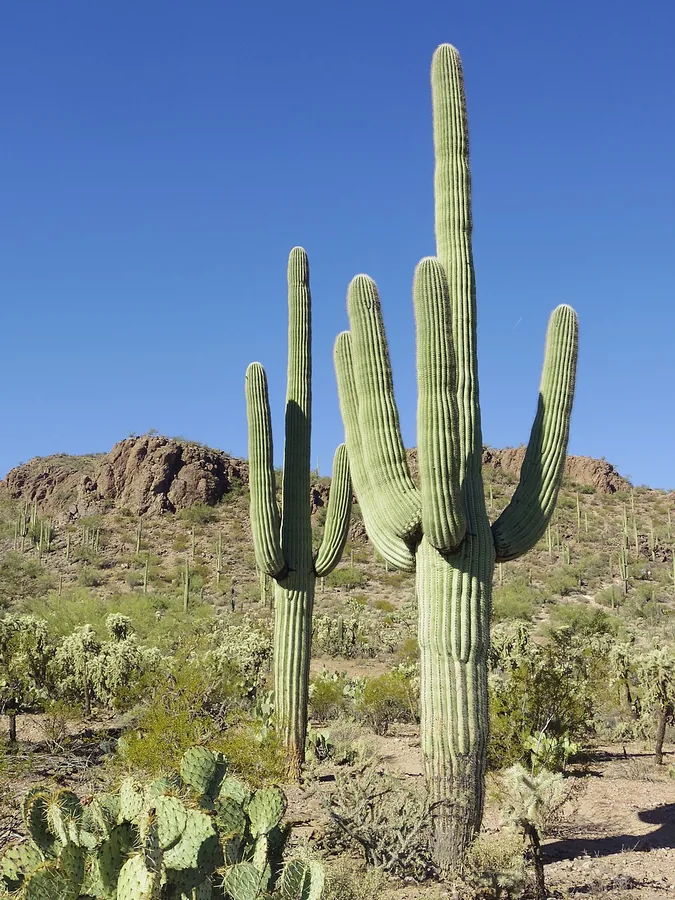
The saguaro is the giant of the Sonoran Desert and the cactus most people picture when they think of the American Southwest. It grows as a single ribbed column that may branch into the famous upraised arms, and a full-grown plant can tower well over a person's head. Everything about it is slow and deliberate, shaped by a land that goes months without rain.
This is a plant that measures its life in centuries. It can take 50 to 75 years just to grow a first arm, and some never branch at all. The pleated stem swells like an accordion to store water after a desert downpour, then draws on that reserve through the long dry stretches. White flowers open at night in late spring and give way to red fruit that desert people have gathered and eaten for generations.
Growing one asks for the right climate and a great deal of patience. It belongs in hot, dry, frost-free ground with soil that drains in seconds, not minutes. Get the site right and the plant practically takes care of itself, but it is also a protected species in the wild, so always start with a nursery-grown plant rather than one dug from the desert.
Care
The short version: full sun, gritty fast-draining soil, and very little water. Let the soil dry out completely between drinks, keep the plant nearly dry all winter, and protect it from hard frost.
Light
Give the saguaro full sun all day. It is built for the open desert and wants as much direct light as it can get, though young plants take a little afternoon shade while they toughen up.
Water
Water deeply but rarely, and only once the soil has dried out completely during warm growth. That works out to roughly every 14 to 30 days in the active season, and through winter the plant wants to stay nearly dry. An established saguaro leans mostly on natural rainfall and the water it stores in its stem.
Soil
Plant in gritty, sharply draining mineral soil, the rockier and sandier the better. A pH anywhere from 6.0 to 8.0 suits it, and the one thing it will not forgive is ground that holds water around the roots.
Temperature
The saguaro handles tremendous heat, up to about 113°F (45°C), but the cold is what kills it. It can survive a brief dip to around 23°F (-5°C), yet a hard or lasting freeze damages the tissue and opens the door to rot.
Humidity
This is a desert plant that wants the air dry, around 10% to 30%. Damp, humid conditions work against it and raise the risk of rot, so it has no place in a steamy spot.
Feeding
It needs very little feeding. A dilute, low-nitrogen cactus fertilizer through spring and summer is plenty, and too much nitrogen only forces soft, weak growth that the plant can't support.
Pruning
Leave the saguaro alone. It needs no routine pruning, so cut only an arm that is clearly damaged or diseased, and on a mature plant hire a professional, since the arms are heavy and the spines are unforgiving.
Repotting
Only young plants in containers need repotting, about every 2 to 4 years while they are small. Once a saguaro is settled in the landscape it stays where it is for life.
Size & spacing
A mature saguaro reaches a towering 33 to 59 feet (10 to 18 m) tall and can spread its arms 2 to 11.5 feet (60 cm to 3.5 m) wide. Give it plenty of open room and a permanent home, because it will be there for generations.
When to plant
The saguaro runs on heat and cannot stand a hard freeze. Start seed in the warm months of late spring and summer, and set young plants out only after the last frost has passed. The white flowers open in late spring and the red fruit follows into early summer.
Northern hemisphere
Southern hemisphere
Typical months for a temperate climate: start earlier in warm zones, later where spring frosts linger.
- Sow: Late spring into summer when soil is warm (21-27°C)
- Plant: Spring after all danger of frost has passed
- Harvest: Late spring to early summer (May-June); white night-opening flowers, followed by red edible fruit
Hardiness
USDA hardiness zones: 9–11
Temperature: down to -7°C
Troubleshooting
Most saguaro trouble traces back to too much water or a hard cold snap. Watch the stem and the base, since that is where rot and frost damage show first. Match what you see below, then act before the problem spreads through the plant.
Soft, dark lesions that ooze and smell on the trunk or arms
This is bacterial necrosis, caused by Erwinia cacticida slipping in through wounds or frost cracks. It spreads through the inner tissue and rots it from within. Cut the infected flesh back to firm green tissue with a sterilized blade, let the wound dry and callus in open air, and bring in an arborist before you treat a large plant.
Fix:
- Cut out infected tissue back to firm healthy green flesh using sterilized tools
- Allow the wound to dry and callus in open dry air
- Consult an arborist or extension specialist before treating large plants
A soft, discolored base and a plant that leans or topples
This is root and basal rot, brought on by too much water or soil that won't drain. The base turns mushy instead of firm, and the whole plant can lean or fall. Stop watering, let the soil dry out completely, and move the plant into a gritty mineral mix if the drainage is the problem.
Fix:
- Stop watering and allow the soil to dry completely
- Improve drainage or replant in gritty fast-draining mineral mix
- Cut away rotted tissue where accessible and let it callus
Yellowed or blackened bands near the tips after a cold snap
This is frost damage, and it shows up on the growing tips and the most exposed surfaces right after a hard freeze. Don't reach for the knife yet. Wait for warm weather to see how far the harm runs, then take off only the tissue that is clearly dead or rotting.
Fix:
- Do not cut immediately; wait until warm weather to assess the extent of damage
- Remove only clearly dead or rotting tissue once freeze risk has passed
Toxicity
The saguaro is not poisonous, and its ripe fruit is good to eat, so there is no risk from a curious nibble. The real danger is physical: the long rigid spines can drive deep into skin, and a mature plant weighs several tons. Handle it with thick gloves and proper tools, and keep children and pets from brushing against it.
Safe for
People · Cats · Dogs · Horses · Rabbits · Livestock · Birds
Cats None
There is nothing poisonous in the flesh, so a curious cat won't be sickened by it. The real worry is the spines, which can drive deep into a paw or face and need a vet to pull.
Dogs None
A dog that gnaws the plant faces no chemical harm. A bumped nose or a spine lodged in the mouth is the genuine risk, so steer them clear of the long needles.
Horses None
Nothing in the cactus will poison a horse. A passing brush against the rigid spines can still leave painful puncture wounds, so keep the plant out of the paddock.
Rabbits None
Rabbits face no toxic threat from the tissue itself. Those stiff spines can injure a small animal badly, so fence them away from any low arms.
Livestock None
Cattle, goats, and sheep aren't poisoned by saguaro. The hazard is purely the spines, which can wound mouths and legs if animals crowd against the plant.
Birds None
Birds take no harm from the plant, and many desert species nest right inside it. The spines pose little trouble for them.
People None
The plant is not poisonous, and its ripe red fruit has long been gathered and eaten. The sharp spines are the one real danger, so handle the plant with thick gloves and proper tools.
The danger is physical, not chemical: large rigid spines can puncture skin and cause painful wounds, and mature plants are extremely heavy.
Varieties
The saguaro comes in one main form, with one rare oddity that collectors prize. These are the two you are likely to hear named.
Typical columnar form
The standard form grows as a tall single trunk that branches into the familiar arms and reaches full tree size with age.
Crested (cristate) Saguaro
A rare mutation makes the apex grow into a flattened fan instead of the usual rounded column.
How to propagate
The saguaro grows from seed, which is straightforward to start but demands real patience as the seedling inches along.
SeedModerate
Warm season, late spring through summer · Germinates in 1-3 weeks but takes several years to reach a transplantable size
Saguaros grow from seed, sown fresh on a gritty mix kept warm and lightly moist through the warm season from late spring into summer. The seed sprouts within 1 to 3 weeks, but be patient, because a seedling needs several years of slow growth before it is large enough to transplant.
Myths
It is illegal to own or grow a saguaro at all.
You can legally grow, sell, and plant a saguaro. Arizona law only regulates removing, harvesting, or destroying native plants in the wild, so lawful cultivation and nursery-grown specimens are entirely fine.
You can tell a saguaro's exact age by counting its arms.
Arm number varies far too widely to read like rings. Many saguaros take 50 to 75 years to push out a first arm and some never branch at all, so arms tell you almost nothing about a plant's age.