Tree · Fagaceae
Northern Red Oak
Quercus rubra
A fast-growing native that throws deep shade and brilliant red fall color for a century or more.
Full sun
Every 7–14 days
USDA 3–8
50–75 ft · 15.2–22.9 m
Overview
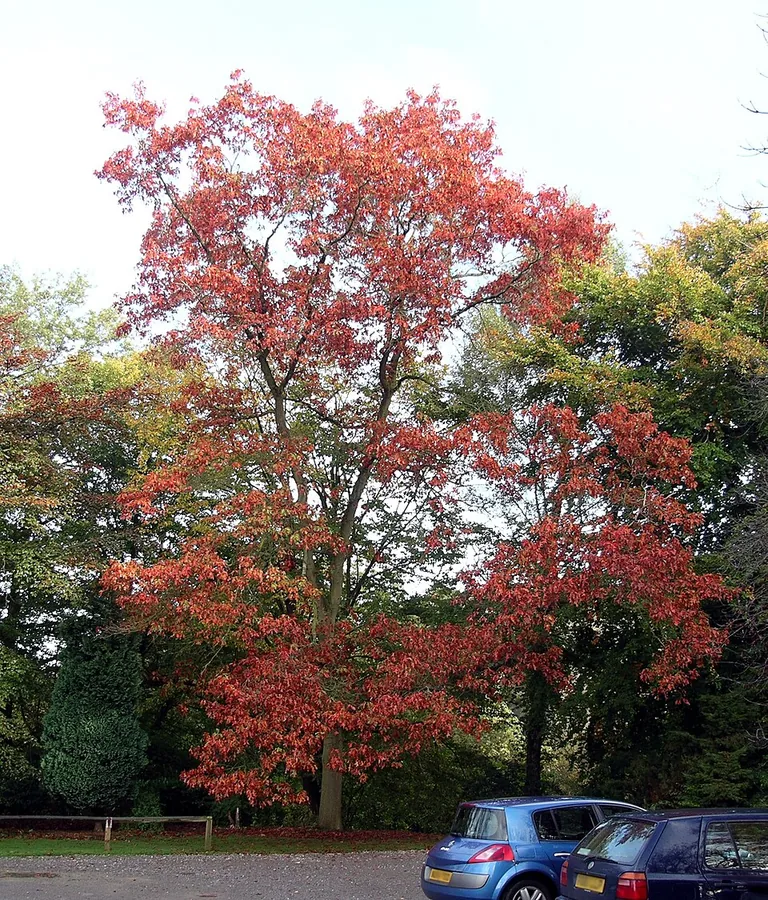
Northern red oak is the shade tree a lot of people picture when they think of an oak. It belongs to the beech family and grows wild across eastern North America, where it reaches 50 to 75 feet (15 to 23 m) tall with a broad, rounded crown. The bark runs in long pale ridges, and the pointed, bristle-tipped lobes mark it out as a member of the red oak group.
What sets it apart from other oaks is speed. Red oak puts on height faster than most of its relatives, which is why towns plant it along streets and in parks where shade is wanted within a lifetime rather than two. It takes city soil and road grit better than many natives, then turns a deep russet to brilliant red once the nights cool.
Give it room and the right ground and it asks for almost nothing after the first few years. The catch is the acorns and young leaves, which carry tannins that are hard on grazing animals, so it earns its keep best in a yard or park rather than a pasture.
Care
The short version: full sun and deep, acidic, well-drained soil, with steady water for the first few years until the taproot settles in and the tree fends for itself.
Light
Red oak wants full sun to grow straight and dense, and it will take partial shade while young. A tree given enough light fills out into the broad, even crown that makes it such a good shade tree.
Water
Keep young trees watered for the first few years while the roots reach down, letting the top half of the soil dry between drinks. Once it's established the oak is drought tolerant and gets by on rain in all but the worst dry spells.
Soil
Plant it in deep, fertile, well-drained soil on the acidic side, anywhere from a pH of 4.5 to 7.0. It dislikes alkaline ground, where it yellows with iron chlorosis, and a moist loam or sandy loam suits it best.
Temperature
This is a cold-hardy tree that handles winters down to -40°F (-40°C) and summer heat up to about 100°F (38°C). That range covers a wide stretch of the temperate zone.
Humidity
Ordinary outdoor humidity is all it needs, so there's no number to watch. Good airflow through the canopy matters more, since stagnant, damp air is what lets leaf fungi take hold.
Feeding
An established landscape oak rarely needs feeding at all. If the soil is genuinely poor, give a balanced slow-release tree fertilizer in early spring and leave it at that.
Pruning
Prune only in the dormant winter months, and never from April through June, when fresh cuts draw the beetles that spread oak wilt. Take out dead, damaged, or crossing branches and otherwise let the tree be.
Repotting
There's no repotting in the long run, since this becomes a forest-sized tree. Move it only while young, before the deep taproot sets, and plant it where it can stand for the rest of its life.
Size & spacing
A mature red oak reaches 50 to 75 feet (15 to 23 m) tall with a spread of 40 to 65 feet (12 to 20 m), so give it plenty of open room well clear of buildings and power lines.
When to plant
Red oak runs on the seasons. Acorns drop in fall and need a cold winter before they sprout, so plant them in autumn or set out young saplings in early spring, and save any pruning for the dead of winter to keep oak wilt at bay.
Northern hemisphere
Southern hemisphere
Typical months for a temperate climate: start earlier in warm zones, later where spring frosts linger.
- Sow: Stratify acorns over winter (60-90 days cold-moist) and sow in deep containers in late winter to early spring
- Plant: Plant acorns in fall or transplant young saplings in early spring
- Harvest: Inconspicuous yellow-green catkins in spring; acorns mature over two growing seasons and drop in fall
Hardiness
USDA hardiness zones: 3–8
Temperature: down to -40°C
Troubleshooting
An established red oak is tough, but a few troubles show up on the leaves first. Oak wilt is the one to take seriously, while most of the rest are cosmetic or pass on their own. Match what you see below, then act while it still counts.
Leaves bronzing from the edges and a crown that dies back fast
This is oak wilt, a fungus that clogs the tree's water channels from the inside, and red oaks have little defense against it. Leaves go dull, bronze in from the margins, and drop while the upper crown thins out, sometimes killing a tree in a single summer. Confirm it through a lab, take the tree down promptly, and sever the shared roots between neighboring oaks so it can't travel underground.
Fix:
- Remove and properly dispose of infected trees promptly
- Sever root grafts between adjacent oaks to limit underground spread
- Avoid wounding or pruning healthy oaks April-June
Brown blotches along the veins after a cool, wet spring
Oak anthracnose is a leaf fungus that flares up when spring stays cold and damp. It leaves brown patches tracking the veins, twists the new leaves, and kills the odd twig, though it rarely threatens an established tree. Rake up and destroy the fallen leaves, prune out dead twigs, and keep air moving through the canopy.
Fix:
- Rake and destroy fallen infected leaves
- Prune out dead twigs
- Apply labeled fungicide early in the season before bud break only in severe cases
Chewed, stripped leaves with caterpillars in the canopy
Spongy moth caterpillars, once called gypsy moth, can strip a crown bare in late spring. A healthy oak shrugs off a year of this and pushes out a second flush of leaves, so the damage looks worse than it is. Scrape egg masses off the trunk in winter, band the trunk or hand-pick small outbreaks, and water the tree through a heavy defoliation.
Fix:
- Hand-pick or use sticky bands on trunks for small infestations
- Apply Bacillus thuringiensis (Bt) to young larvae
- Support tree vigor with water during defoliation years
Yellow leaves with green veins on the newest growth
This is iron chlorosis, and it shows up when the soil runs too alkaline for the roots to pull up iron. The leaf turns yellow between the veins while the veins themselves stay green, worst on the youngest growth. Lower the pH over time with elemental sulfur and treat a struggling tree with chelated iron, but the lasting answer is planting on acidic ground in the first place.
Fix:
- Lower soil pH with elemental sulfur over time
- Apply chelated iron as a soil drench or foliar spray
- Improve soil drainage and aeration
Toxicity
This is a tree to enjoy from a distance if you keep animals. The leaves, buds, and green acorns hold tannins that upset the gut and, in horses and livestock, can damage the kidneys badly enough to kill. People shouldn't eat raw acorns either, since they're bitter and astringent until leached, so keep grazing stock, pets, and small children away from what falls.
Toxic to
Cats · Dogs · Horses · Rabbits · Livestock · Birds · People
Cats Mild
A cat that nibbles a leaf or acorn usually gets an upset stomach, with vomiting, loose stools, and no interest in food. Cats rarely eat enough to do real harm, but keep fallen acorns swept up where one likes to wander.
Dogs Mild
Dogs are the ones most likely to crunch a few acorns, which brings on vomiting, diarrhea, and a poor appetite. A bellyful of whole acorns can also lodge in the gut and block it, so it's worth clearing them from a yard where a dog forages.
Horses Severe
Horses are hit hard by oak. Young leaves, buds, and green acorns bring on belly pain, constipation that turns to bloody diarrhea, a dull mood, frequent urination, dark urine, jaundice, and kidney damage that can kill.
Rabbits Toxic
The tannins in oak leaves and acorns are far too harsh for a rabbit's gut, so none of the tree belongs anywhere near a hutch. Even a small amount can leave a rabbit off its food and in distress.
Livestock Severe
Cattle, sheep, and goats that graze young oak leaves, buds, or green acorns can suffer ulcers along the gut and kidney failure as the tannins build up. A big enough feed turns fatal, and stock will seek acorns out after a storm drops them.
Birds Caution
Wild jays and woodpeckers handle acorns as part of their diet, but the raw tannins are rough on backyard poultry and cage birds. Keep pet birds away from the leaves and green acorns to be safe.
People Caution
Raw acorns are bitter and astringent with tannins, so no one should eat them straight off the tree. The traditional way around it is long leaching in water, and small children should be kept from putting acorns or leaves in their mouths.
Keep livestock and horses away from oak leaves, buds, and fallen green acorns; pick up acorns where pets forage. Most poisoning occurs when animals eat large amounts.
Helpline numbers

United States
ASPCA Animal Poison Control: (888) 426-4435 (fee applies)
Poison Control: (800) 222-1222


Canada
Poison Centres: 1-844-764-7669
Varieties
Almost every red oak you'll meet is the straight species, but a couple of named selections turn up now and then.
Aurea
Its young leaves open a bright golden yellow before settling to green, though you'll rarely find it for sale.
Splendens
This one was picked for an especially clean, brilliant red in fall.
How to propagate
Red oak comes up easily from its own acorns, as long as you respect the cold spell the seed needs before it will sprout.
SeedModerate
Collect ripe acorns in fall; sow outdoors immediately or stratify over winter and sow in spring · Germinates the spring after cold stratification; several years to establish a sapling
Red oak grows readily from acorns, but the seed needs a cold winter first. Gather ripe acorns in fall and either sow them outdoors right away or give them 60 to 90 days of cold, moist stratification near 32°F to 40°F (0°C to 4°C) before sowing in spring, after which they sprout the following spring and take several years to fill out into a sapling. Because the tree drives down a deep taproot, sow it where it will stand for good or move it only while young in a deep container.
Myths
Every fallen oak leaf and brown acorn is just as dangerous to grazing animals all year long.
The danger is concentrated in spring's young leaves and buds and in immature green acorns, where the tannins run highest. Mature brown leaves in fall carry far less, and a serious case takes a large feed rather than a stray mouthful. Timing and quantity decide the real risk, not the simple presence of oak.
Red oak grows too slowly to bother planting as a shade tree.
Northern red oak is one of the quicker oaks, putting on real height at a moderate-to-fast pace. It earns its place as a long-lived native shade and street tree, and the wait is shorter than the reputation suggests.