Shrub · Rosaceae
Raspberry
Rubus idaeus
Give it full sun, rich soil, and a yearly prune, and the raspberry repays you with berries by the handful.
Full sun
Every 3–7 days
59–77°F · 15–25°C
USDA 3–8
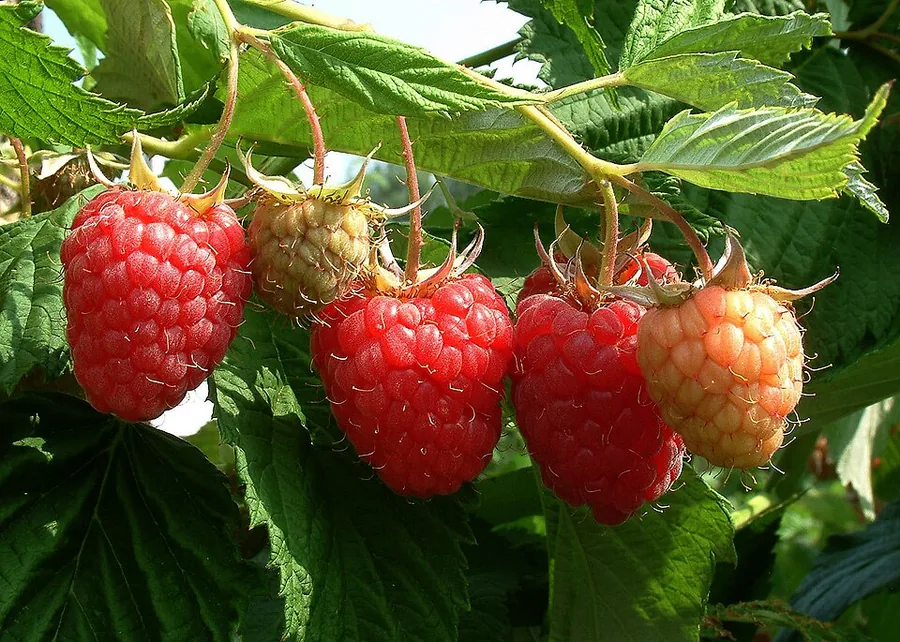
Overview
Few fruits beat a raspberry picked warm off the cane. It belongs to the rose family and grows wild across the cooler half of the world, which is why it shrugs off winters that flatten softer crops. In the garden it forms a thicket of upright canes, hardy from zone 3 through zone 8, and spreads on its own once it settles in.
The big choice is which kind to grow. Summer-bearing types fruit once, in early to midsummer, on canes that grew the year before. Everbearing types push a crop on their first-year canes in late summer and fall, and knowing which one you planted decides how and when you prune.
Raspberries ask for little beyond sun, steady moisture, and air moving through the row. Give them that and they crop heavily for years, though their wandering roots mean you'll spend some time keeping the patch where you want it. The canes carry sharp prickles, so gloves and long sleeves earn their keep at harvest.
Care
The short version: full sun, deep and slightly acidic soil rich in compost, and about an inch of water a week. Prune by cane type each year and give the roots room to roam or a barrier to stop them.
Light
Raspberries crop best in full sun, with six hours or more of direct light a day. They'll take a little partial shade, but the canes stretch and the harvest thins out where the sun is weak.
Water
Aim for steady moisture, about an inch of water a week, and a touch more while the fruit is filling. Keep the soil damp but never waterlogged, since roots sitting in wet ground rot and the berries soften.
Soil
Plant in deep, well-drained loam loaded with organic matter. Raspberries like the soil on the acidic side, a pH of 5.6 to 6.5, and the new leaves yellow when the ground runs too alkaline.
Temperature
They grow best in cool to mild weather, roughly 59°F to 77°F (15°C to 25°C). The canes are tough enough to ride out hard winters down to zone 3, but heavy summer heat can stress the plants and scorch the fruit.
Humidity
Average humidity of 40% to 70% suits them fine, so there's no number to fuss over. Airflow is what counts, since still, damp air around crowded canes is how gray mold gets going.
Feeding
Feed once in early spring as growth starts, using a balanced fertilizer like 10-10-10 or a topdressing of aged compost or manure. That single seasonal feed carries the canes through a full crop.
Pruning
Prune to match the type. On summer-bearing plants, cut out the spent floricanes right after harvest and thin the new primocanes; everbearing types can simply be mowed to the ground in late winter for one strong fall crop.
Repotting
Raspberries belong in the ground, not in pots, so repotting rarely comes up. If you do grow one in a container, move it on when the roots start circling and the soil dries out fast.
Size & spacing
Canes reach 3 to 6 feet (90 to 180 cm) tall and clump out to 2 to 4 feet (60 to 120 cm) wide. Give the rows room and a trellis so air moves through and the prickly canes stay off your arms.
When to plant
Raspberries go in early, while the plants are still dormant and the ground has barely woken up. Set the canes out in early spring, and depending on the type you'll pick fruit from early summer right through into fall.
Northern hemisphere
Southern hemisphere
Typical months for a temperate climate: start earlier in warm zones, later where spring frosts linger.
- Plant: Early spring while plants are still dormant
- Harvest: Summer-bearing types ripen early to midsummer; everbearing types crop late summer into fall
Hardiness
USDA hardiness zones: 3–8
Temperature: down to -40°C
Troubleshooting
Most raspberry trouble lands on the fruit, the canes, or the new leaves. Catch it early and a quick cut or a change in watering usually settles it. Match what you see below, then act before it spreads down the row.
Soft berries furred with gray mold
This is gray mold, caused by Botrytis cinerea, and it takes hold when wet weather meets a crowded, airless planting. Pick the fruit often and bin anything that turns soft, since the spores race through a punnet in storage. Thin the canes so air moves freely and water at the base, not over the top.
Fix:
- Remove and discard infected berries promptly
- Harvest frequently and keep fruit dry
- Improve air circulation by thinning canes
Wilting cane tips ringed by twin scars
Two girdling rings just below a drooping tip point to the raspberry cane borer, while dark sunken patches at the nodes mean a cane disease like spur blight. Cut the affected cane well below the damage and destroy it, then clear any wild brambles that shelter the same pests nearby. Pruning out old and infected canes each year and keeping the rows narrow is what keeps both in check.
Fix:
- Cut and destroy affected canes below the damage
- Remove all wild brambles nearby
- Maintain open, thinned plantings
New leaves yellowing between green veins
When the newest leaves go yellow but the veins stay green, the cause is usually iron chlorosis brought on by soil that runs too alkaline. A soil test will confirm a pH above the comfortable range, and chelated iron buys a quick fix while you correct the ground itself. Work in organic matter, acidify toward a pH of 5.6 to 6.5, and ease off the lime.
Fix:
- Test soil and acidify toward pH 5.6 to 6.5
- Apply chelated iron as a short-term correction
- Incorporate organic matter
Toxicity
Good news here: every part of the raspberry is safe. The fruit and foliage carry no toxins for pets, livestock, or people, so a stolen berry or a nibbled leaf does no harm. The one thing to watch is physical, not chemical, the sharp prickles on the canes that can scratch skin.
Safe for
People · Cats · Dogs · Horses · Rabbits · Livestock · Birds
Cats None
Nothing on the raspberry is poisonous to cats, so a nibbled leaf or stolen berry won't harm one. The only thing to mind is the prickles, which can scratch a curious nose.
Dogs None
Dogs can eat the ripe berries with no ill effect, and the leaves and canes are safe too. Watch for the sharp prickles on the canes, which are the real hazard.
Horses None
A horse can graze the foliage and fruit without trouble, since none of the plant is toxic. Thorny canes are worth fencing off so a muzzle isn't scratched.
Rabbits None
Rabbits handle both the leaves and the berries safely, and many enjoy the foliage. Mind the prickly stems, which are all there is to avoid here.
Livestock None
Cattle, goats, and sheep browse raspberry without harm, as the plant carries no toxin. The prickles are the single thing to keep an eye on.
Birds None
Birds feast on ripe raspberries freely and spread the seeds far and wide. Nothing on the plant poses any danger to them.
People None
Raspberries are a favorite fresh fruit and perfectly safe to eat, leaves and all. The only caution is the prickles on the canes, so glove up when you prune or pick.
Most raspberry canes are armed with sharp prickles/thorns that can scratch or puncture skin; wear gloves and long sleeves when pruning or harvesting.
Varieties
Hundreds of raspberry varieties exist, but a few hardy reds turn up in most home gardens. These are the ones worth knowing by name.
Heritage
An everbearing red type that fruits on its first-year canes for a dependable fall crop.
Latham
A hardy summer-bearing red heirloom that has long been a staple in cold climates.
Boyne
A summer-bearing red raspberry so cold-tough it thrives in the far northern zones.
Caroline
A vigorous everbearing type that carries large, full-flavored fruit into fall.
Companions
Raspberries do best beside aromatic plants that push pests away, and worst near their nightshade neighbors, which trade soilborne wilt back and forth.
Plant near
Garlic: Aromatic alliums may help deter some pests around the planting.
Marigold: Often interplanted to discourage nematodes and some insect pests.
How to propagate
Raspberries multiply almost without asking, and there's a method to fit every type, from the suckers reds throw off to the arching tips of the black and purple kinds.
DivisionEasy
Early spring or fall while dormant · One growing season
The simplest way to make more raspberries is to dig up the rooted suckers that push up from the crown. Do it in early spring or fall while the plant is dormant, replant the offsets, and they settle in over a single growing season.
LayeringModerate
Late summer · One season to root
Black and purple raspberries take to tip-layering, where you bend an arching cane down in late summer and bury its tip. Left in place, that tip roots over the season into a new plant you can sever and move.
Stem cuttingsModerate
Spring to early summer · Several weeks to root
Root cuttings and softwood cuttings both work, taken from spring into early summer, and strike in several weeks. Most gardeners skip them, though, since suckers give new plants with far less fuss.
Myths
Raspberries are toxic to dogs and cats.
The fruit, leaves, and canes are all safe for cats and dogs, and the berries make a fine treat. The only real hazard is the prickles on the canes, which can scratch a nose or paw.
You should cut down every raspberry cane each winter.
That works for everbearing types, which fruit on first-year canes and can be mowed to the ground. Summer-bearing types fruit on second-year canes, so cutting them all down wipes out next year's harvest.