Ornamental · Nelumbonaceae
Sacred Lotus
Nelumbo nucifera
Give it still water, full sun, and room to spread, and the lotus lifts its flowers clear above the pond.
Full sun
USDA 4–10
3–6 ft · 0.9–1.8 m
Overview
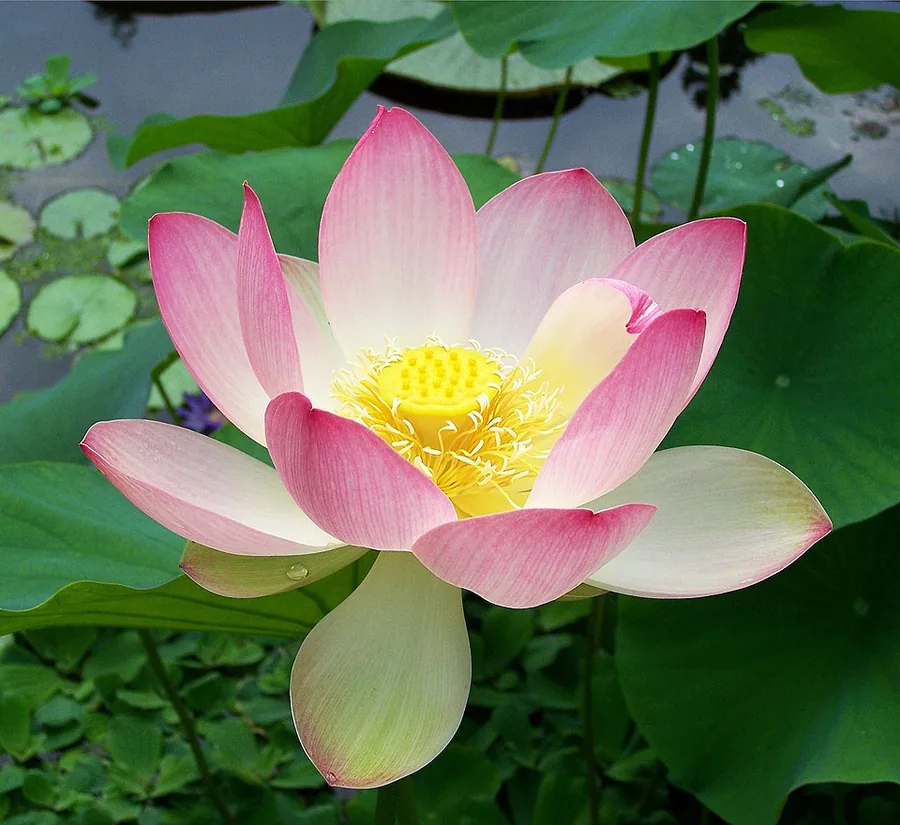
Sacred lotus is the plant that holds its leaves and blooms high above the water rather than floating them on the surface. It grows from a creeping rhizome anchored in mucky pond-bottom mud, sending up round, water-shedding leaves and fragrant flowers on tall stalks. Each bloom lasts only about three days, then drops its petals to reveal the woody, showerhead-shaped seed pod that gives the plant away at a glance.
This is an aquatic perennial, hardy across USDA zones 4 to 10 as long as the rhizome sits below the freeze line through winter. It carries a long history as a food and ornamental across Asia, where the rhizomes, seeds, and young leaves all go into the kitchen. In a garden setting it's grown in a wide, sturdy container sunk into a pond or a half-barrel, which keeps its vigorous roots in check.
Lotus rewards patience more than fuss. A freshly divided plant may spend its first season just building roots and skip flowering until the second year. Give it heat, full sun, and still water, and it settles in to become one of the boldest plants you can grow on the water.
Care
The short version: full sun and still, warm water over a wide container of heavy clay loam, with the rhizome kept below the freeze line through winter and divided every year or two so it doesn't outgrow its pot.
Light
Lotus demands full sun, at least 6 hours a day and ideally more. Skimp on light and you get healthy leaves but few or no flowers, so give it the brightest, most open spot you have.
Water
Grow it in still, calm water over a wide container of heavy clay loam. Start with the crown about 6 inches deep, then let the water reach 18 to 24 inches over the rhizome as the plant grows. Keep the rhizome below the freeze line, moving shallow containers to deeper water or indoors before a hard freeze.
Soil
Plant in heavy, organically rich clay loam, the mucky pond-bottom kind of substrate. Light, fluffy potting mixes float away and won't hold the rhizome, so pack the container with dense, weighty soil and cap it with sand or gravel.
Temperature
This is a warmth-driven plant that hits its stride in summer heat, tolerating up to about 100°F (38°C). The dormant rhizome is far tougher than the top growth and rides out cold down to roughly -29°F (-34°C) as long as it stays below the freeze line.
Humidity
Grown in open water, lotus sits in high humidity by default, so there's no figure to manage. The pond does the work, and the leaves never want for moisture.
Feeding
Feed through the summer growing season with aquatic fertilizer tablets pushed down into the container substrate, about once a month. Stop feeding as growth slows toward fall and the plant heads into dormancy.
Pruning
There's no structural pruning to do. Just clip off yellowing or dead leaves and spent flower stalks to keep the water clean, and thin or divide crowded rhizomes when the plant starts to push at its bounds.
Repotting
Plan to divide and repot every 1 to 2 years in spring, because the rhizome fills its container fast and can crack the walls. Rhizomes circling the pot, a deformed container, or smaller, crowded leaves all signal it's time.
Size & spacing
A mature lotus stands 3 to 6 feet (91 to 183 cm) tall and spreads 3 to 4 feet (91 to 122 cm) across. Give each one its own wide container so the running rhizome has room and the foliage isn't fighting for light.
When to plant
Lotus runs on warmth and won't stir until the water heats up. Set rhizome divisions out in spring to early summer once the cold has lifted, then watch for flowers held high above the water from June into July.
Northern hemisphere
Southern hemisphere
Typical months for a temperate climate: start earlier in warm zones, later where spring frosts linger.
- Sow: Not typically started indoors; usually grown from rhizome divisions planted in spring
- Plant: Spring to early summer once water has warmed
- Harvest: Summer (June to July); flowers held high above the water, each bloom lasting about three days
Hardiness
USDA hardiness zones: 4–10
Temperature: down to -34°C
Troubleshooting
Most lotus trouble traces back to too little sun, a rhizome that's outrunning its container, or the ordinary dieback of old leaves. Read the early signs below and you can sort a small problem before it spreads. Match what you see, then act while it still helps.
Plenty of leaves but few or no flowers
Lotus blooms only with full sun and sustained warmth, so shade or a short, cool season is the usual reason a healthy-looking plant stays bare. A newly divided or first-year rhizome often skips flowering altogether while it settles in. Give it a sunny spot, a wide container of heavy loam, and a full warm season, and the flowers follow.
Fix:
- Site the container in full sun with 6 or more hours of direct light
- Allow a full warm season; do not expect bloom from a freshly divided or first-year plant
- Move to a larger, wider container of heavy loam so the rhizome can run
- Handle rhizomes gently when dividing or planting to avoid breakage
Rhizomes escaping the pot or cracking the container
The creeping rhizomes run hard through mucky substrate, and an unconfined lotus can colonize a shallow pond in a season or two. Left in a pot that's too small, the same vigor bulges against and splits the container walls. Keep plants in wide, sturdy submerged containers, divide them every year or two, and pull any rhizome that escapes before it roots into the pond bottom.
Fix:
- Confine plants to wide, sturdy submerged containers rather than open pond mud
- Divide and thin rhizomes every 1-2 years
- Remove escaped rhizomes promptly to keep them from rooting into the pond bottom
Sticky, twisted new growth with tiny clustered insects
Soft-bodied aphids gather on tender stems and leaves, leaving them sticky and distorted, while spider mites show up in hot, dry spells as fine webbing and pale stippling. A strong jet of water knocks most of them off, and a pond stocked with fish keeps the numbers down on its own. Skip chemical sprays, which poison the fish and the helpful insects along with the pests.
Fix:
- Spray pests off with a strong jet of water
- Encourage fish and natural predators in the pond to control populations
- Avoid chemical pesticides that harm pond life and beneficial insects
Oldest leaves yellowing while new growth stays green
Yellowing confined to the oldest leaves is usually just natural aging, especially late in the season as the plant slides toward dormancy. Pull the dead leaves so they don't foul the water, and ease off the feeding as growth slows. Keep the rhizome below the freeze line and it carries through winter to come back in spring.
Fix:
- Remove yellow or dead leaves to keep the water clean
- Allow normal seasonal dieback; reduce feeding as growth slows
Toxicity
Sacred lotus is safe all round. It's missing from the ASPCA toxic-plant list, and far from being a hazard, its rhizomes, seeds, and young leaves are eaten as food across Asia. Despite the name, it's not a true lily and carries none of the danger that group poses to cats.
Safe for
People · Cats · Dogs · Horses · Rabbits · Livestock · Birds
Cats None
No reaction to worry about. Lotus isn't on the ASPCA toxic list, and a cat that nibbles a leaf is in no danger.
Dogs None
Safe for dogs. A curious chew on the foliage or a fallen seed pod causes nothing more than the odd loose stool from the roughage.
Horses Safe
Horses can graze the leaves at the water's edge without harm, since none of the plant carries a toxin.
Rabbits Safe
Fine for rabbits. The young leaves are tender and harmless, though they're best as an occasional green rather than the bulk of a diet.
Livestock Safe
Cattle, goats, and sheep can browse lotus along a pond margin with no ill effect.
Birds Safe
Waterfowl and other birds eat the nutritious seeds in the wild, and the plant poses no risk to them.
People Safe
Sacred lotus is food. The rhizomes, seeds, and young leaves are all eaten across Asia and are perfectly safe for the kitchen.
Edible and food-safe; the rhizomes, seeds, and leaves are used in cooking. No special handling precautions for pet households.
Varieties
A handful of named lotus stand out, from changeable-color hybrids to dwarfs that fit a half-barrel. These are the ones worth knowing by name.
Mrs. Perry D. Slocum
A popular hybrid of sacred and American lotus whose changeable flowers open pink and age toward yellow.
Momo Botan
A dwarf reaching only 1 to 2 feet tall, with double, richly fragrant rose-pink flowers to about 5 inches across that suit half-barrels and small water gardens.
Chawan Basu
A dwarf cultivar sized for small containers and tub gardens.
American lotus (Nelumbo lutea)
The native North American species, carrying pale-yellow flowers and hardy down into USDA zone 4.
How to propagate
Lotus is multiplied two ways, by splitting an established rhizome or by starting the hard seeds, and the method you pick shapes how soon you'll see flowers.
DivisionModerate
Spring, as growth resumes · One full growing season; bloom often does not occur until the second year
Division is the reliable way to multiply lotus, done in spring once growth picks back up. Cut a segment of the creeping rhizome and lay it horizontally near the edge of a wide container of heavy loam, top it with sand or gravel, and submerge it. Handle the rhizomes gently to spare the growing tips, then give the plant a full season to settle, since the first flowers often hold off until the second year.
SeedModerate
Spring to summer in warm water · Slower to flowering than division; may take more than one season
Growing from seed works but takes patience. The hard seed coat needs scarifying before the seed will sprout in warm water, and flowering can take more than a single season to arrive. Named cultivars won't come true this way, so start them by division if you want to match the parent.
Myths
Lotus and water lily are the same plant.
They belong to different families and look it once you know what to check. Lotus holds its big round leaves and flowers high above the water on tall stalks and finishes with a woody, showerhead-shaped seed pod, while a water lily floats its leaves and blooms flat on the surface and never forms that pod. The lotus leaves and seeds are also edible, where the water lily's are not.