Ornamental · Asteraceae
Ligularia
Ligularia dentata
Plant it in damp shade and the leopard plant rewards you with bold leaves and tall daisy spires.
Partial shade
Every 2–4 days
USDA 3–8
3–4 ft · 0.9–1.2 m
Overview
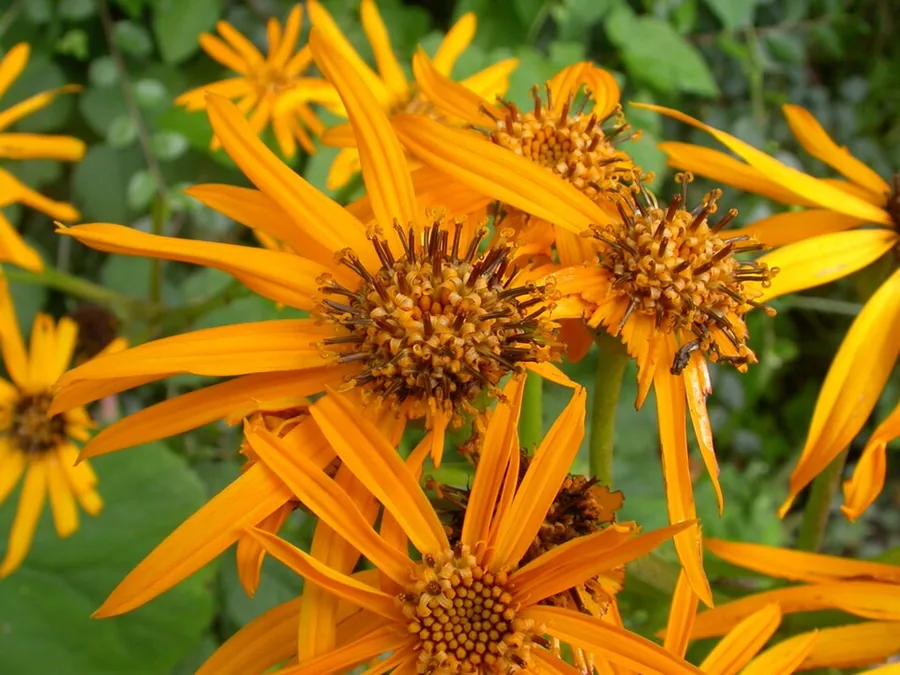
Ligularia, the leopard plant, is a bold-leaved perennial in the daisy family grown for drama at the shady edge of a pond or bog. Where most shade plants stay quiet, this one throws up huge rounded leaves and tall stalks of yellow and orange flowers. It thrives in cold country, holding up through winters as far down as zone 3.
What it asks for in return is water and shade. The roots want soil that stays damp to wet and never dries out, and the leaves scorch and flop in full sun, especially where summers turn hot. Give it a cool, moist, sheltered spot and it settles into a steady, long-lived clump.
The cultivars are where the fun is. Some carry purple-black foliage all season, others push their flowers up on dark spires well above the leaves. All of them want the same damp shade, so the choice comes down to whether you want the leaf or the bloom to carry the show.
Care
The short version: part to full shade in rich soil that stays constantly moist to wet, an afternoon out of direct sun in hot climates, and a clean cutback after the leaves fade.
Light
Plant ligularia in part to full shade. It tolerates deep shade better than open sun, and in hot-summer regions a spot out of the harsh afternoon light is what keeps the big leaves from scorching and flopping.
Water
This plant wants constantly moist to wet soil that never dries out, so water deeply and often, every 2 to 4 days in warm weather. The leaves may still wilt on hot afternoons even when the ground is damp, and they recover once the day cools.
Soil
Give it rich, humusy ground loaded with organic matter that holds water well. It takes clay, loam, or sand as long as the soil stays moist, and it handles a wide pH from 6.0 to 8.0.
Temperature
Ligularia is built for cool country, hardy from a brutal -40°F (-40°C) up to about 86°F (30°C). Heat is the limit, not cold, so it fades fast where summers run hot and dry.
Humidity
Ordinary outdoor air suits it, so there's no number to hit. What matters far more is moisture at the roots, which is the real driver of how the leaves hold up through summer.
Feeding
Feed through the growing season with a balanced fertilizer, or simply top-dress the crown with compost in spring. The richer the soil, the better this heavy-leaved plant performs.
Pruning
Cut the spent flower stalks off after bloom and clean up any tired foliage as it fades. Then cut the whole plant to the ground in late fall or early spring to make way for fresh growth.
Size & spacing
A mature clump stands 3 to 4 feet (91 to 122 cm) tall and spreads 2 to 3 feet (61 to 91 cm) across. Give it that much room so the broad leaves have space to open without crowding.
When to plant
Ligularia is a cool-season perennial that comes back on its own each year. Start seed in late winter, set plants out in spring once frost has passed or in early fall, and the daisy flowers open in June and July.
Northern hemisphere
Southern hemisphere
Typical months for a temperate climate: start earlier in warm zones, later where spring frosts linger.
- Sow: Late winter to early spring; seed germinates best with cool conditions
- Plant: Spring after frost danger passes, or early fall
- Harvest: Blooms June to July
Hardiness
USDA hardiness zones: 3–8
Temperature: down to -40°C
Troubleshooting
Most ligularia trouble traces back to one of two things: hungry slugs or too much heat and sun. Read the leaves and you can usually tell which. Match what you see below, then fix the cause rather than the symptom.
A struggling, scorched plant in a hot-summer climate
Ligularia is a cool-climate plant that sulks in heat, drought, and full sun. When decline tracks the hottest, driest stretch of summer, the site itself is the problem. Move it to a shadier, cooler spot that stays consistently moist, and work in organic matter so the ground holds water between rains.
Fix:
- Relocate to a shadier, cooler, consistently moist site
- Add organic matter and maintain even soil moisture
Ragged holes chewed through the big leaves
The broad, soft foliage is a magnet for slugs and snails, which feed at night and leave shiny slime trails behind. Go out after dark and pick them off by hand, or set shallow traps and iron-phosphate bait near the plant. Clear away damp mulch and debris so they lose the cool hiding spots they need by day.
Fix:
- Hand-pick slugs in the evening
- Set out shallow traps or iron-phosphate slug bait
- Reduce excess mulch and debris where they hide
Leaves flop in the afternoon heat, then perk up by night
This is heat stress, and it shows up on hot afternoons even when the soil is plenty moist. The big leaves simply lose water faster than the roots can replace it, and they firm back up once the day cools. Give the plant afternoon shade, water deeply, and mulch to keep the roots cool and the soil from drying out.
Fix:
- Provide afternoon shade or dappled shade
- Keep soil consistently moist with deep watering
- Mulch to conserve soil moisture and keep roots cool
Toxicity
Treat ligularia as a look-but-don't-eat plant. The leaves carry pyrrolizidine alkaloids, the same kind of liver-stressing compounds found in its ragwort relatives, so they're mildly toxic to pets, livestock, and people if eaten in any amount. A single curious nibble rarely causes more than an upset stomach, but no part of the plant is food.
Toxic to
Cats · Dogs · Horses · Rabbits · Livestock · Birds · People
Cats Caution
A nibble usually passes with little more than drooling or a mild upset stomach. The real worry is the pyrrolizidine alkaloids in the leaves, which can strain the liver if a cat keeps grazing on the plant.
Dogs Caution
Most dogs that chew a leaf get away with some drooling and a loose stomach. Eating it in quantity is the problem, since the alkaloids are hard on the liver over time.
Horses Caution
Horses tend to leave it alone, which is just as well. Like its ragwort relatives, ligularia carries pyrrolizidine alkaloids that build up and damage the liver when grazed steadily.
Rabbits Caution
Don't offer it as forage. The same liver-stressing alkaloids that trouble larger animals are in the leaves, so keep rabbits to safe greens instead.
Livestock Caution
Cattle, sheep, and goats face the classic ragwort risk here. The pyrrolizidine alkaloids accumulate in the liver, so a plant grazed day after day does the harm, not a single mouthful.
Birds Caution
Keep poultry and pet birds from pecking at the foliage. The alkaloids that affect mammals are best treated as a risk for birds too, so it isn't a plant to share.
People Caution
No part of ligularia is food. The leaves hold pyrrolizidine alkaloids that are hepatotoxic if eaten in any quantity, so keep curious children from tasting it and treat it as a strictly ornamental plant.
Helpline numbers

United States
ASPCA Animal Poison Control: (888) 426-4435 (fee applies)
Poison Control: (800) 222-1222



Canada
Poison Centres: 1-844-764-7669
Varieties
Only a handful of ligularias turn up in most gardens, and they split neatly into the ones grown for dark foliage and the ones grown for flower spires.
Desdemona
Its large new leaves come up purplish-red and settle into brownish-green tops over purple undersides, paired with big daisy flowers.
Britt Marie Crawford
The glossy, leathery leaves hold a showy purple-black all season under bright orange-yellow daisies.
The Rocket (Ligularia stenocephala)
This one is the related Ligularia stenocephala rather than L. dentata, sending up narrow 4 to 5 foot spires packed with small lemon-yellow flowers on purple-tinged stems above triangular, toothed leaves.
How to propagate
Ligularia is slow but easy to multiply, whether you split an established clump or raise new plants from seed.
DivisionModerate
Early spring or fall · One growing season
Dividing a mature clump is the surest way to make more plants. Lift and split it in early spring or fall, then keep the divisions consistently moist while they settle in, and they take hold over a single growing season.
SeedModerate
Late winter to spring · Plants may take a year or more to reach flowering size
You can also grow it from seed sown in late winter to spring, where cool conditions help germination. Just be patient, since a seedling often needs a year or more before it reaches flowering size.
Myths
Ligularia needs full sun to flower well.
It's the opposite. This is a shade lover that does best in part to full shade, and too much sun leaves it wilting and weak, especially where summers run hot. Give it shade and steady moisture and the flowers follow.
Ligularia and Farfugium japonicum are the same plant.
They share the leopard plant name and Farfugium was once filed under Ligularia, which is where the mix-up starts. But botanists split it into its own genus years ago. True ligularias are distinct moisture-loving perennials, not the same plant.