Shrub · Rosaceae
Japanese Kerria
Kerria japonica
Give it dappled shade and well-drained soil, and Japanese kerria lights up spring with golden flowers on bright green stems.
Partial shade
Every 5–10 days
USDA 4–9
3–7 ft · 0.9–2.2 m
Overview
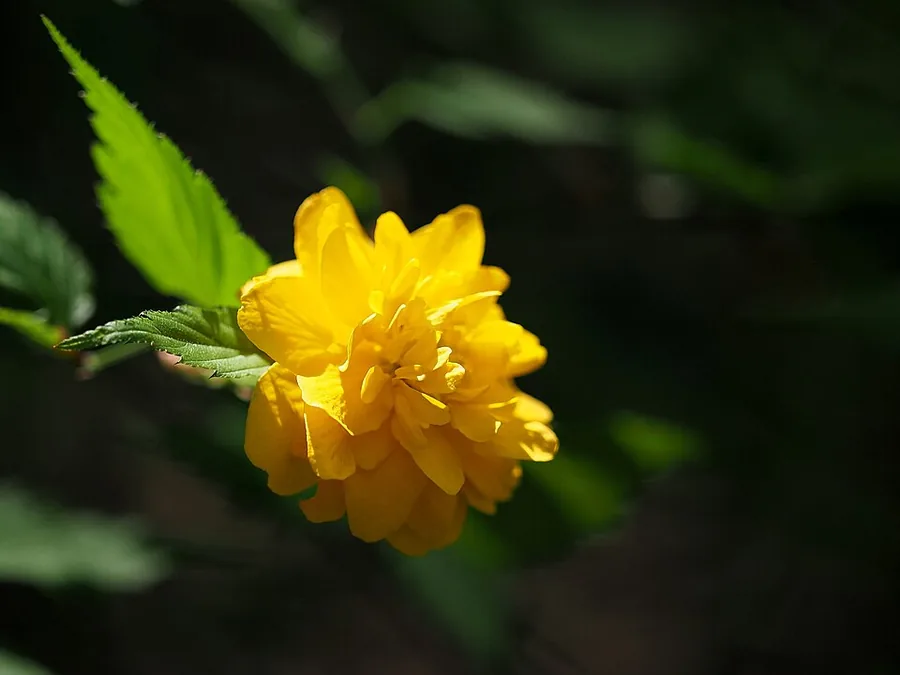
Japanese kerria is an easygoing deciduous shrub grown for the golden-yellow flowers that cover its arching branches in spring. It belongs to the rose family but stands on its own as the only species in its genus, and the bright green stems hold their color through winter long after the leaves have dropped.
This is a forgiving plant for a shady spot where little else flowers well. It thrives in partial shade, shrugs off cold down to zone 4, and asks for almost nothing once it settles in. The trade-off is its habit of spreading by suckers, slowly building into a thicket if you let it.
Plant it where you want a relaxed, informal shrub rather than a tidy specimen. The branches arch and weave, the flowers come thick in April and May, and many plants throw a scattering of repeat blooms through summer. Keep it out of harsh afternoon sun and off soggy ground, and it more or less takes care of itself.
Care
The short version: partial shade, loamy soil that drains well, and steady water until it establishes, after which it handles drought on its own. Prune right after it flowers and pull suckers as they appear.
Light
Kerria does best in partial shade, and it will take full shade too. Keep it out of strong direct sun, which bleaches the yellow flowers and washes out the bloom.
Water
Give a new plant steady, medium moisture while it roots in, watering every 5 to 10 days as the top inch dries. Once established it handles drought well, so water at the base and keep it off the leaves to head off blight.
Soil
Plant in loamy, well-drained soil of medium fertility. A pH anywhere from 5.5 to 7.5 suits it, but heavy, soggy clay is the one thing to avoid, since wet roots invite rot.
Temperature
This is a tough, cold-hardy shrub that takes winters down to about -29°F (-34°C) and summers up to 100°F (38°C). That range covers a wide swath of temperate gardens with no special protection.
Humidity
Ordinary outdoor humidity is fine, so there's no figure to manage. What matters more is air moving through the branches, since still, damp air around crowded stems is what blight likes best.
Feeding
Kerria needs little feeding. A light spring application of a balanced slow-release fertilizer once a season is plenty, and overfeeding only pushes soft growth at the cost of flowers.
Pruning
Prune right after flowering, because the blooms come on last year's wood and cutting too late takes off next spring's flowers. Pull unwanted suckers as they appear, and cut tired, overgrown stems to the ground to renew the plant.
Repotting
Kerria is a garden shrub that rarely needs a pot. If you're holding one in a container, move it up when roots start circling or escaping the pot or growth stalls.
Size & spacing
Expect a mature shrub of roughly 3 to 7 feet (90 to 215 cm) tall with a wider spread of about 6 to 9 feet (180 to 275 cm). Give it that room to arch and spread, and account for the suckers it sends out beyond the main clump.
When to plant
Kerria runs on a simple yearly rhythm. Set new plants out in spring or fall while the weather is mild, enjoy the main flush of bloom in April and May, and watch for a few scattered flowers again through summer. Save any pruning for right after the spring show, since next year's flowers form on this year's wood.
Northern hemisphere
Southern hemisphere
Typical months for a temperate climate: start earlier in warm zones, later where spring frosts linger.
- Plant: Spring or fall
- Harvest: April to May with sporadic rebloom in summer
Hardiness
USDA hardiness zones: 4–9
Temperature: down to -34°C
Troubleshooting
Kerria stays healthy with little fuss, but a few problems turn up in wet weather or wet ground. Most show first on the leaves, flowers, or roots, so read the early signs below and act before a small issue spreads through the shrub.
Wilting and dieback with dark, rotted roots
When a kerria sits in soggy ground, root rot sets in and the plant slowly fails from below. Dig down and you'll find dark, mushy roots instead of firm white ones. The real fix is drainage, so amend heavy soil with compost, ease off the water, and never plant it in a low spot that stays wet.
Fix:
- Improve drainage by amending soil with compost
- Reduce watering frequency
- Avoid planting in heavy clay or low wet spots
Purple-edged leaf spots and dark cankers on the stems
This is kerria twig and leaf blight, a fungus that takes hold in wet weather and works from the leaves into the stems. The cankers can ring a stem and kill everything above them, so cut out the diseased wood and clear fallen leaves before they carry the disease into next year. Keeping water off the foliage with a soaker hose does more than any spray.
Fix:
- Prune out and dispose of diseased stems
- Rake and dispose of fallen infected foliage
- Apply a labeled fungicide such as chlorothalonil on a bi-weekly schedule during wet summer weather
- Switch to soaker hose or drip irrigation to keep foliage dry
Faded flowers and a thin, sparse bloom
Kerria flowers turn pale and bloom poorly for two common reasons. Too much direct sun bleaches the petals, so move the plant into partial shade where the yellow stays rich. The other cause is bad timing on the shears, since it flowers on last year's wood, so prune only right after the spring bloom finishes.
Fix:
- Site the plant in partial shade
- Prune only immediately after flowering since it blooms on previous year's wood
Toxicity
Good news for pet owners and parents: Japanese kerria is not toxic. It isn't on the ASPCA's poison lists, and it's regarded as safe around cats, dogs, and the rest of the household. A chewed leaf might cause a passing stomach grumble, as any plant can, but there's nothing here that poisons.
Safe for
People · Cats · Dogs · Horses · Rabbits · Livestock · Birds
Cats None
Kerria is safe around cats, so a nibbled leaf won't poison one. A curious cat might get a brief upset stomach from chewing any plant, but there's nothing toxic here to worry about.
Dogs None
Dogs can be around this shrub without any risk of poisoning. The most you'd expect from a determined chewer is some mild tummy grumbling, which passes on its own.
Horses None
No toxins in kerria affect horses, so it's a safe shrub to have near a paddock. A horse that strips a few leaves should be none the worse for it.
Rabbits None
Rabbits face no poisoning danger from kerria. They may simply browse the foliage like any other garden plant, with no special concern.
Livestock None
Grazing animals such as cattle, goats, and sheep can be around kerria safely, since it carries no compounds known to harm them.
Birds None
Backyard and wild birds are in no danger near this shrub. They can perch and forage among the stems without any toxic risk.
People None
Kerria is not poisonous to people, so it's a fine choice for a family garden. There's no edible part worth eating, but a child who tastes a leaf is in no real danger.
No special handling required; wear gloves for routine pruning to avoid scratches.
Varieties
A handful of named kerrias turn up at garden centers, differing mostly in flower form, size, and leaf color. These are the ones worth knowing by name.
Pleniflora
A vigorous form reaching about 8 to 10 feet tall, carrying double, ball-shaped yellow pompons instead of single blooms.
Golden Guinea
Grown for its large single flowers up to about 2.5 inches across and a notably long bloom period.
Picta
Has variegated leaves edged in creamy white, grows more slowly than the species, and can revert to all green if not watched.
Albescens
A compact 4 to 5 foot plant with soft creamy pale-yellow flowers about 2 inches across.
How to propagate
Kerria multiplies almost on its own, which makes it one of the simplest shrubs to share. You can split off its suckers, root soft cuttings, or let the low branches layer themselves into new plants.
DivisionEasy
Spring or fall · One growing season
The easiest way to make more kerria is to dig up the suckers that spring up around the edge of the shrub and replant them. Lift them in spring or fall, and a divided sucker settles in and takes hold within a single growing season.
Stem cuttingsModerate
May to July · Several weeks to root
For cuttings, take terminal softwood tips from May through July and dip them in an IBA rooting hormone to push out roots. Given warmth and steady moisture, they root over the course of several weeks.
LayeringEasy
Spring to summer · One growing season
Kerria layers itself with almost no help. From spring into summer, the low arching stems root wherever they touch moist soil, and within a growing season you can sever a rooted stem and move it as a new plant.
Myths
Japanese kerria is a true rose because of its common name.
The name comes from its rose-like yellow flowers, not its botany. It does sit in the rose family, Rosaceae, but it stands alone as the only species in the genus Kerria and is not a true Rosa at all.