Shrub · Rosaceae
Hybrid Tea Rose
Rosa
Give it full sun, deep water, and a hard spring cut, and the hybrid tea rose returns long-stemmed blooms from summer to fall.
Full sun
Every 3–8 days
USDA 5–9
3–7 ft · 0.9–2.1 m
Overview
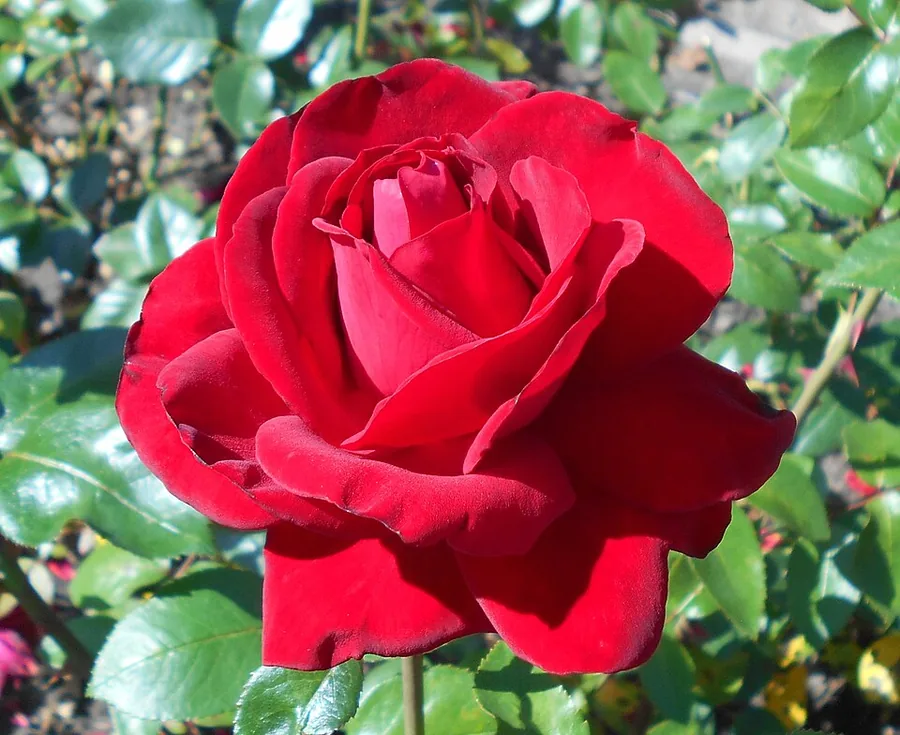
The hybrid tea is the rose most people picture: a single, high-centered bloom on a long, straight stem, the classic cut flower of the florist's bucket. It came out of crossing the old tea roses with hardier hybrid perpetuals, and the result took the best of both. You get repeat blooming through the season on a plant tough enough to winter outdoors across zones 5 to 9.
These are upright, somewhat formal shrubs that put their energy into a few large flowers rather than a mass of small ones. They reach 3 to 7 feet (90 to 210 cm) tall and want full sun, rich soil, and steady moisture to perform. The trade for those showpiece blooms is upkeep, since hybrid teas need a hard yearly pruning and a watchful eye for disease.
None of that should put off a beginner willing to learn the rhythm. Cut hard in early spring, water deep at the base, feed through the bloom flushes, and keep the leaves dry, and a hybrid tea rewards you with cutting stems all summer. The thorns are the only real hazard, so keep a pair of gloves nearby.
Care
The short version: full sun and at least six hours of it, with loose, rich, well-drained soil. Water deeply at the base so the top half of the soil dries between drinks, cut the canes back hard each spring, and feed through the season until about six weeks before frost.
Light
Hybrid teas need full sun, six hours or more of direct light a day, to bloom well and stay healthy. They'll take a little partial sun, but shade gives you weak, leggy growth and far fewer flowers. Morning sun is best of all, since it dries the dew and holds disease at bay.
Water
Water deeply but not often, soaking the root zone and then letting the top half of the soil dry before the next drink. In warm weather that works out to about twice a week, stretching to every 8 days as conditions allow. Always water at the base with a soaker hose, because wet leaves are how black spot and mildew get started.
Soil
Plant in loose, rich, well-drained loam with plenty of organic matter worked in. A pH between 6.0 and 7.0, near neutral, suits them best. Drainage matters most, since roses rot in ground that stays soggy.
Temperature
These roses are hardy across a wide band, handling lows near -20°F (-29°C) in zone 5 and summer highs up to 100°F (38°C). The hardiest types still appreciate a winter mulch over the graft in the coldest zones.
Humidity
Ordinary outdoor humidity is fine, so there's no number to chase. Airflow matters far more than the moisture in the air, since crowded, still, damp conditions are exactly what the fungal diseases want.
Feeding
Feed through the growing season, starting when the plant first leafs out and again after each flush of bloom. Use a balanced rose fertilizer or a slow-release shrub formula, and stop about six weeks before your first frost so you don't push tender growth into the cold.
Pruning
Cut hard in early spring as the buds break, keeping three to five of the strongest canes and shortening them to about 15 to 18 inches. Take out anything thinner than a pencil along with dead, diseased, or crossing wood. Through the season, deadhead spent blooms down to a five- or seven-leaflet leaf to keep the flowers coming.
Repotting
Roses are rarely repotted and prefer a permanent home in the ground. A container-grown plant tells you it's outgrown its pot when roots circle the drainage holes, water runs straight through, and the blooms shrink. Move it to a larger container or into a bed when you see those signs.
Size & spacing
A hybrid tea grows fast to 3 to 7 feet (90 to 210 cm) tall with a spread of 24 to 35 inches (60 to 90 cm). Give each plant that much room so air moves freely through the canes and the leaves can dry, which is the single best defense against disease.
When to plant
A rose runs on the seasons. Set out bare-root or container plants in early spring once the soil can be worked and before the buds break, prune hard at the same time, then let it bloom in repeating flushes from summer into fall.
Northern hemisphere
Southern hemisphere
Typical months for a temperate climate: start earlier in warm zones, later where spring frosts linger.
- Plant: early spring after the soil can be worked, planting bare-root or container roses before bud break
- Harvest: summer to fall, repeat blooming
Hardiness
USDA hardiness zones: 5–9
Temperature: down to -29°C
Troubleshooting
Most rose trouble shows up on the leaves first, and the two big fungal diseases both spread on wet foliage. Catch the early signs and you can step in before a plant defoliates. Match what you see below, then act while it still helps.
Black spots ringed with yellow, then leaves dropping
This is black spot, the fungus that troubles roses more than any other. It spreads when water sits on the leaves in warm weather and starts low on the plant before climbing. Strip off the marked leaves, rake up every fallen one, and water at the base so the foliage stays dry.
Fix:
- Remove and discard infected leaves and prune severely affected canes in late winter
- Rake up and destroy fallen leaves and replace mulch
- Switch to base watering with soaker hoses to keep foliage dry
- Apply a labeled fungicide such as chlorothalonil, mancozeb, myclobutanil, or propiconazole during high-disease periods
White powdery dust on new leaves and buds
That gray-white film is powdery mildew, which settles in when days are mild, nights are humid, and the plant sits in shade. New growth twists out of shape and buds stall before they open. Cut away the worst of it, open the plant to more sun and moving air, and treat with a labeled fungicide if it keeps spreading.
Fix:
- Remove and destroy infected foliage during the season
- Improve air circulation and sun exposure by spacing and pruning
- Apply a labeled fungicide such as sulfur, myclobutanil, propiconazole, thiophanate-methyl, or horticultural oil when needed
Soft green or pink insects crowding the new shoots
Those clusters are aphids, drawn to the soft tip growth and flower buds in spring. They curl the new shoots and leave a sticky honeydew behind. A hard jet of water knocks most of them off, and the lady beetles and lacewings they attract will clean up the rest.
Fix:
- Dislodge colonies with a strong spray of water
- Encourage and protect natural predators such as lady beetles and lacewings
- Apply insecticidal soap or horticultural oil to heavy infestations if needed
Toxicity
Good news for pet owners and parents: true roses are safe all around. The ASPCA lists them as non-toxic to cats, dogs, and horses, and the petals and hips are edible for people. The one real hazard is mechanical, not chemical, so mind the thorns and wear gloves when you prune.
Safe for
People · Cats · Dogs · Horses · Rabbits · Livestock · Birds
Cats Safe
A true rose holds nothing that will poison a cat, so a nibbled petal or leaf does no harm. The only thing to watch is the thorns, which can scratch a curious nose or paw.
Dogs Safe
Dogs can chew the leaves, petals, or hips with no risk of poisoning. Keep an eye on the prickly canes, since a hard chew can scratch the mouth or a paw.
Horses Safe
Roses are non-toxic to horses, and many will graze the soft new growth and flowers without trouble. The thorns are the only real hazard, capable of pricking the lips and muzzle.
Rabbits Safe
Rabbits eat rose leaves and petals safely, and gardeners often find them grazed to the stem. Trim away the thornier canes before offering any to a house rabbit.
Livestock Safe
Cattle, goats, and sheep can browse roses without any poisoning. The prickles are the only thing that might catch a soft mouth.
Birds Safe
Birds come to no harm from roses, and many feast on the rose hips through autumn and winter. There's no toxin in any part of the plant for them.
People Safe
Rose petals and hips are edible and used in teas, jams, and syrups, so the plant is safe to grow around children. Just mind the thorns, which are the one real hazard a rose presents.
The hazard from roses is mechanical, not chemical: the thorns and prickles on canes can cause scratches and puncture wounds to people and pets, so handle and site plants accordingly. Wear gloves when pruning.
Varieties
Hybrid teas number in the hundreds, but a few classics turn up again and again in gardens and florist shops. These are the ones worth knowing by name.
Mister Lincoln
A tall, vigorous dark red rose that reaches roughly 3 to 7 feet and gives you long, strongly scented stems made for cutting.
Peace
One of the most widely grown hybrid teas of all, carrying large yellow blooms edged in soft pink.
Double Delight
A fragrant bicolor whose creamy white petals take on a deeper red rim the longer they sit in the sun.
How to propagate
Roses can be multiplied a few ways, though none is as simple as rooting a houseplant. How you go about it depends on whether you want a single backyard copy or a true commercial plant.
GraftingDemanding
Propagated commercially by T-budding onto a vigorous rootstock during the active growing season · One or more seasons to produce a saleable plant
Almost every hybrid tea you buy was made this way, with the flowering top T-budded onto a hardier, more disease-resistant rootstock during the growing season. The rootstock hands its vigor up to the bloom, but it takes a season or more before the plant is ready to sell. It's demanding work, which is why it stays in the hands of commercial growers.
Stem cuttingsModerate
Take semi-hardwood cuttings from current-year stems during the growing season · Several weeks to root, longer to establish
Take a semi-hardwood cutting from a healthy current-year stem about 8 inches long with several leaf nodes, any time during the growing season. Give it a few weeks to put out roots and longer still to settle in. Hybrid teas root less reliably than many other roses, and how well it takes depends a lot on the cultivar.
LayeringModerate
Spring to summer while canes are flexible · One season for roots to form before separating
The simplest method for a home gardener. While a cane is still flexible in spring or summer, pin it down against the soil and let it sit. Give it a full season to grow its own roots, then cut it free from the parent as a new plant.
Myths
Roses are poisonous to cats and dogs.
The ASPCA lists true roses as non-toxic to cats, dogs, and horses, so the only real risk is a scratch from the thorns. The confusion comes from unrelated plants that borrow the name, like desert rose and Lenten rose, which are genuinely toxic.
Roses should be pruned hard in the fall.
The hard cut belongs in early spring, just as the buds break dormancy. Fall is for light cleanup and winter protection only, because a heavy autumn pruning leaves the open canes exposed to cold and dieback.