Shrub · Rosaceae
Groundcover Rose
Rosa
Give it full sun and room to breathe, and a groundcover rose carpets the ground in bloom from spring to frost.
Full sun
Every 3–7 days
USDA 5–9
12–35 in · 30–90 cm
Overview
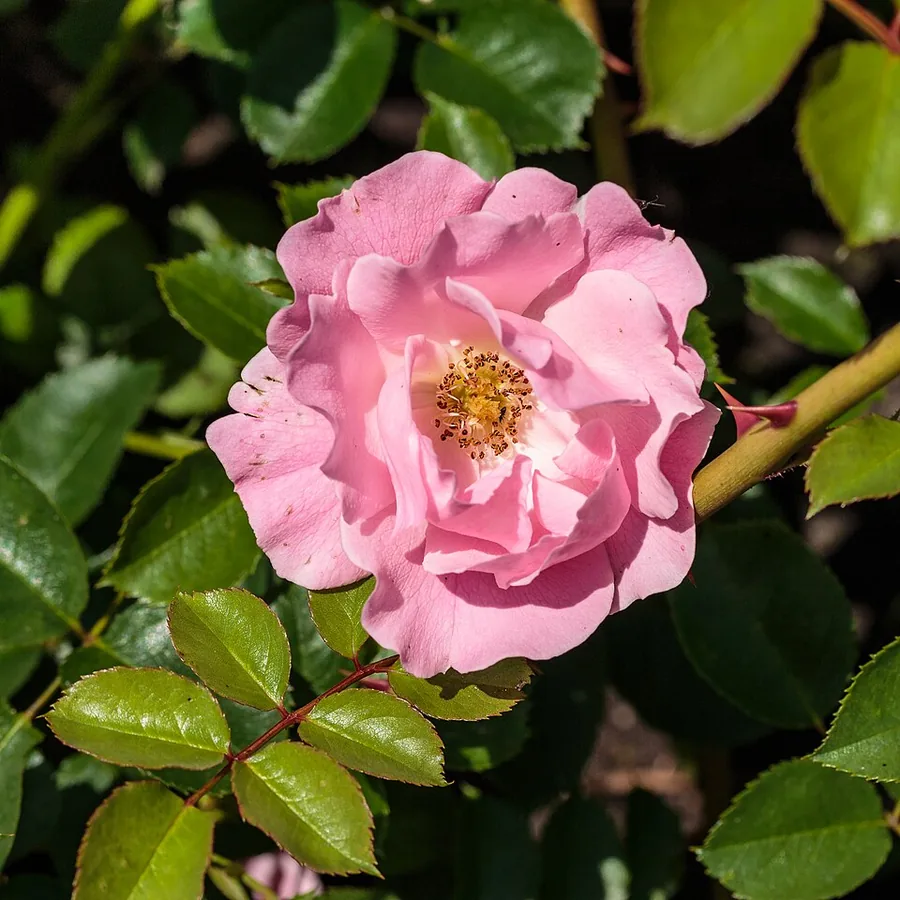
A groundcover rose is a true rose bred to sprawl low and wide instead of standing tall. It belongs to the genus Rosa and the rose family, and it trades the fussy upkeep of a hybrid tea for a tough, spreading habit that knits across a bed or a slope. Most stay under 3 feet (90 cm) tall while reaching well past that in width, so a few plants fill a lot of ground.
The big draw is the flowering. These roses bloom in waves from late spring right through to frost, often without any deadheading, and the better strains shrug off the leaf diseases that plague their taller cousins. That makes them a natural fit for banks, borders, and any spot where you want color without a standing weekly chore.
They are about as forgiving as roses get, but they aren't no-care. Set them in full sun with air moving freely around the canes, keep the water off the leaves, and they reward you with a long, heavy show. Crowd them in damp shade and you invite black spot and mildew instead.
Care
The short version: full sun, fertile and well-drained soil, a deep soak about twice a week at the base rather than overhead, a light prune in late winter, and plenty of space for air to move through the canes.
Light
Give a groundcover rose full sun, at least six hours a day, for the heaviest bloom and the healthiest leaves. It will take partial sun or light shade, but the flowering thins out and damp, shaded foliage invites disease.
Water
Water deeply and regularly, roughly twice a week depending on your soil and the weather, and do it in the morning. Aim the water at the base of the plant, since wet leaves are how black spot and mildew get started.
Soil
Plant in fertile, well-drained soil worked full of organic matter. These roses are easy about pH and handle anything from acidic to neutral, with a range of 6.0 to 7.0 suiting them well.
Temperature
Groundcover roses are tough across a wide swing, hardy from about -20°F to 100°F (-29°C to 38°C). That cold hardiness is what carries them through winter in zones 5 to 9 with little fuss.
Humidity
Ordinary outdoor humidity is no problem, so there's no number to manage. Air movement matters far more than the moisture level, because still, crowded air around the canes is what lets leaf diseases take hold.
Feeding
Feed with a slow-release nitrogen fertilizer in spring and again in fall, at a rate of about a pound of nitrogen per 1,000 square feet across the two applications. Steady, moderate feeding keeps the plant blooming without forcing the soft, sappy growth that aphids love.
Pruning
These roses skip the heavy, precise pruning a hybrid tea demands. Shear or shape them lightly in late winter to early spring for a denser, bushier plant, cut out any dead or diseased canes, and give the oldest stems a harder rejuvenation cut every 2 to 3 years to keep them vigorous.
Repotting
Groundcover roses are grown in the ground as landscape shrubs and rarely sit in a pot. If you do keep one in a container, repot when you see roots circling the inside or pushing out the drainage holes.
Size & spacing
Plants reach about 12 to 35 inches (30 to 90 cm) tall and spread wider than they stand, around 2 to 4 feet (60 to 120 cm) across. Give each one room to fill out so air moves freely and the leaves stay dry.
When to plant
Groundcover roses are hardy across zones 5 to 9 and live for years once they take. Plant them out in spring after the last frost has passed, prune them lightly in late winter as they wake up, and enjoy the bloom that rolls on from late spring until frost.
Northern hemisphere
Southern hemisphere
Typical months for a temperate climate: start earlier in warm zones, later where spring frosts linger.
- Plant: spring after the last frost
- Harvest: Continuous bloom from late spring or early summer through fall (May to frost)
Hardiness
USDA hardiness zones: 5–9
Temperature: down to -29°C
Troubleshooting
Most trouble with a groundcover rose lands on the leaves, and it usually traces back to wet foliage or crowded, still air. Catch the early signs and a quick cleanup keeps a small problem from spreading. Match what you see below, then act while it still helps.
Wildly thorny red shoots and clustered, deformed growth
This is rose rosette disease, a virus carried by tiny eriophyid mites, and there is no cure once a plant has it. Watch for fast, elongated red shoots, a thicket of extra thorns, and warped witches-broom clusters that never settle down. Dig the plant out roots and all, bag it for the bin rather than the compost, and tear out any wild multiflora roses nearby that keep the disease in circulation.
Fix:
- Remove and destroy infected plants promptly including roots
- Do not compost infected material
- Replace with resistant plants and avoid planting roses in the same spot immediately
Black spots ringed with yellow on the leaves
This is black spot, a fungus that takes hold when the leaves stay wet and the air sits still. It works up from the bottom of the plant, turning leaves yellow and dropping them. Strip off the marked leaves, clear any fallen debris, and water at the base in the morning so the foliage dries fast.
Fix:
- Remove and discard infected leaves and fallen debris
- Avoid overhead watering and water at the base in the morning
- Improve air circulation and apply a fungicide in humid climates if needed
A white dusty film on leaves and new buds
Powdery mildew coats the leaves and shoot tips in a pale, talc-like layer, and the new growth curls or stalls. It favors crowded, shaded plants where the air barely moves. Open the plant up with a light prune, ease off the nitrogen that pushes soft growth, and treat with a fungicide if it spreads.
Fix:
- Prune to improve air circulation
- Avoid excess nitrogen that pushes soft growth
- Apply an appropriate fungicide if severe
Soft little bugs swarming the new shoots
These are aphids, and they crowd onto the tenderest buds and shoot tips to suck the sap. They leave a sticky honeydew behind that can turn to sooty mold, and the new growth twists out of shape. Blast them off with a hard jet of water, follow up with insecticidal soap if they persist, and let lady beetles do the rest.
Fix:
- Spray plants with a strong stream of water to dislodge aphids
- Apply insecticidal soap if populations are high
- Encourage natural predators such as lady beetles
Toxicity
Good news for pet owners and parents: true roses are non-toxic to cats, dogs, horses, and people, so a chewed leaf or stolen petal does no chemical harm. The one real hazard is mechanical. The thorns can scratch or prick, so wear gloves to prune and keep the canes where pets and children won't brush against them.
Safe for
People · Cats · Dogs · Horses · Rabbits · Livestock · Birds
Cats None
True roses are safe for cats, so a nibbled leaf or petal won't poison one. The thorns are the only real worry, since a curious cat can scratch its nose or paws on the canes.
Dogs None
A dog can chew the foliage or flowers without any risk of poisoning. Keep an eye out for scratches instead, because the prickles can prick a snout or a paw pad.
Horses None
Rose plants are non-toxic to horses and a browsing horse comes to no chemical harm. The sharp canes are the catch, so site the planting where a horse won't push into the thorns.
Rabbits None
Rabbits can graze the leaves and stems with no poisoning risk at all. The thorns are the one hazard worth minding around small, soft-skinned animals.
Livestock None
Cattle, goats, and sheep can browse the foliage safely, as nothing in a true rose is toxic to them. Only the prickly canes pose any threat, and that is purely a scratch.
Birds None
Birds face no poisoning danger from the leaves, petals, or hips. The dense thorny canes actually give small birds good cover and a safe place to perch.
People None
Rose petals and hips are safe enough to eat, and the hips are a known source of vitamin C. The thorns are the only real hazard, so wear gloves when you prune or handle the canes.
Thorns and prickles can cause scratches or puncture wounds; wear gloves when pruning or handling and place plants where pets and children will not brush against the canes.
Varieties
Groundcover roses come in several well-known series and named plants, each bred for a slightly different size, color, or toughness. These are the ones you'll meet most often at the nursery.
Flower Carpet series
A low, trailing groundcover rose that runs about 2 to 3 feet tall and 3 to 4 feet wide, blooming nonstop over glossy, disease-resistant foliage with no deadheading needed.
Drift series
A compact, low-spreading landscape rose that pairs the toughness of a groundcover with a small, neat mounding habit.
Red Meidiland
A vigorous, disease-resistant rose that earns its keep on slopes and in low-maintenance landscape plantings.
Ralph's Creeper
A spreading groundcover rose grown for its bright orange-red flowers carried close to the ground.
How to propagate
You can make more groundcover roses from the plants you already grow, either by rooting cuttings or by layering a low cane straight into the soil.
Stem cuttingsModerate
Softwood cuttings in late spring to summer or hardwood cuttings in fall · Several weeks to a few months to root
Take cuttings from healthy current-season growth, using softwood in late spring through summer or hardwood in fall, and expect them to root over several weeks to a few months. One catch before you propagate to sell: many named groundcover roses are patented and can't legally be reproduced for resale.
LayeringEasy
Spring to summer · One growing season
The low, spreading canes make layering simple, since they root on their own wherever they rest against moist soil. Pin a cane down in spring or summer, bury a section, and give it a full growing season before you cut the rooted piece free as a new plant.
Myths
Roses are poisonous to dogs and cats and shouldn't be planted where pets roam.
True roses, the Rosa species, are non-toxic to cats, dogs, and horses according to the ASPCA, so a chewed leaf or petal won't poison a pet. The real risk is a scratch from the thorns, not poisoning. Watch out for lookalikes, though, since plants like desert rose carry rose in the name but are a different plant and can be toxic.
All roses need heavy, complicated yearly pruning at exact bud nodes.
Groundcover and landscape roses are low maintenance and don't ask for any of that fuss. A light shearing plus the removal of dead or diseased canes is all they need, nothing like the careful, heavy pruning a hybrid tea demands.