Shrub · Oleaceae
Border Forsythia
Forsythia × intermedia
Plant it for the first burst of yellow that opens long before anything else wakes up in spring.
Full sun
Every 7–14 days
USDA 5–8
8–10 ft · 2.4–3 m
Overview
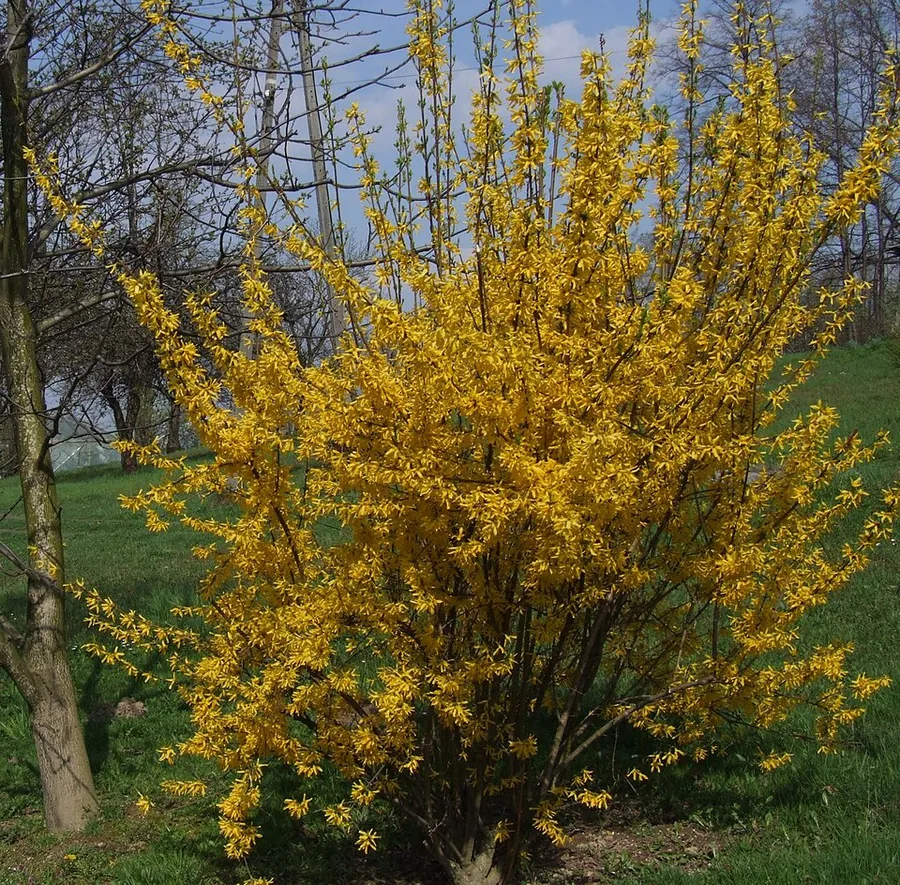
Forsythia is the shrub that tells you winter is over. In early spring its bare branches light up with bright yellow bells weeks before the leaves appear, and before most of the garden has stirred. It belongs to the olive family and grows fast into a big, arching mound, which is why it has anchored shrub borders and bank plantings for generations.
This is a plant that asks for very little. It shrugs off clay, sand, poor ground, and city soil, takes hardiness zones 5 through 8 in stride, and handles a stretch of drought once its roots are down. The one thing it insists on is sun. Plant it in shade and you trade away the flowers that are the whole reason to grow it.
Size is the catch worth knowing up front. A mature shrub runs 8 to 10 feet (2.4 to 3 m) tall and spreads even wider, and the low branches root wherever they touch the ground, so it forms thickets if you let it. Give it room to arch and a yearly trim right after bloom, and it stays handsome instead of becoming a tangle.
Care
The short version: full sun for the best bloom, loose well-drained soil it shares with almost any site, even moisture while it settles in, and a single pruning each year right after the flowers fade.
Light
Give forsythia full sun for the heaviest bloom. It will grow in partial shade, but every hour of shade trades away flowers, and a shaded shrub turns leafy and shy of color.
Water
Water regularly through the first year to settle the roots, then let it coast. An established plant handles short dry spells well and wants only medium, even moisture, roughly a soak every 7 to 14 days in dry weather. Steer clear of soggy ground, which invites root rot.
Soil
Forsythia is famously easy on soil. It takes clay, loam, sand, and even poor urban ground, asking mainly that the site drain well and sit somewhere in the 6.0 to 8.0 pH range.
Temperature
This is a cold-hardy shrub, comfortable from about -20°F to 95°F (-29°C to 35°C). The plant itself rides out hard winters, though the flower buds can be damaged once temperatures fall below roughly -5°F.
Humidity
Ordinary outdoor air suits it, so there's no humidity target to hit. Good airflow does more good than any moisture level, since crowded, damp foliage is where leaf spot gets a foothold.
Feeding
Forsythia is not a heavy feeder. A balanced shrub fertilizer or some compost in early spring is plenty, and overdoing it just grows leaves at the expense of flowers.
Pruning
Prune once a year, right after the flowers fade. Thin the oldest stems out at the base, and cut the whole shrub back near the ground every 3 to 4 years to renew it. Wait past mid-July and you cut off next spring's buds, since the flowers form on old wood.
Repotting
Forsythia is a landscape shrub and rarely lives in a pot. If you do grow one in a container, repot only when the roots circle and mat, water runs straight through, or new growth stalls.
Size & spacing
Plan for a big plant. A mature forsythia stands 8 to 10 feet (2.4 to 3 m) tall and spreads even wider, around 10 to 12 feet (3 to 3.7 m), so give it the room to arch out without crowding its neighbors.
When to plant
Forsythia runs on the calendar of early spring. Set new plants out in spring or fall once the ground is workable and hard frost has passed, watch the yellow bells open in March and April before the leaves, then do your one yearly pruning as soon as the flowers fade.
Northern hemisphere
Southern hemisphere
Typical months for a temperate climate: start earlier in warm zones, later where spring frosts linger.
- Plant: Spring or fall, after the ground is workable and the threat of hard frost has passed.
- Harvest: Early spring (March to April), before the leaves emerge.
Hardiness
USDA hardiness zones: 5–8
Temperature: down to -29°C
Troubleshooting
Forsythia is tough, so trouble is uncommon, and most of it traces back to the wrong site or the wrong pruning date. The signs below cover what actually goes wrong. Match what you see, then fix the cause rather than the symptom.
A wilting plant with dark, rotted roots
When a forsythia wilts and fades in soggy ground, suspect Phytophthora root rot, which turns the roots dark and mushy. Small knots or swellings on the roots instead point to root-knot nematode, and steady overwatering in compacted soil makes either one worse. Lift a struggling plant to read the roots, improve the drainage, and ease off the water. A badly affected shrub is best removed and replanted on a raised, well-drained site.
Fix:
- Improve drainage and reduce watering
- Remove severely affected plants
- Replant in a raised, well-drained site
Few or no flowers in spring
The usual culprit is pruning at the wrong time. Forsythia sets its flower buds on old wood, so any cut made after mid-July strips off next spring's display. Too much shade thins the bloom as well, and in a hard winter the cold itself can kill the buds once temperatures drop below about -5°F (-21°C). Prune right after flowering, give the shrub full sun, and pick a cold-hardy cultivar where winters bite.
Fix:
- Prune only immediately after flowering, never in summer or late winter
- Move or limb up nearby plants to give the shrub full sun
- In cold regions choose hardier cultivars such as Northern Sun or Meadowlark
Spotted leaves and dying-back stems
Spots on the leaves point to fungal leaf spot, while sunken, dead tips usually mean stem dieback or canker, often set off by drought stress. Check the base too, since rough woody swellings there signal crown gall. Cut out the dead and cankered wood back to healthy tissue, clean your pruners between cuts, and thin the shrub so air moves through it. Watering at the base keeps the foliage dry and the spores in check.
Fix:
- Remove and discard affected leaves and prune out dead or cankered wood to healthy tissue
- Disinfect pruners between cuts
- Improve air circulation by thinning the shrub
- Water at the base to keep foliage dry
Toxicity
Good news for households with pets and children: forsythia is non-toxic across the board. The ASPCA lists it as safe for dogs, cats, and horses, and it carries no poisonous compounds. The flowers taste bitter, which keeps most animals from making a habit of it anyway.
Safe for
People · Cats · Dogs · Horses · Rabbits · Livestock · Birds
Cats None
Safe around cats. A curious nibble on a leaf or flower causes no poisoning, and the bitter taste tends to put them off before they eat much.
Dogs None
Dogs can brush past or chew the shrub without harm. The most you might see from a big mouthful of any plant matter is a brief, mild stomach upset that settles on its own.
Horses None
Listed as non-toxic to horses. Grazing on the foliage carries no poisoning risk.
Rabbits Safe
No toxic compounds threaten rabbits, so a stem within reach is not a danger. The bitter flowers usually discourage heavy browsing anyway.
Livestock Safe
Cattle, goats, and sheep can share a pasture edge with forsythia without poisoning concern.
Birds Safe
Birds that perch in or peck at the shrub face no toxic hazard from its leaves, flowers, or stems.
People Safe
Safe to plant where children play and to prune without gloves. Nothing on the shrub is poisonous, though it's good practice to wash your hands after handling any garden plant.
No special handling required; the flowers are bitter, which discourages nibbling. Wash hands after pruning as a general practice.
Varieties
Most forsythia sold for gardens is this hybrid, but the named cultivars differ in size, hardiness, and how heavily they flower. A few are worth knowing by name.
Lynwood (Lynwood Gold)
An upright cultivar that has become a standard, with bright yellow flowers spaced evenly all along the stems.
Spectabilis
The classic show-off of the group, smothering its branches in dense, deep yellow bloom.
Beatrix Farrand
An extra-vigorous selection that carries large, deep canary-yellow flowers.
Northern Sun
A cold-hardy choice down to about zone 4 that reaches roughly 10 feet tall and still sets flower buds through harsh winters.
Gold Tide
A low, spreading dwarf form that works as a groundcover or to hold a bank or slope.
Companions
Forsythia pairs well with early bloomers that pick up where its yellow leaves off, and poorly with anything trying to grow in the shade beneath its dense canopy.
Plant near
Daffodils: Yellow daffodils bloom at the same time and echo the forsythia's early-spring color at ground level.
Lilac: Lilac flowers shortly after forsythia, extending the shrub-border bloom season; both share full-sun, well-drained conditions.
Keep apart
Turfgrass directly beneath the canopy: The dense arching canopy and surface roots shade and compete with lawn grass, which struggles under the shrub.
How to propagate
Few shrubs are easier to copy. Forsythia roots from cuttings or simply layers itself wherever a branch leans down to the soil, so one plant quickly becomes many.
Stem cuttingsEasy
Late spring to summer · 4 to 8 weeks to root
Forsythia roots from cuttings with little fuss. Take softwood cuttings in late spring or early summer, or semi-hardwood cuttings later in the season, and most will strike roots within 4 to 8 weeks.
LayeringEasy
Spring through summer · One growing season to root
The arching branches root on their own wherever they touch the soil. Pin a low branch down anytime from spring through summer, give it a full growing season to root, then sever it from the parent and move the new plant.
Myths
Forsythia should be cut back hard in late winter to make it bloom better.
Cutting in late winter or summer strips off the flower buds, which form on the previous year's wood. Heavy pruning at the wrong moment thins or wipes out the spring display. Prune only right after flowering and the buds for next year stay safe.
Forsythia berries and flowers are poisonous to pets and children.
The ASPCA lists Forsythia, or Golden Bells, as non-toxic to dogs, cats, and horses, and it's regarded as safe around children too. There are no toxic principles in the plant, and the bitter flowers discourage browsing on their own.