Bulb · Primulaceae
Florist's Cyclamen
Cyclamen persicum
Keep it cool, bright, and watered from below, and cyclamen blooms straight through the winter.
Bright indirect
Every 5–10 days
50–64°F · 10–18°C
420–540 days
Overview
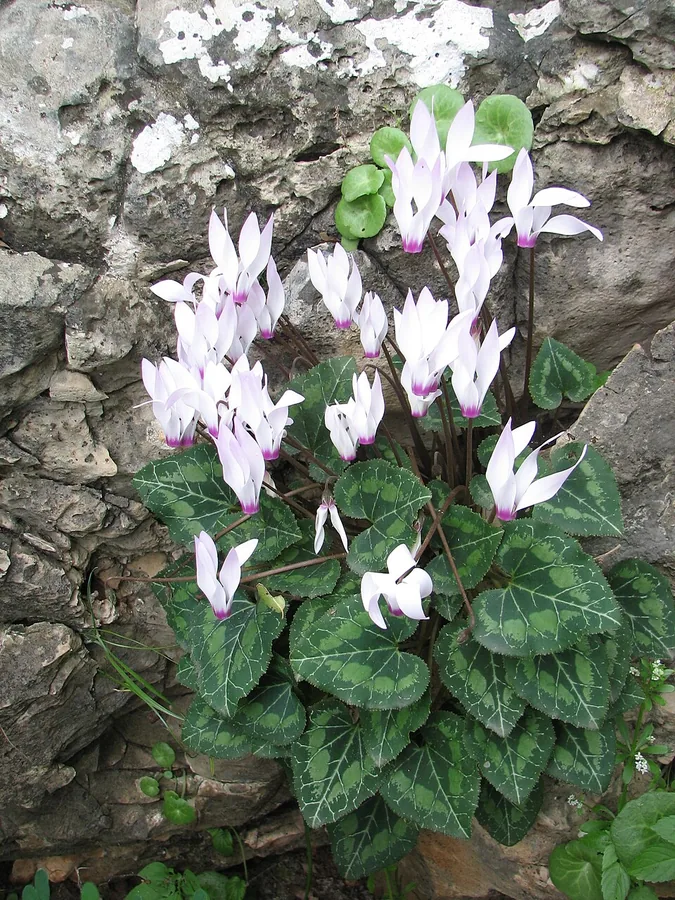
Cyclamen brings color indoors at the time most plants have given up, throwing out upswept flowers from late fall into spring. It belongs to the primrose family and grows from a flat tuber that sits at the soil surface, sending up heart-shaped leaves marbled in silver and green. Most people meet it as a florist's cyclamen, the tender hybrid sold in pots for the winter windowsill.
What it asks for runs against the usual houseplant habit. Cyclamen wants things cool and bright, not warm and cozy, and it sulks in a heated room the way other plants sulk in a draft. Water it from below to keep the crown dry, give it a chilly spot near a window, and it rewards you with weeks of bloom.
Come late spring the leaves yellow and fade, and a first-time grower often throws the plant out thinking it has died. It hasn't. The tuber is simply going dormant for the summer, resting until cooler days call it back into growth.
Care
The short version: keep it cool and bright, water from below whenever the surface dries so the crown stays dry, feed lightly through the growing season, and let the tuber rest dry through its summer dormancy.
Light
Give cyclamen bright, indirect light, the kind it would get near a window out of the midday glare. It puts up with a bit of partial sun or shade, but harsh direct sun scorches the leaves while deep shade cuts the flowering right back.
Water
Water only when the surface feels dry, every 5 to 10 days in the growing season, and always from below so the crown and tuber stay dry. Wet on the crown is what rots the plant. Once the leaves yellow for summer, cut watering back sharply and let the tuber rest.
Soil
Plant in a rich, light, well-drained loam that lets water run through fast rather than pool around the tuber. A pH anywhere from 5.5 to 7.0 suits it, so slightly acidic to neutral ground is fine.
Temperature
This is the one most people get wrong. Cyclamen wants it cool, between 50°F and 64°F (10°C to 18°C), and a warm living room sends it into early decline. A bright, chilly windowsill is exactly what it's after.
Humidity
Aim for 40% to 60% humidity, the middling range of an ordinary home. Skip misting, which only wets the crown and invites rot; if the air is very dry, set the pot on a tray of damp pebbles instead.
Feeding
Feed monthly from fall through spring while the plant is in active growth, using a dilute balanced or low-nitrogen houseplant food. Stop feeding once the leaves start to yellow and the tuber heads into its summer rest.
Pruning
There's no real pruning to do here. Just twist off spent flowers and yellowing leaves at the base, pulling rather than cutting, which keeps stubs from rotting and tidies the plant as it goes.
Repotting
Repot every 1 to 2 years after the summer dormancy, just as new growth stirs. Roots crowding the pot, a tuber filling the surface, or smaller leaves and fewer flowers all say it's time to move up a size.
Size & spacing
Cyclamen stays small and tidy, reaching only 6 to 9 inches (15 to 23 cm) tall and about as wide. That neat, mounded shape is what makes it such an easy fit for a windowsill or a tabletop.
When to plant
Cyclamen runs on a winter clock, the reverse of most plants. Seed sown in late summer comes into bloom the following winter, and indoors the flowers carry from November into April before the tuber slips into its summer rest.
Northern hemisphere
Southern hemisphere
Typical months for a temperate climate: start earlier in warm zones, later where spring frosts linger.
- Sow: late summer
- Plant: after frost in zones 9-11 only
- Harvest: winter to spring (November to April)
Hardiness
USDA hardiness zones: 9–11
Temperature: down to -7°C
Troubleshooting
Most cyclamen trouble traces back to warmth, water on the crown, or a hidden mite. Learn to tell a rotting tuber from a plant that is simply going dormant, and you'll know when to act and when to leave it be. Match what you see below, then step in early.
Puckered, stunted new leaves and twisted buds
This is the work of cyclamen mites or their close cousins the broad mites, both far too small to see. They feed inside the unfurling growth, so the youngest leaves and flower buds come out cupped, curled, and stunted. Isolate the plant the moment you spot it, and bin a badly infested one rather than risk passing the mites to everything nearby.
Fix:
- Discard heavily infested plants to prevent spread
- Isolate affected plants immediately
- Apply a miticide labeled for cyclamen mites if treating
Soft, foul-smelling tuber and a collapsing crown
Water sitting on the crown invites tuber and crown rot, and once the base turns soft and smells sour the plant rarely recovers. The usual cause is too much water, often poured straight over the top. Water from below instead, dig out and discard any tuber that has gone mushy, and give the rest sharper drainage and better airflow.
Fix:
- Reduce watering and water from below
- Remove and discard severely rotted tubers
- Improve drainage and air circulation
Leaves turning yellow and dropping away
Yellowing in late spring or summer is usually just natural dormancy, the tuber's way of resting once its season ends, and nothing to fix. If the leaves yellow during the active winter season, the plant is likely too warm or too wet. Move it somewhere cooler, near 65°F (18°C), and ease back on the watering.
Fix:
- During dormancy, reduce watering and rest the tuber in a cool spot
- During active growth, move to a cooler location and correct watering
Toxicity
Cyclamen is toxic, and the danger is not limited to pets. The whole plant carries terpenoid saponins, with the buried tuber holding by far the most, and eating it can bring on vomiting and, in quantity, heart-rhythm trouble and seizures. Keep it out of reach of cats, dogs, horses, and small children, and wash your hands after handling the root.
Toxic to
Cats · Dogs · Horses · Rabbits · Livestock · Birds · People
Cats Severe
Even a nibble brings on drooling, vomiting, and diarrhea. A cat that digs into the tuber can suffer an irregular heartbeat and seizures, and a large dose can be fatal.
Dogs Severe
Expect heavy drooling, vomiting, and a churning stomach. The tuber holds the most toxin, so a dog that chews into the root risks heart-rhythm trouble, seizures, and in the worst cases death.
Horses Severe
The saponins trigger drooling, diarrhea, and colic, and because a horse cannot vomit it has no way to clear the poison. A big dose of tuber can throw off the heartbeat and bring on seizures.
Rabbits Toxic
The same saponins make every part unsafe for a rabbit, with the tuber by far the worst. Keep a potted cyclamen well out of reach and never let one graze the leaves.
Livestock Toxic
Cattle, sheep, and goats that browse cyclamen take in the same gut-churning toxin, and the buried tuber carries the highest dose of all. Keep the plants away from any animal that grazes.
Birds Toxic
The saponins are no safer for birds, so a pet parrot or finch should never have access to the foliage or tuber. Move the plant somewhere a curious beak cannot reach.
People Caution
No part of cyclamen is meant to be eaten, and swallowing it can cause vomiting and stomach upset, with the tuber the most dangerous part. Handling the tuber can also irritate the skin, so wash your hands and keep it away from children.
The tuber/root is the most toxic part. Keep plants out of reach of pets and children, and wash hands after handling as the tuber can cause contact dermatitis.
Helpline numbers

United States
ASPCA Animal Poison Control: (888) 426-4435 (fee applies)
Poison Control: (800) 222-1222



Canada
Poison Centres: 1-844-764-7669
Varieties
Cyclamen covers everything from a tender pot plant to a hardy woodland groundcover. These two are the ones you're most likely to meet.
Cyclamen persicum (florist cyclamen hybrids)
These tender hybrids are the ones sold as winter houseplants, carrying big upswept blooms in violet, lavender, pink, rose, red, and white, many with a darker eye at the center.
Cyclamen hederifolium
Named for its ivy-shaped leaves, this hardy species shrugs off real cold and earns its place outdoors as a groundcover rather than a pot plant.
How to propagate
Cyclamen is slow to multiply and asks for patience either way you go about it. Seed is the route nearly everyone takes, with division a long shot best left to the determined.
SeedModerate
Late summer · About 12-18 months to first bloom
Seed is the dependable route with cyclamen. Sow fresh seed in late summer and the plants flower the following winter, though you'll wait 12 to 18 months from sowing to that first bloom, so patience is part of the deal.
DivisionDemanding
During dormancy · Variable
You can try splitting the tuber during summer dormancy, but it rarely pays off. Cut pieces tend to rot before they root, and recovery times vary wildly, which is why growers stick with seed.
Myths
Cyclamen is safe around pets because it is sold as a common houseplant.
Being a familiar shop plant says nothing about whether it is safe to chew. Cyclamen is toxic to cats, dogs, and horses, and the tuber in particular can cause an irregular heartbeat, seizures, and death if a pet eats enough. Keep it well out of reach of animals and children.