Ornamental · Sarraceniaceae
Cobra Lily
Darlingtonia californica
Give it full sun on top and cold, pure water at the roots, and the cobra lily rears up like its namesake.
Full sun
Every 1–3 days
1095–1825 days
USDA 6–9
Overview
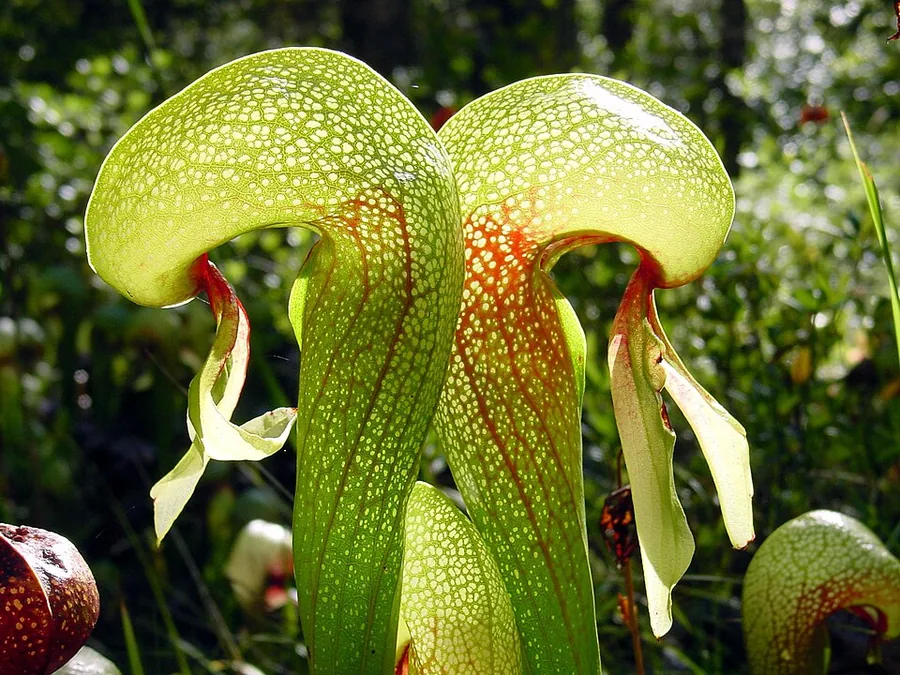
The cobra lily earns its name on looks alone. Each leaf swells into a hooded pitcher that rears up like a striking snake, with a forked, tongue-like flap dangling beneath a translucent dome. It is a carnivorous pitcher plant native to the cold mountain bogs and seeps of northern California and Oregon, where it traps insects to make up for soil that holds almost no nutrients.
Despite the common name, it is not a true lily and not related to one. The trick that draws prey is light: insects crawl in toward the bright patches in the hood, lose the exit, and slide down into the digestive pool below. None of this is dangerous to handle, and the plant poses no poisoning risk to people or pets.
What makes the cobra lily demanding is its habitat. In the wild, cold snowmelt runs constantly over its roots while the foliage sits in open sun. Recreating that split, hot top and cold bottom, is the whole game, and it is why this plant defeats growers who treat it like any other potted ornamental.
Care
The short version: full sun on the foliage with the roots kept cold and constantly wet, watered only with distilled, reverse-osmosis, or rainwater, grown in a nutrient-poor acidic bog mix, and never fertilized.
Light
Give the cobra lily full sun on its pitchers, which is what brings out the deep red veining in the hood. It will take partial sun or light shade, but a plant kept too dim grows pale and floppy. The catch is that strong light must come with cool roots, never a hot, dry spot.
Water
Keep the bog mix constantly wet, watering every 1 to 3 days, and use only distilled, reverse-osmosis, or rainwater, since tap and mineral water will kill it. Just as important, keep that water cold. Warm standing water around the roots is the most common cause of death, even when the top of the plant is thriving in full sun.
Soil
Plant it in a nutrient-poor bog mix of live sphagnum or a peat and perlite blend, never standard potting soil. The mix should run acidic, somewhere around a pH of 4.0 to 6.0, with nothing rich or fertile in it. Ordinary soil holds far too many minerals and will slowly poison the roots.
Temperature
It is cold-hardy and shrugs off a freeze, handling roughly 5°F to 86°F (-15°C to 30°C). The number that matters most is at the roots, which want to stay cool even on hot days. Heat at the crown does far more damage than cold ever will.
Humidity
This is a bog plant that likes the air on the damp side, around 50% to 80% humidity. Good airflow matters alongside that moisture, since stagnant, muggy air around the crown invites rot. Outdoors in a cool, breezy spot it usually gets what it needs on its own.
Feeding
Do not feed it. The pitchers catch and digest their own insects for nutrients, and that is the only food it wants. Fertilizer or a chunk of fatty meat dropped in won't help and will rot the plant from the inside.
Pruning
There is little to do here. Once a pitcher has fully browned and died back, snip it off at the base with clean scissors. Beyond clearing dead growth, leave the plant alone, since it should never be cut back for shape.
Repotting
Repot every 2 to 3 years in early spring into fresh bog mix, since the old medium breaks down and packs tight over time. Watch for stolons crowding the pot edge, compacted medium, or smaller, weaker pitchers, all signs it is ready to move.
Size & spacing
A mature cobra lily stands 10 to 31 inches (25 to 80 cm) tall and spreads 12 to 24 inches (30 to 60 cm) wide as its stolons creep outward. It grows slowly, so give it that room from the start and let the clump fill in over the years.
When to plant
The cobra lily is a hardy outdoor perennial for zones 6 through 9, and it works on a slow clock. Sow seed in late winter after a cold spell to break dormancy, set divisions or plants out in spring once frost has passed, and watch for its nodding flowers in late spring before the new pitchers fill in.
Northern hemisphere
Southern hemisphere
Typical months for a temperate climate: start earlier in warm zones, later where spring frosts linger.
- Sow: late winter after cold stratification
- Plant: spring after last frost
- Harvest: late spring
Hardiness
USDA hardiness zones: 6–9
Temperature: down to -23°C
Troubleshooting
Almost every cobra lily problem traces back to one of three things: warm roots, the wrong water, or too little light. Read the early signs below and you can usually catch the cause before it kills the plant. Match what you see, then act while it still helps.
Plant fades in warm weather even though the soil stays wet
This is cooked roots, the single most common way to lose a cobra lily. In the wild its crown sits in cold mountain runoff, so warm standing water around the roots starves it even while the pitchers bake in full sun. Move it somewhere cool and airy, flush the medium with cold distilled or rainwater on hot days, and top-dress with live sphagnum to insulate the root zone.
Fix:
- Move the plant to a cooler, airy spot out of reflected heat
- Flush the medium with cool distilled or rainwater on hot days
- Top-dress with live sphagnum to insulate and cool the root zone
- Avoid leaving the pot in warm standing trays in summer
Pitcher tips brown and the plant slowly weakens
This is mineral burn, caused by tap or hard water leaving salts behind, or by fertilizer reaching the roots. Look for a white crust on the medium or pot rim. Switch to distilled, reverse-osmosis, or rainwater only, flush the mix repeatedly to leach the salts out, and repot into fresh bog mix if the contamination has gone deep.
Fix:
- Switch to distilled, RO, or rainwater only
- Flush the medium repeatedly with pure water to leach salts
- Repot into fresh nutrient-poor bog mix if contamination is severe
Pale, floppy pitchers with little red veining
Weak color and limp growth point to too little light. New pitchers that come up green instead of veined red are the giveaway, and a plant kept in shade or indoors rarely colors well. Give it brighter light, ideally full sun with the roots kept cool, and step up the exposure over a week or two so it doesn't scorch.
Fix:
- Provide brighter light, ideally full sun with cool roots
- Acclimate gradually to avoid scorch
Toxicity
Good news for households with animals or small children: the cobra lily is not toxic to anyone. It traps and digests insects, not pets, and no part of it carries a poison worth worrying about. The only real risk runs the other way, since a curious nose or paw is more likely to wreck the fragile bog setup than to come to any harm.
Safe for
People · Cats · Dogs · Horses · Rabbits · Livestock · Birds
Cats None
A curious cat that nibbles a pitcher won't be poisoned, since the plant carries no toxins. The worst you might see is a little drool or a fussy stomach from the odd mouthful of fibrous leaf.
Dogs None
Dogs face no poisoning risk from this plant. A big chew of the tough pitchers could pass with a touch of mild stomach upset, but nothing more serious than that.
Horses Safe
There is nothing here to harm a horse. The fragile bog setup is far more likely to suffer from the visit than the animal is.
Rabbits Safe
Rabbits can be around it without any danger of poisoning, though the wet, acidic leaves hold no real appeal as food.
Livestock Safe
Grazing animals such as cattle, goats, and sheep face no toxic risk from the cobra lily.
Birds Safe
Birds are in no danger near this plant. They are far more likely to raid the trapped insects inside the pitchers than to come to any harm.
People Safe
The cobra lily is not toxic to people, and no part of it is poisonous to handle or touch. It isn't grown as food, so there's simply nothing to eat from it.
No special handling hazards; the pitchers digest small insects, not pets, and the plant has no toxic principles of concern.
Varieties
There is really just one species, plus a color form, so the names are few. Here are the two you'll come across.
Darlingtonia californica
This is the only species in its genus, known at a glance by the hooded, cobra-like pitcher and the forked tongue that hangs below the opening.
'Othello'
A cultivated selection that skips the usual red veining and comes up an even all-green instead.
How to propagate
You can multiply a cobra lily by splitting an established clump or by raising it from seed, but neither is quick and both call for patience.
DivisionDemanding
Early spring before active growth · 1-2 growing seasons
The reliable way to multiply a cobra lily is to lift it in early spring, before growth picks up, and separate the offsets that form on its running stolons. Take only pieces that already carry their own roots and pot them straight into fresh, cool, wet bog mix. Expect a division to settle in over one to two growing seasons.
SeedDemanding
Sow after cold stratification in late winter · 3-5 years to mature plant
Growing from seed is slow work for the patient. The seed first needs several weeks of cold, moist stratification in late winter to break its dormancy, and even then the seedlings inch along. Count on 3 to 5 years before a sown plant reaches a mature size.
Myths
You have to hand-feed the cobra lily insects or meat to keep it alive.
It catches all the prey it needs on its own, so feeding it by hand does no good and feeding it meat or fertilizer can rot the crown outright. What actually keeps it alive is light, pure water, and cool roots, not a diet you provide.
Like most houseplants it just needs warmth and regular potting soil.
It needs the opposite of standard houseplant care: a nutrient-poor, acidic bog mix and mineral-free water. Warm roots and rich soil are lethal to it, which is what makes a cool root zone the hardest part to get right.