Houseplant · Urticaceae
Chinese Money Plant
Pilea peperomioides
Easy, pet-safe, and generous with free pups, the Chinese money plant is the houseplant friends pass around.
Bright indirect
55–75°F · 13–24°C
USDA 9–11
8–12 in · 20–30 cm
Overview
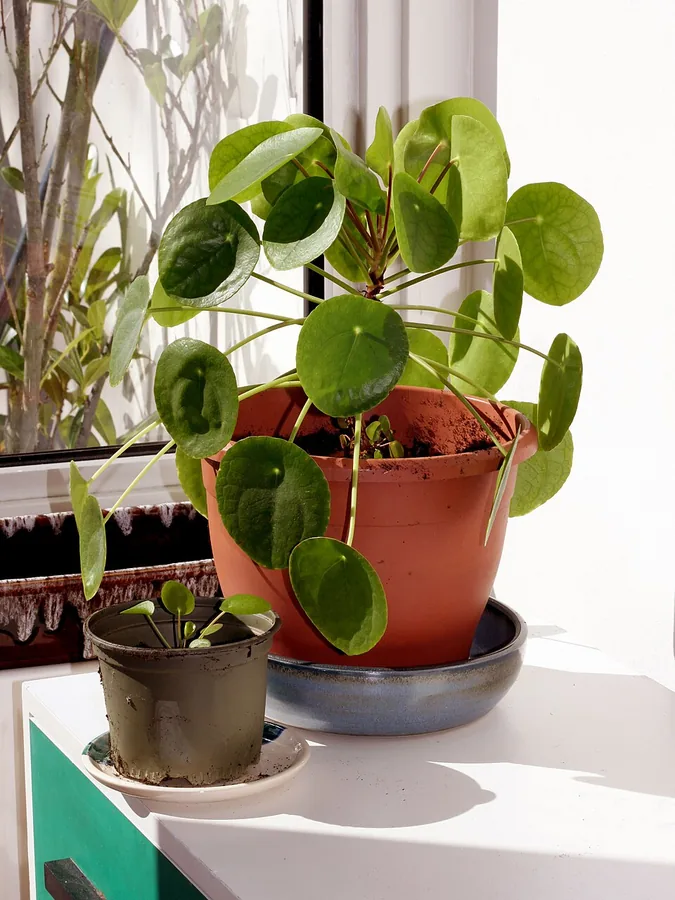
The Chinese money plant earns its keep on a shelf with those round, coin-shaped leaves on slender stalks, the look that gave it nicknames like pancake plant and UFO plant. It comes from the mountains of Yunnan in southwest China and grows as a small evergreen perennial, topping out around 8 to 12 inches (20 to 30 cm) tall and wide. That tidy size makes it a natural for a desk, a windowsill, or a bright corner.
What sets it apart is how freely it shares itself. The parent throws up baby plants, called pups, from its base and roots, and you simply lift them out and pot them on. People have handed these pups around for decades, which is how the plant picked up its other names, friendship plant and missionary plant.
It asks for little. Bright indirect light, a drink only when the top of the soil dries, and a pot that drains keep it happy and growing fast. The one habit to break is overwatering, since soggy soil is the quickest way to lose it to root rot.
Care
The short version: bright, indirect light, and water only when the top of the soil has dried. Plant it in a well-drained mix in a pot with drainage, keep it in average room warmth, and let it dry out a touch rather than stay wet.
Light
Give it bright, indirect light, the kind near a window but out of harsh direct sun. It will get by in partial shade or medium indirect light, but too little and the stems stretch and lean. Turn the pot now and then so it grows evenly on all sides.
Water
Let the top half of the soil dry before you water again, then water thoroughly and let it drain. The plant hates sitting wet, and overwatering is the fastest path to root rot, so when in doubt, wait a day. A well-drained mix makes this easy to get right.
Soil
Use a well-drained houseplant mix; NC State suggests loam or sand that lets water move through. It's relaxed about acidity, taking anything from a pH of 6.0 to 8.0. The one thing it won't forgive is a mix that stays soggy.
Temperature
Normal room warmth suits it, roughly 55°F to 75°F (13°C to 24°C). Keep it away from cold drafts and hot radiators, both of which stress the leaves.
Humidity
Average household humidity is plenty, so there's no number to chase. In fact, too much humidity invites bacterial leaf spot, so steady air movement does more good than a humidifier.
Feeding
Feed once a month with a balanced houseplant fertilizer through spring and summer while it's actively growing. Ease off in the darker months when growth slows.
Pruning
It barely needs pruning. Pull off any damaged or spotted leaves as they appear to keep the plant clean and the air moving, and pinch out pups at the base if you want to tidy the parent or share them.
Repotting
Repot in spring or early summer every 1 to 2 years, or whenever it turns rootbound. Roots poking from the drainage holes, a pot crammed with pups, or soil that dries out fast all tell you it's time to size up.
Size & spacing
Expect a compact plant of about 8 to 12 inches (20 to 30 cm) tall and the same across. Its small footprint means it fits a shelf or sill with no need to space it from anything.
Troubleshooting
Most problems with this plant trace back to light or water, and the leaves tell you which. Read the early signs below and you can fix the cause before a leaf or two turns into a real setback.
Wilting and mushy stems even though the soil is wet
When a plant flags despite damp soil, suspect root rot from overwatering in a mix that holds too much water. Tip it out and you'll find brown, soft, mushy roots instead of firm white ones. Stop watering, repot into fresh well-drained mix while trimming away the rotted roots, and only use a pot that drains.
Fix:
- Stop watering and allow soil to dry
- Repot into fresh, well-drained mix, trimming away soft, rotted roots
- Ensure the container drains freely
Fine webbing and a speckled, bronzed look to the leaves
Faint webbing on the leaf undersides and a stippled, faded surface mean spider mites, which thrive when the air is warm and dry. Rinse the foliage and wipe the leaves to knock the mites loose, then treat with insecticidal soap or horticultural oil and repeat until they're gone. Keep the plant away from your others until it's clean.
Fix:
- Rinse foliage and wipe leaves to dislodge mites
- Treat with insecticidal soap or horticultural oil, repeating as needed
- Isolate the plant from other houseplants until controlled
Soft brown or black spots spreading on the leaves
Dark, mushy patches are bacterial leaf spot, and they take hold when the air is too humid and the leaves stay wet. Remove the marked leaves right away and bin them. Then cut the humidity, get more air moving around the plant, and water at the soil so the foliage stays dry.
Fix:
- Remove and dispose of affected leaves promptly
- Decrease humidity and increase air circulation
- Avoid wetting the foliage when watering
Stretched, leggy stems leaning toward the window
This is light starvation. When the plant sits too far from a window, the stems stretch and the gaps between leaves widen as it reaches for what light it can find. Move it somewhere bright but indirect, filter a strong window with a sheer curtain, and turn the pot every week or so to keep the growth even.
Fix:
- Move to a spot with bright, indirect light
- Filter strong light through a sheer curtain rather than placing in deep shade
- Rotate the pot periodically so all sides receive even light
Leaves curling, cupping, or looking distorted
Curled or cupped leaves usually point to light or water stress, either too much harsh sun, too little light, or watering that swings between bone dry and soggy. Pull the plant back from any direct sun into bright, indirect light and keep the watering steady. Check the leaf undersides for pests too, then watch the new growth flatten out as conditions settle.
Fix:
- Move out of direct sun to bright, indirect light
- Keep watering even, avoiding both drying out and waterlogging
- Maintain stable temperatures away from drafts and heat sources
Lower, older leaves turning yellow
A stray yellow leaf at the bottom is often just old age as the plant lets go of its earliest growth. But if the lower leaves yellow while the soil stays soggy, the cause is overwatering in a mix that won't drain. Let the top of the soil dry before you water again, make sure the pot drains freely, and pick off the yellowed leaves.
Fix:
- Allow the top of the soil to dry before watering again
- Ensure the pot has drainage and uses a well-drained mix
- Remove yellowed leaves
Toxicity
Good news for a busy household: this is one of the safe ones. NC State Extension lists the Chinese money plant as safe for pets and children, so there's no toxin to worry about if a cat bats a leaf or a toddler takes a bite. A curious nibble may still cause a mild tummy upset the way any plant matter can, but nothing here will poison anyone.
Safe for
People · Cats · Dogs · Horses · Rabbits · Livestock · Birds
Cats None
Cats are in the clear here. NC State Extension lists the plant as safe, so a curious cat that bats at a leaf has nothing to fear.
Dogs None
No toxin troubles dogs either. A chewed leaf won't poison your dog, though gnawing the foliage may still cause a passing tummy upset the way any stray plant matter can.
Horses None
Horses face no poisoning risk from this plant, which carries none of the toxins that make other species hazardous around a paddock.
Rabbits None
Rabbits can nibble without harm. The leaves hold nothing toxic, so a stray bite is a non-event.
Livestock None
Grazing animals like cattle, goats, and sheep can browse it without ill effect, since the plant carries no poison.
Birds None
Pet birds are safe around it. A nibbled leaf poses no toxic threat to them at all.
People None
People have nothing to worry about. NC State Extension rates the plant safe for children, so a leaf a toddler puts in their mouth is harmless, even if it isn't meant for eating.
No special handling precautions documented by approved sources
How to propagate
Few houseplants are easier to multiply. The plant does most of the work for you by making pups, and a single parent can keep you in new plants and gifts for years.
Offsets & pupsEasy
Spring to summer · Several weeks
This is the easy, reliable way to make more plants, and it's what gave the Chinese money plant its friendly reputation. From spring through summer, lift the rooted pups off the base and rhizome and pot each one on its own. Give them a few weeks and they settle into independent little plants.
DivisionEasy
Spring at repotting · Several weeks
When you repot in spring, take the chance to split a crowded clump into pieces, making sure each one keeps its own roots. Pot the divisions separately and they take hold over the following few weeks.
Stem cuttingsModerate
Spring to summer · Several weeks to root
Stem or leaf cuttings are the backup plan when there are no pups to take, best done from spring through summer. They're a bit fussier than pups and need several weeks to root, so reach for this method only if you have to.
Myths
Leaf cuttings are the only way to propagate a Chinese money plant.
The easiest and most reliable route is the pups, those little offsets that push up from the base and rhizome, which you can lift out and pot on their own. Stem and leaf cuttings work too, but they're the harder option. All that free sharing of pups is exactly why the plant picked up names like friendship plant and missionary plant.
It needs very high humidity to thrive indoors.
It likes moderate humidity, but NC State notes it gets on fine in ordinary household air. Pushing the humidity too high actually invites bacterial leaf spot, so what really counts is good air circulation, not a misting bottle.