Vegetable · Solanaceae
Chili Pepper
Capsicum annuum
Give it heat, sun, and steady water, and a chili plant loads up with fruit from summer into fall.
Full sun
Every 2–4 days
59–86°F · 15–30°C
70–85 days
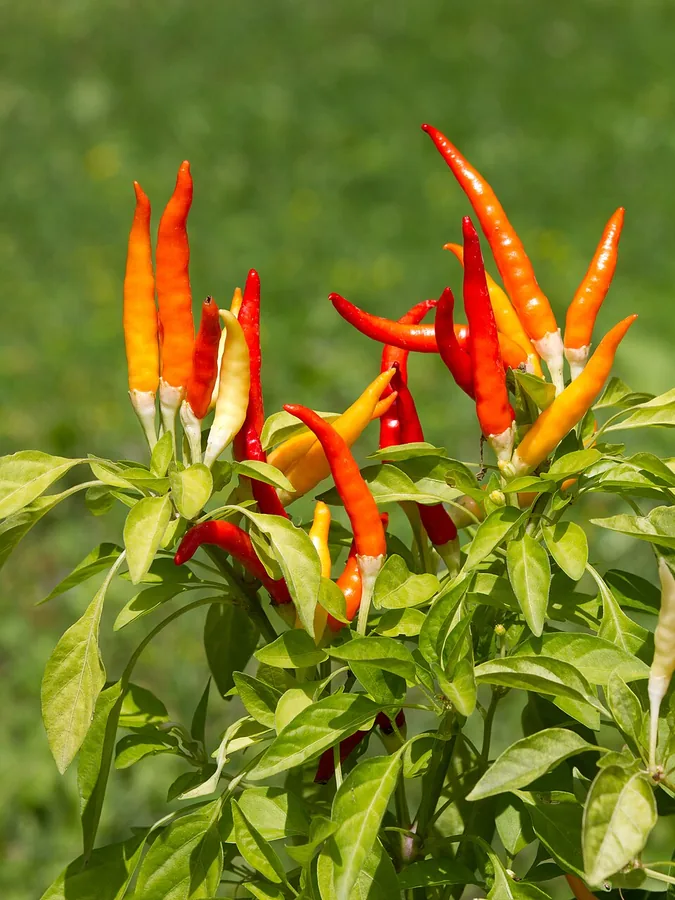
Overview
Chili peppers bring the heat to the garden, and they earn it. A member of the nightshade family alongside the tomato, the chili came out of the Americas and now grows on every continent people garden. Treat it as a warm season annual, and it works just as well in a sunny bed as in a pot on a hot patio.
The range of fruit is wide. Some peppers stay mild and thick-walled for fresh eating, while others pack a punch fierce enough to need gloves at the cutting board. What sets the heat is capsaicin, the compound concentrated in the ribs and seeds, and the same compound that irritates skin, eyes, and the mouths of most animals.
Peppers ask for patience early and warmth throughout. They're slow to start from seed and they sulk in the cold, but give them full sun, even moisture, and a long warm season and they reward you with fruit right up to frost.
Care
The short version: full sun and steady warmth, with the soil kept evenly moist so the fruit doesn't rot at the bottom. Plant in rich, well drained ground, feed lightly through the season, and don't rush them out into the cold.
Light
Chili peppers want full sun, eight or more hours of it a day. Skimp on light and you get leggy plants with thin foliage and far fewer peppers to show for the season.
Water
Keep the soil evenly moist, watering deeply to at least 6 inches and mulching to hold that moisture in. Steady watering matters most through flowering and fruit set, since the dry-then-wet swings are what trigger blossom end rot. In a pot or a heat wave, expect to water every 2 to 4 days.
Soil
Plant in well drained loam or sandy loam worked full of organic matter. A pH between 6.0 and 6.8 suits them, a touch on the acidic side, and good drainage keeps the roots from sitting wet.
Temperature
Peppers thrive in warmth, growing best between 59°F and 86°F (15°C to 30°C). Cold soil stalls them early, and fruit set stutters once days run too hot, so a long mild stretch is what fills the plant.
Humidity
Average humidity around 40% to 70% is plenty, so there's no number to fuss over. Airflow counts for more, since crowded, damp leaves invite the bacterial spots that trouble peppers.
Feeding
Feed monthly through the growing season with a balanced vegetable fertilizer. A side-dressing of calcium nitrate about 3 to 4 weeks after transplanting, and again a few weeks later, supports fruit set, but lean on a soil test rather than guessing.
Pruning
Peppers need little pruning. You can pinch off the first flowers to push bushier growth and stronger roots, pull any damaged or diseased leaves, and stake the taller plants so a heavy load of fruit doesn't topple them.
Repotting
Treat the chili as a one-season plant, started fresh from seed each year. Move seedlings into roomier pots before they go outside so the roots never coil, and watch for circling roots or fast wilting as the sign a young plant has outgrown its cell.
Size & spacing
Most chili plants stand 12 to 35 inches (30 to 90 cm) tall depending on the type, bushing out to 12 to 24 inches (30 to 60 cm) wide. Give each plant that much room so air moves freely and the leaves stay dry.
When to plant
Chili peppers love heat and won't tolerate frost. Start the seeds indoors well before the last frost, hold the transplants back until nights stay above about 55°F (13°C), and pick fruit from summer into fall.
Northern hemisphere
Southern hemisphere
Typical months for a temperate climate: start earlier in warm zones, later where spring frosts linger.
- Sow: 6 to 8 weeks before the last spring frost
- Plant: After the last frost once night temperatures stay above about 55°F (13°C)
- Harvest: Summer to fall harvest of fruit
Hardiness
USDA hardiness zones: 9–11
Temperature: down to -7°C
Troubleshooting
Most pepper trouble turns up on the fruit, the leaves, or the flowers. Catch those early signs and you can step in before a small problem spreads through the plant. Match what you see below, then act while it still helps.
Angular brown leaf spots ringed with yellow
This is bacterial leaf spot, which spreads fast in wet, splashy conditions and can strip a plant of its leaves. There's no cure once a plant is heavily marked, so pull and discard the worst ones. Water at the base, keep your hands off wet foliage, and rotate peppers away from tomatoes and their nightshade kin.
Fix:
- Remove and discard heavily infected plants
- Avoid overhead watering and handling plants when wet
- Use copper-based products where appropriate
Dark, sunken patch on the bottom of the fruit
This is blossom end rot, and it traces back to uneven watering rather than soil that lacks calcium. When the soil swings from dry to soaked, the plant can't carry calcium into the growing fruit. Water on a steady schedule, mulch to hold moisture, and go easy on the nitrogen.
Fix:
- Maintain even soil moisture and mulch to buffer drying
- Avoid over-applying nitrogen fertilizer
- Confirm adequate calcium with a soil test and amend if needed
Flowers drop without setting fruit
Peppers shed their open blossoms when the weather turns extreme, dropping flowers once days push past 90°F (32°C) or nights fall below about 60°F (16°C). The plant itself stays green and healthy. Keep the soil evenly moist, ease off the nitrogen during bloom, and fruit set picks back up once the weather settles.
Fix:
- Wait for moderate temperatures, when fruit set usually resumes
- Keep soil evenly moist
- Avoid heavy nitrogen feeding during flowering
Curled leaves with clusters of tiny insects and sticky residue
Those soft green-to-black specks are aphids, and they crowd onto shoot tips and leaf undersides where they leave a sticky honeydew behind. Knock them off with a hard jet of water, and reach for insecticidal soap or spinosad only when the colonies are heavy. Lady beetles and lacewings will clear up the rest if you let them work.
Fix:
- Dislodge colonies with a strong spray of water
- Apply insecticidal soap or spinosad if populations are high
- Encourage natural predators such as lady beetles and lacewings
Toxicity
The fruit is good to eat and a staple in kitchens worldwide, so people are perfectly safe with chilis. The catch is capsaicin, the heat compound, which is a strong irritant to cats, dogs, and most animals and can leave them with a burning mouth, drooling, and an upset stomach. Birds are the odd exception and aren't bothered at all.
Toxic to
Cats · Dogs · Horses · Rabbits · Livestock
Safe for
People · Birds
Cats Mild
A cat that bites into the fruit gets a mouthful of burn. Expect drooling, pawing at the mouth, and maybe some vomiting or loose stool that passes on its own.
Dogs Mild
Dogs feel the same sting if they chew a pepper, with drooling, an upset stomach, and a sudden thirst. Most settle once the heat fades and they've had a drink.
Horses Caution
Horses rarely touch the spicy fruit, but capsaicin would burn the mouth and irritate the gut all the same, so keep the plants out of reach.
Rabbits Caution
The heat is harsh on a small grazer. A nibble can leave a rabbit drooling and off its feed, so don't let it browse the plant.
Livestock Caution
Goats, sheep, and cattle find the burn off-putting and usually leave peppers alone, but a curious animal that does eat the fruit can suffer mouth and stomach irritation.
Birds Safe
Birds don't feel the heat at all. They lack the receptor capsaicin acts on, which is exactly how wild peppers get birds to carry off and spread their seeds.
People Edible
Chili fruit is a kitchen staple and safe to eat, hot as it may be. Wear gloves when cutting the fiercest types and keep the cut flesh away from your eyes.
Capsaicin causes painful skin and eye irritation when handling or cutting hot peppers. Wear gloves, avoid touching your eyes or face, and wash hands thoroughly afterward; inhaling fumes from cut peppers can irritate the airways.
Helpline numbers

United States
ASPCA Animal Poison Control: (888) 426-4435 (fee applies)

United Kingdom
Animal PoisonLine: 01202 509000 (fee applies)

Australia
Animal Poisons Helpline: 1300 869 738
Varieties
Thousands of chili varieties exist, but a few show up again and again in home gardens. These are the ones worth knowing by name and by heat.
Jalapeno
A thick-walled, medium-hot pepper usually picked while still green, and the go-to choice for fresh eating and pickling.
Cayenne
Long, thin, wrinkled fruit that runs hotter than a jalapeno and dries down into the familiar ground cayenne powder.
Habanero
A lantern-shaped, very hot pepper of the Capsicum chinense species, carrying a distinct fruity aroma under all that heat.
Thai (bird) pepper
Small, fiercely pungent fruit held upright in clusters on neat, compact plants.
How to propagate
Chili peppers are grown from seed, and the only real trick is giving them enough warmth and a long enough head start indoors.
SeedModerate
Start seed indoors 6 to 8 weeks before the last spring frost · Germinates in roughly 1 to 3 weeks in warm soil (about 80-85°F); transplants are field-ready 6 to 8 weeks after sowing
Peppers grow from seed, but they ask for steady warmth to get going. Sow indoors 6 to 8 weeks before your last frost and give them bottom heat near 80°F to 85°F (27°C to 29°C) and bright light, and they sprout in about 1 to 3 weeks. The seedlings are ready for the garden 6 to 8 weeks on, once you've hardened them off and the frost has passed.
Myths
Chili peppers are deadly poisonous to dogs and cats.
Capsaicin burns, but it doesn't poison the way a true toxin does. A pet that chews a hot pepper gets a sore mouth and an upset stomach for a while, not lasting harm, and culinary peppers aren't on the ASPCA's classic toxic-plant list.
The heat in chili peppers harms birds.
Birds don't register capsaicin at all and eat the fruit without a flinch. That blind spot is the whole point, since wild peppers rely on birds to swallow the fruit and scatter the seeds far and wide.