Ornamental · Typhaceae
Cattail
Typha latifolia
Stand its roots in mud or shallow water and the cattail thrives, but give it room and it will take the whole pond.
Full sun
USDA 3–10
4–10 ft · 1.2–3 m
Overview
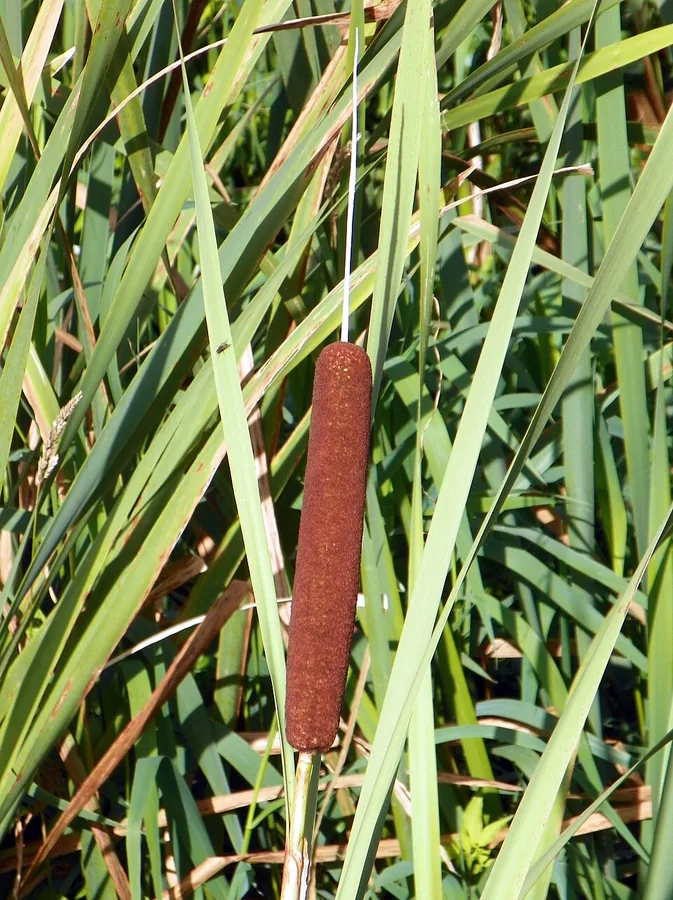
The cattail is the tall, brown-spiked plant that lines the edge of almost every pond, ditch, and marsh across North America. It is an emergent aquatic perennial, rooted in mud with its leaves and flower spikes standing well above the water. Sword-shaped gray-green leaves and that unmistakable brown seed head make it one of the easiest wetland plants to recognize.
It grows fast and asks for almost nothing beyond wet feet. Hardy from USDA zones 3 to 10, it shrugs off cold down to -40°F (-40°C) and tolerates a remarkable range of soils and water, but it will not survive a root zone that dries out. That same toughness is the catch: thick creeping rhizomes let a single plant become a dense, single-species stand in a year or two.
Most parts have a long history as wild food, and the stand feeds and shelters waterfowl, marsh birds, and other wildlife. Grow it for that wildlife value or for the strong vertical line it gives a pond edge. Just plan to contain it from the start, because a cattail left loose rarely stays where you put it.
Care
The short version: full sun and constantly wet ground, with the roots in saturated mud or up to about a foot of standing water. It needs little feeding and almost no fuss, but plant it in a submerged basket so it can't take over.
Light
Cattails want full sun for the strongest growth and the best flowering, though they put up with a little partial shade. The more light they get, the denser and taller the stand.
Water
This is the one thing you cannot get wrong. Keep the root zone saturated at all times or stand the crown in shallow water, roughly 0 to 12 inches (0 to 30 cm) deep, and never let the mud dry out. Planting in a submerged basket also reins in the spreading rhizomes.
Soil
Cattails root in heavy, mucky, fertile mud or saturated loam, clay, or sand at the water's edge, and they take a wide range of wet soils. They handle an unusually broad pH band, anywhere from 3.7 to 8.5, so soil chemistry is rarely the limiting factor.
Temperature
Few plants are hardier. Cattails endure from about -40°F to 100°F (-40°C to 38°C), dying back in winter and pushing fresh growth each spring.
Humidity
Growing in or beside water, the cattail lives in high humidity by default, so there's no number to manage. The wet setting it demands keeps the air around it damp on its own.
Feeding
In a natural pond or wetland, feeding is rarely needed, since the rich mud carries the plant. If you grow it in a container, a single aquatic plant tab in spring is plenty.
Pruning
Cut the old, dead foliage down to the waterline in late winter or early spring before new shoots appear. Removing the brown female spikes before they burst is the simplest way to cut down on self-seeding.
Repotting
A container-grown cattail needs splitting every 1 to 2 years, because the vigorous rhizomes fill a basket fast. When you see roots circling the rim, smaller leaves, or the plant heaving itself up out of the pot, it's time to divide and replant.
Size & spacing
Expect a mature plant to reach 4 to 10 feet (1.2 to 3 m) tall and spread 4 to 6 feet (122 to 183 cm) wide. Give it that much room, or better yet a basket, so a single clump doesn't swallow the pond edge.
When to plant
Cattails are tied to the seasons of a temperate climate. Divide and set out rhizomes in spring once the water has warmed and frost has passed, watch the brown spikes form through early summer, and cut the old foliage back in late winter before new growth pushes up.
Northern hemisphere
Southern hemisphere
Typical months for a temperate climate: start earlier in warm zones, later where spring frosts linger.
- Sow: Late winter to early spring; seeds need warmth, light, and moist or flooded conditions to germinate
- Plant: Spring after frost, once water has warmed; divide and set out rhizomes in spring
- Harvest: May to July (brown cylindrical female spike topped by a narrower yellow male spike)
Hardiness
USDA hardiness zones: 3–10
Temperature: down to -40°C
Troubleshooting
Most cattail trouble is about spread rather than disease, since this is a tough plant that rarely sickens. The signs to read are a stand that creeps wider each year and seedlings turning up where you never planted them. Match what you see below, then act before the colony gets ahead of you.
A single clump turns into a thick, spreading stand
The culprit is the cattail's fast-creeping rhizomes, which run just under the mud and throw up new shoots well outside the original clump. Nutrient-rich water only speeds it along. Plant in a submerged basket to fence the roots in, dig out stray runners, and cut stems below the waterline through the season to wear the colony down.
Fix:
- Grow the plant in a submerged planting basket or tub instead of open pond mud to physically confine the rhizomes
- Dig out and remove unwanted rhizome runners; repeated removal is needed because fragments resprout
- Cut stems below the waterline repeatedly through the season to weaken the colony
- Hand-pull or thin new shoots before they establish
New cattails sprouting where you never planted any
Each brown spike bursts into thousands of fluffy, wind-borne seeds that drift off and root on bare wet mud, while loose rhizome pieces float to new spots and take hold. Cut and bin the female spikes before they shed, pull young volunteers while they come away easily, and keep the parent plant contained so stray pieces can't escape.
Fix:
- Cut and remove the brown female spikes before they mature and shed seed
- Pull volunteer seedlings while young and easy to remove
- Keep the plant contained so stray rhizome pieces cannot spread
Leaves yellowing and browning, or the stand thinning out
In late fall this is just seasonal dieback as the perennial goes dormant, and it returns on its own in spring. Browning at the wrong time of year usually means a dry root zone, which cattails won't tolerate. Keep the soil saturated or the crown in shallow water, then cut the spent foliage to the waterline in late winter.
Fix:
- Keep the soil saturated or the crown standing in shallow water at all times
- Cut spent foliage to the waterline in late winter; vigorous new growth returns in spring
Toxicity
Good news on this one: the cattail is not toxic to people, pets, or livestock. Many parts are even eaten, and the stand is a valued wildlife food. The only thing to watch is the fluffy seed down, a mechanical irritant that can bother the eyes or airways if you breathe in a cloud of it.
Safe for
People · Cats · Dogs · Horses · Rabbits · Livestock · Birds
Cats Safe
No toxins to worry about here. A cat that bats at the leaves is fine, though a mouthful of the cottony seed down might trigger a sneeze or two.
Dogs Safe
Safe for dogs. Chewing the leaves or shoots causes no poisoning, and the rhizomes are even an old wild food, so a curious nibble does no harm.
Horses Safe
Horses can graze cattail without risk. It carries nothing toxic, and the young shoots and roots are a known forage plant in wet pastures.
Rabbits Safe
Rabbits are in the clear. The tender shoots and leaf bases are non-toxic and make a perfectly good green treat in small amounts.
Livestock Safe
Cattle, goats, and sheep can browse the foliage and shoots safely. The plant holds no poison, and stock often graze it where it grows along water.
Birds Safe
Birds eat the seed and shelter in the stand with no ill effect. Waterfowl and marsh birds rely on cattail for both food and cover.
People Safe
Long valued as a wild food, with edible young shoots, rhizomes, and pollen. The only nuisance is the airy seed down, which can irritate the eyes or airways if you breathe in a cloud of it.
Not poisonous. The fluffy seed down is a non-toxic mechanical irritant only; it can be messy and may irritate eyes or airways if inhaled, but it is not chemically toxic.
Varieties
A few cattails turn up in gardens and wetlands, and they differ in size, leaf width, and how hard they are to keep in bounds. These are the ones worth telling apart.
Typha latifolia (common / broadleaf cattail)
The familiar species stands 4 to 10 feet tall with broad, flat, gray-green leaves and a thick brown female spike pressed right up against the yellow male spike with little or no gap between them.
Typha angustifolia (narrowleaf cattail)
You can tell this one by its narrower leaves and the bare strip of stem that separates the female and male spikes, and it tends to turn invasive and aggressive once it escapes a container.
Typha × glauca (hybrid cattail)
A cross between the broadleaf and narrowleaf species, it shows traits midway between the two and is notably invasive, taking over wetlands in dense single-species stands.
Typha minima (dwarf / miniature cattail)
The smallest of the group reaches only about 18 inches with slender leaves and little spikes, and its restrained spread makes it the one cattail genuinely suited to small water gardens, pools, and tubs.
'Variegata'
Grown for its looks, this selection carries leaves striped lengthwise in creamy yellow to white.
How to propagate
Cattails multiply with almost no help, whether you split an existing clump or let it grow from seed.
DivisionEasy
Spring · One growing season; rhizome divisions root and spread quickly
Division is by far the easiest and fastest way to make more cattail. In spring, lift the plant and cut the thick rhizome into sections, each carrying a growing shoot, then replant them in saturated mud or shallow water where they root and spread within a single season.
SeedModerate
Late winter to spring · Seedlings establish over one season; flowering may take a year or more
Growing from seed takes more patience. Sow in late winter to spring on warm, moist or flooded soil in bright light, since the seeds germinate best in warmth on exposed wet mud. Seedlings settle in over a season, but flowering may wait a year or more, which is why the plant self-sows so freely in the wild.
Myths
Cattail is a good, easy plant for a small backyard pond.
Common cattail is far too aggressive for a small pond. The thick rhizomes spread fast and take over a small water garden within a year or two unless you confine them to a submerged basket, and the plant self-seeds on top of that. For a small feature, reach for the dwarf cattail (Typha minima) instead, or keep the broadleaf type tightly contained.
All cattails are native and harmless to wetlands.
Broadleaf cattail is native across most of North America, but the narrowleaf cattail and the hybrid Typha x glauca are invasive in many regions and build dense stands that crowd out other wetland plants. Even the native species can run wild, so none of them belong in a natural waterway.