
Introduction
The umbrella plant gets its name from glossy leaflets that fan out like the spokes of an open umbrella. Each leaf cluster forms a mini canopy that gives your room a lush, tropical feel. Whether you are brand new to plants or a longtime grower, this schefflera makes a great tropical houseplant for your home.
I started growing umbrella plants about 8 years ago when a friend gave me a small cutting from her office plant. That tiny stem turned into a 4 foot tree in my living room. In my experience, few houseplants grow this fast with so little fuss. Scientists have named 602 species of Schefflera so far, yet fewer than 20 have been studied in depth.
What I love most is the dual role these plants play in your home. You get a bold visual statement piece and a proven air purifier that pulls toxins from your indoor air. Smart indoor plant care starts with choosing the right plant, and Schefflera checks both the beauty and health boxes for you.
You get two main species to choose from. Schefflera actinophylla is the tall type that grows up to 15 feet indoors for a dramatic look. Schefflera arboricola stays compact at 2 to 6 feet, so it fits your desk or small room. This guide gives you everything you need to grow either one with full confidence.
6 Popular Umbrella Plant Varieties
Not all umbrella plants look or grow the same. I tested 4 of these 6 umbrella plant varieties in my home over the years. Each one brought something unique to my space. The tall type is schefflera actinophylla. The compact one is schefflera arboricola, your dwarf umbrella tree.
The dwarf type now goes by a new name in science: Heptapleurum. That shows you how much we still learn about umbrella tree types each year. When you shop for a variegated umbrella plant, you want to know what each cultivar offers. Here are the 6 best types I suggest from my own growing time with them.
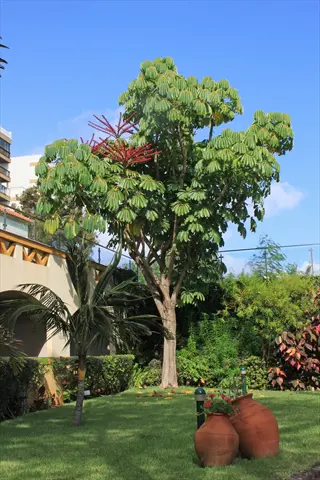
Schefflera Actinophylla
- Size: This is the larger umbrella tree species, growing 30 to 40 feet (9 to 12 meters) outdoors and 8 to 15 feet (2.4 to 4.6 meters) when kept as an indoor container plant.
- Leaves: Mature plants produce 7 or more glossy leaflets per leaf, each reaching up to 12 inches (30 centimeters) in length, creating a dramatic canopy effect.
- Origin: Native to Queensland, Australia, this species was introduced to Florida in 1927 as an ornamental and has since become invasive in warmer regions.
- Light needs: Requires bright indirect light indoors and full sun outdoors, though indoor plants almost never flower without intense light exposure.
- Growth habit: Young plants start with just 3 to 5 leaflets per leaf, developing more as they mature, giving owners a visible measure of the plant's progression.
- Best for: Your large rooms, entryways, and spaces where you want a statement tropical plant, as long as your ceilings are high enough for its upward growth.
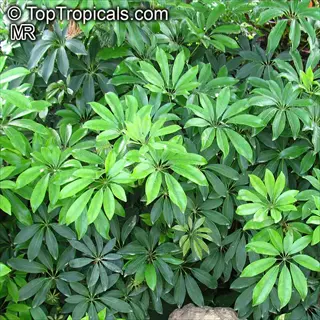
Schefflera Arboricola (Dwarf)
- Size: The compact species stays between 2 and 6 feet (0.6 to 1.8 meters) indoors, making it the most popular choice for tabletops, desks, and windowsills.
- Leaves: Each leaf carries 7 to 11 smaller leaflets up to 4 inches (10 centimeters) long, creating a dense and bushy appearance that fills out nicely.
- Growth rate: One of the faster growing houseplants you can find, putting out new growth at a strong pace during spring and summer with good light and feeding.
- Adaptability: Tolerates lower light conditions better than its larger cousin, though growth will slow and variegated forms may revert to solid green.
- Pruning response: Responds well to pruning by branching at cut points, allowing growers to shape the plant into a bushier form rather than a single trunk.
- Best for: Your apartment, office, or any indoor space where you want a manageable tropical plant without committing to a floor standing specimen.
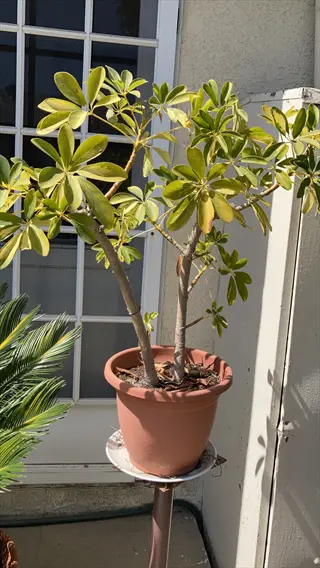
Gold Capella
- Appearance: This popular variegated cultivar of S. arboricola features striking golden-yellow splashes and margins on deep green leaflets that brighten any room.
- Light needs: Requires brighter light than solid green varieties to maintain its variegation pattern, as low light causes leaves to revert to plain green over time.
- Size: Stays compact like other arboricola varieties at 2 to 5 feet (0.6 to 1.5 meters) indoors, making it a manageable and colorful houseplant option.
- Care difference: A bit slower growing than solid green forms because the yellow portions of leaves contain less chlorophyll for photosynthesis, so patience is needed.
- Popularity: One of the most common umbrella plant cultivars in garden centers, valued for its cheerful coloring and ease of care compared to other variegated plants.
- Best for: Bright rooms where the variegation can be showcased, such as near east or west facing windows that provide consistent indirect light throughout the day.
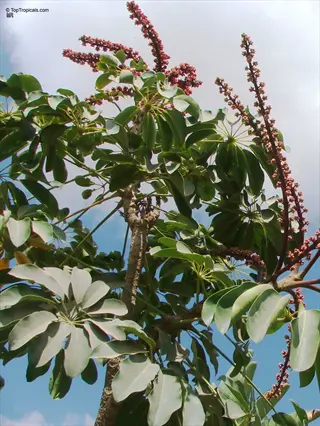
Amate
- Disease resistance: This cultivar stands out for its documented resistance to Alternaria leaf spot, a fungal disease that affects many other Schefflera varieties according to Clemson University Extension.
- Leaf quality: Produces larger, darker green leaves with a glossy finish that gives it a more polished and upscale appearance compared to standard arboricola types.
- Indoor performance: Bred for indoor growing conditions, Amate adapts well to lower light levels while keeping its lush foliage and deep color intact.
- Growth habit: Develops a strong central trunk with well spaced branching that creates an attractive tree form on its own without heavy pruning or training.
- Availability: Found at specialty nurseries and some larger garden centers, though stocked less often than Gold Capella or standard green varieties.
- Best for: You if you want a resilient variety that fights off common fungal problems, and it works great in humid rooms where leaf spot tends to strike other plants.
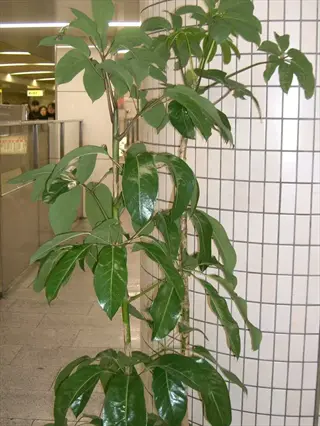
Compacta
- Size: True to its name, this cultivar stays much smaller and more contained than standard arboricola, making it ideal for tight spaces and small containers.
- Leaf spacing: Produces tight, close leaves along shorter stems, creating a dense and full appearance without the legginess that some umbrella plants develop indoors.
- Growth rate: Grows at a slower pace than other arboricola cultivars, which cuts down on repotting and makes it a low fuss choice for busy growers.
- Appearance: Deep green leaflets are a bit smaller and rounder than standard varieties, giving the plant a tidy and neat look at any size.
- Care needs: Follows the same care routine as other arboricola types but needs less pruning to stay in shape thanks to its contained growth pattern.
- Best for: Your small apartment, desktop, bookshelf, or terrarium where space is tight but you still want that tropical plant presence.
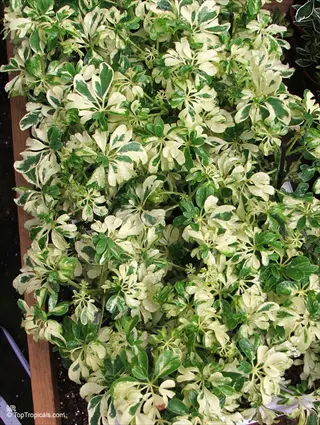
Janine
- Appearance: Features cream and green variegation with irregular patterns on each leaflet, giving every leaf a unique look that differs from the more uniform Gold Capella.
- Size: Stays on the smaller side of the arboricola range, reaching about 2 to 4 feet (0.6 to 1.2 meters) indoors with a bushy and rounded growth habit.
- Light sensitivity: Like all variegated umbrella plants, Janine needs bright indirect light to keep its cream coloring vibrant and prevent gradual loss of the lighter markings.
- Rarity: Harder to find in mainstream garden centers compared to Gold Capella, and you may need to search through specialty houseplant shops or online sellers.
- Growth pattern: Tends to branch on its own and fill out without heavy pruning, forming an attractive rounded canopy shape that looks full even at smaller sizes.
- Best for: You if you love unique variegation patterns and want a standout umbrella plant that your guests will notice and ask about.
Light and Placement
Getting your umbrella plant light requirements right makes a huge difference in how your plant grows. I moved one of my schefflera plants to 3 different spots before I found the sweet spot. The key is bright indirect light near an east or west window where your plant gets strong light without harsh direct sun.
Your eyes adjust to dim rooms in ways that plants cannot. A spot that looks bright to you may not give your schefflera enough energy to grow full and compact. Too much direct sun scorches leaves with brown patches, while too little light stretches stems with wide gaps between leaves. When you find the right indoor plant placement, your umbrella plant rewards you with dense growth and more leaflets per leaf.
Variegated types like Gold Capella need brighter spots than solid green ones do. In my experience, the green varieties show real low light tolerance and still grow in shadier corners, but they slow down a lot. Put your variegated plant in a dim room and you will watch those gold markings fade back to plain green within a few months.
The schefflera temperature range matters just as much as light does. Keep your day temps between 65 to 75°F and your night temps above 60°F for steady growth. Cold damage hits fast below 50°F, and I lost a young plant to a drafty window one winter because I didn't move it in time. Keep your umbrella plant away from heating vents and cold drafts near doors.
Watering and Soil Needs
Umbrella plant watering trips up more growers than any other part of care. I killed my first schefflera by watering it every week no matter what. That mistake taught me that root rot prevention starts with checking the soil first. Let the top half inch of your well-drained soil dry out before you water again.
A moisture meter takes the guesswork out of your watering routine for just a few dollars. Stick it into the soil about 2 inches deep and water only when the reading drops to the dry zone. You can also try the immersion method where you set the whole pot in a basin of water until the air bubbles stop rising. This soaks the root ball all the way through without leaving the top soil soggy.
Watch for overwatering signs like yellow drooping leaves and a mushy stem base. Hard water can also leave white calcium deposits on your soil surface over time. In my experience, switching to filtered water or letting tap water sit out for 24 hours solves that buildup problem fast.
Your schefflera soil mix matters just as much as how often you water. The right blend drains fast but holds enough moisture to keep roots happy between waterings. Here is the exact recipe I use for all my umbrella plants.
Peat-Free Potting Mix (Base)
- Ratio: Use 2 parts as the base layer of your umbrella plant soil mix, providing the primary growing medium with balanced moisture retention.
- Function: Holds enough moisture to keep roots hydrated between watering sessions while supplying a stable structure for the root system to anchor into.
- Selection tip: Choose a general-purpose indoor potting mix that does not contain added moisture crystals or water-retaining gels, as these hold too much water for Schefflera.
Perlite (Drainage)
- Ratio: Add 1 part perlite to the mix, creating air pockets throughout the soil that allow excess water to drain and roots to breathe.
- Function: Prevents soil compaction over time by keeping a loose and airy texture, which is essential for stopping the waterlogged conditions that cause root rot.
- Selection tip: Use medium grade horticultural perlite rather than fine grade, as the larger particles create better drainage channels throughout the entire pot.
Orchid Bark (Structure)
- Ratio: Mix in 1 part orchid bark or chunky coco coir to add larger structural pieces that keep your soil open and resist compaction even after months of watering.
- Function: Creates stable air channels that last longer than perlite alone, mimicking the loose forest floor conditions where Schefflera grows in tropical regions.
- Selection tip: Small to medium bark chips work best for your umbrella plants, providing drainage without creating gaps so large that water runs straight through.
Activated Charcoal (Optional)
- Ratio: Add a small handful per pot as an optional boost that absorbs impurities and helps keep the soil fresh between repotting sessions.
- Function: Filters out mineral buildup from hard water and absorbs byproducts of organic breakdown that can create bad odors in older potting mixes.
- Selection tip: Use horticultural grade activated charcoal rather than grilling charcoal, as the horticultural version works safe around your plant roots.
Propagation Techniques
Umbrella plant propagation lets you grow new plants from ones you already own. I have tried all 3 methods over the years, and each one works best in different cases. Stem cutting propagation is the most popular route. But air layering gives you the best results with woody plants like Schefflera.
Be honest with yourself about success rates before you start. Schefflera cuttings don't root as fast as some other houseplants, and you may lose a few along the way. Using rooting hormone on your cut ends boosts your odds, and keeping the soil warm at 70°F to 75°F helps roots form faster. Here is how each method compares so you can pick the right one for your situation.
Stem Cuttings in Soil
- Process: Cut a 4 to 6 inch stem section just below a leaf node at a 45 degree angle, remove the lower leaves, dip the cut end in rooting hormone, and insert into moist potting mix.
- Timeline: Roots develop within 4 to 8 weeks when you keep them warm at 70°F to 75°F with steady moisture and bright indirect light.
- Success rate: Moderate success that improves with rooting hormone use, bottom heat from a seedling mat, and high humidity from a clear plastic bag over the cutting.
Stem Cuttings in Water
- Process: Place your prepared cutting in a clean glass of room temp water, submerging at least 2 nodes while keeping leaves above the waterline to prevent rot.
- Timeline: Visible root growth may appear in 3 to 6 weeks, but let roots grow at least 2 inches long before you move the cutting to soil.
- Success rate: Lower than soil propagation because water grown roots are more fragile and the move to soil can cause transplant shock that slows things down.
Air Layering
- Process: Make a small upward cut on a healthy stem, wedge it open with a toothpick, wrap the wound with damp sphagnum moss, and seal it in plastic wrap to trap moisture.
- Timeline: Roots grow from the wound site within 6 to 12 weeks while the stem stays on the parent plant, so it gets full water and nutrients the whole time.
- Success rate: Highest success of all methods for woody tropical plants because the cutting never loses its water and nutrient supply during root growth.
Seed Propagation
- Process: Sow fresh seeds on the surface of moist seed starting mix, cover with a thin layer of vermiculite, and keep temps at 75°F to 80°F for sprouting.
- Timeline: Seeds sprout in 2 to 8 weeks based on freshness and steady warmth, with seedlings growing at a slow pace for the first several months.
- Success rate: Viable but slow, and fresh seeds are hard to find because umbrella plants almost never flower indoors where most growers keep them.
I recommend starting with air layering if you have a mature plant with thick stems. In my experience, it gives you the best results because the cutting stays fed the whole time it grows new roots. You can try stem cuttings too, but take 3 or 4 at once so you have backups in case some don't make it.
Pests and Troubleshooting
Umbrella plant pests show up when you least expect them, and catching problems early saves your plant from real damage. I have dealt with spider mites and scale insects on my own Schefflera plants more times than I can count. The trick is knowing what to look for before a small issue turns into a full outbreak.
Schefflera yellow leaves are the most common call for help I see from other growers. Leaf drop causes range from overwatering and cold drafts to hidden pest problems. Sticky leaves schefflera owners find on their plants often mean scale insects are present. Check the stems and leaf undersides right away.
Alternaria leaf spot is a fungal disease that most care guides skip. It hits Schefflera hard in humid rooms. You will see dark spots spreading across leaves, and the best fix is to remove those leaves and boost air flow. The Amate cultivar resists this disease if you want a safer pick.
I keep neem oil and rubbing alcohol on hand at all times for my plants. I found that wiping leaves with alcohol takes out mealybugs on contact. A neem oil spray every 2 weeks during warm months keeps spider mites away for good. The table below helps you match symptoms to fixes fast.
Air Purification Science
Most air purifying plants get praise without real science to back it up. But schefflera air purification has solid research on its side. A 2018 study tested how well this plant cleans benzene from indoor air. The results should make you rethink what your houseplants can do for you.
Planted test chambers removed 94% of airborne benzene on average. Empty chambers with no plants only removed 17%. At low benzene levels, the plants pulled out 97% of the toxin. Even at high levels, benzene removal stayed at 91%. These numbers come from a controlled 36 day lab study, not guesswork.
When I first read about the NASA clean air study from 1989, I was shocked at how far back this research goes. NASA researcher B.C. Wolverton tested Schefflera at the Stennis Space Center. In my experience growing these plants, I noticed my home office air felt fresher with 3 of them on my shelves. His team found that roots and soil organisms break down airborne toxins and turn them into new plant tissue for your indoor air quality.
Your living room is not a sealed lab chamber, and I want to be honest about that. Real world results change based on your room size and air flow. But the science shows Schefflera does help clean your indoor air. Adding a few plants to your space gives you both beauty and a real air quality boost.
5 Common Myths
Umbrella plants need to be watered on a strict weekly schedule regardless of environmental conditions or pot size.
Watering frequency depends on light, temperature, humidity, and soil moisture. Always check that the top half inch (1.3 centimeters) of soil is dry before adding water.
Umbrella plants cannot survive in low light rooms and will die without a sunny window nearby.
Schefflera tolerates low light conditions better than many houseplants, though growth slows and variegated varieties may lose their coloring without brighter light.
Misting umbrella plant leaves every day is required to keep the plant healthy and prevent leaf drop.
Daily misting is unnecessary and can promote fungal issues. A pebble tray or room humidifier provides steady humidity without wetting the foliage constantly.
All umbrella plant species are safe to keep around pets because the toxins are too mild to cause harm.
All parts of Schefflera contain calcium oxalate crystals, terpenoids, and saponins that are toxic to cats and dogs, causing oral irritation, drooling, and vomiting.
Umbrella plants purify indoor air only through their leaves by absorbing pollutants during photosynthesis.
Research shows that roots, soil microorganisms, and leaves all contribute to air purification, with root-zone microbes playing a major role in breaking down volatile organic compounds.
Conclusion
You now have a full plan for umbrella plant care that covers every step of growing these plants at home. Pick the right variety for your space and mix up the right soil blend. Your schefflera houseplant will reward you with lush growth when you give it bright light and careful watering.
With the right setup, your umbrella plant can live for 25 years or more in your home. I have kept my oldest one going for 8 years now, and it still pushes out new growth every spring. Indoor gardening gets more fun when you try air layering to grow new plants. The genus holds over 600 species with many more worth trying.
Keep in mind that all parts of this plant are toxic to cats and dogs. Place your Schefflera out of reach if you have pets, or choose a pet safe plant instead. Call the ASPCA hotline at 888 426 4435 if your pet chews on any part. Tropical plant growing comes with this duty to keep your animals safe at all times.
Start with one umbrella plant and give it good care. You will see fast why growers around the globe love this tough, striking tropical plant. It adds beauty, cleans your air, and asks for very little in return.
External Sources
Frequently Asked Questions
Do umbrella plants like sun or shade?
Umbrella plants prefer bright indirect light but tolerate lower light conditions. Direct sun can scorch leaves while too little light causes leggy, sparse growth.
How do you take care of an umbrella plant?
Provide bright indirect light, water when the top half inch of soil dries, maintain temperatures of 65 to 75 degrees Fahrenheit, and fertilize monthly during the growing season.
Are umbrella plants good indoor plants?
Umbrella plants are excellent indoor plants thanks to their low maintenance needs, tolerance of various light levels, and proven air purifying capabilities.
Where should I place my umbrella plant?
Place your umbrella plant near an east or west facing window where it receives bright indirect light and stays away from cold drafts and heating vents.
How often do I water an umbrella plant?
Water your umbrella plant when the top half inch of soil feels dry, typically every 7 to 14 days depending on season, humidity, and pot size.
How long do umbrella plants last?
With proper care, umbrella plants can live for 25 or more years indoors, growing steadily taller and developing more leaflets on each leaf as they mature.
Can umbrella plants survive winter?
Umbrella plants survive winter indoors easily but suffer cold damage below 50 degrees Fahrenheit (10 degrees Celsius) and cannot tolerate frost outdoors.
What are the disadvantages of an umbrella tree?
Disadvantages include toxicity to pets, vulnerability to scale insects and spider mites, invasive potential in warm climates, and tendency toward leggy growth in low light.
Should I mist my umbrella plant?
Misting provides temporary humidity but is not essential if household humidity stays above 40 percent. A pebble tray or humidifier offers more consistent results.
What is the luckiest plant inside the house?
Several plants are considered lucky including the money tree, jade plant, and lucky bamboo, though umbrella plants are also associated with positive energy in some traditions.