
Introduction
Few houseplants grab your attention like a string of pearls spilling over a shelf or hanging basket. In my experience, those tiny green beads on trailing stems look like living jewelry draped across your space. This trailing succulent has earned its spot as one of the most loved indoor plants for good reason.
I first picked up a string of pearls at a local garden center about 8 years ago. The plant caught my eye because each bead had a thin translucent stripe running along its surface. That stripe works like a tiny skylight built into the leaf. It lets sunlight reach deep inside the bead so the plant can make food while storing water in its round shape. The beads measure about 1/4 inch across and the stems can trail up to 3 feet long when the plant feels at home.
You might see this plant listed under two different scientific names. Botanists used to call it Senecio rowleyanus, but P.V. Heath moved it to the genus Curio rowleyanus back in 1999. It belongs to the Asteraceae family, the same group as daisies, and grows wild in the Cape Provinces of South Africa. Out there it creeps under bushes and between rocks to escape the harsh sun. That native habitat tells you a lot about what this plant needs in your home.
This succulent care guide covers everything you need for a thriving plant. You will learn the right way to water, the best soil and pot choices, how to spot problems early, and how to grow new plants from stem cuttings. Whether you just brought your first one home or you want to save a struggling plant, the tips ahead will help you keep those beads plump and green.
String of Pearls Care Basics
Good string of pearls care starts with getting the light right. Your plant needs 6 to 8 hours of bright indirect light each day, with 10 or more hours being ideal. An east facing window works great because it gives gentle morning sun without the scorching heat of the afternoon. I keep mine about a foot back from a south facing window with a sheer curtain, and it grows thick healthy strands all year.
The soak and dry method is the best approach for string of pearls watering. Pour water through the pot until it drains from the bottom, then wait for the soil to dry out before you water again. During spring and summer, this means watering every 2 to 3 weeks on average. In winter, cut back to once a month or less. If you want to know how to care for string of pearls without losing it, master this one habit first.
String of pearls temperature needs match what most homes offer. Aim for 70 to 80°F in summer and let it cool down to 50 to 60°F in winter. That cooler winter rest can even trigger blooming the next summer. Keep humidity low to moderate since these plants store water in their beads and don't need moist air. Good string of pearls indoor care means placing the plant away from heaters and cold drafts that stress the stems.
Feed your plant with a balanced liquid fertilizer mixed to 1/4 strength during the growing season from spring through late summer. Stop feeding in fall and winter when the plant rests. I've found that less food produces better results than too much, which causes weak leggy growth. One more thing to know about string of pearls light requirements and placement: keep this plant away from kids and pets. The sap and beads are mildly toxic and can cause vomiting or skin rashes if touched or eaten.
8 String of Pearls Varieties
The classic string of pearls is just the start of a whole group of trailing succulent plants you can grow at home. I've grown 6 of these 8 string of pearls varieties over the years and each one brings a different look to your shelf or basket. They all share the Curio genus and do well outdoors in USDA Hardiness Zones 9b through 12b.
Each variety stands out with a unique leaf shape, from round beads to tiny dolphins and mini bananas. Some grow faster while others need a bit more light or less water. This list compares string of tears, string of bananas, string of dolphins, and 5 more options so you can find the best match for your space and skill level. I've also included the variegated string of pearls for collectors who want something rare.
Classic String of Pearls
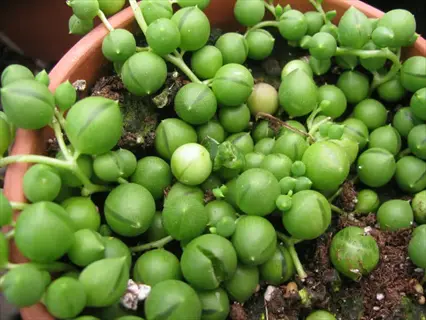
- Botanical name: Curio rowleyanus, formerly classified as Senecio rowleyanus, is the original species with round, pea-sized beads that grow about 1/4 inch (6 mm) in diameter.
- Leaf feature: Each bead has a thin translucent stripe called an epidermal window that allows sunlight to reach the interior of the leaf for more efficient photosynthesis.
- Growth habit: Trailing stems can reach up to 3 feet (91 cm) long and root at every node where they touch soil, creating dense cascading curtains from hanging baskets.
- Flower detail: Produces small white compound flowers about 1/2 inch (1.3 cm) across with bright yellow anthers and a distinctive sweet cinnamon-like fragrance.
- Best display: Looks best in hanging planters or on high shelves where the trailing stems can drape freely and catch bright indirect light from a nearby window.
- Difficulty level: Moderate care difficulty, perfect for growers who have mastered basic succulent watering discipline and want a showpiece trailing plant.
Variegated String of Pearls
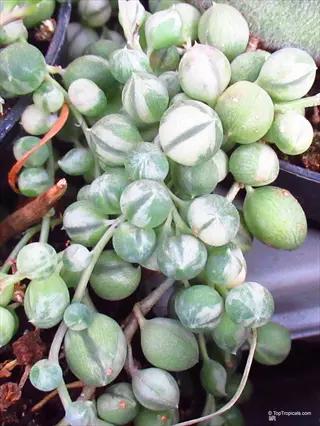
- Botanical name: Curio rowleyanus 'Variegata' features the same spherical beads as the classic but with cream, white, and pale yellow streaks mixed into the green coloring.
- Light needs: Requires more bright indirect light than the solid green form to maintain its variegation, since the lighter patches produce less chlorophyll for energy.
- Growth rate: Grows at a slower pace than the standard variety because the variegated sections photosynthesize at a slower rate, resulting in shorter trailing stems over the same time period.
- Watering note: More sensitive to overwatering than the classic form, so let the soil dry out and use the finger test before watering again.
- Availability: Harder to find and more expensive than the standard variety because variegation must be maintained through careful cutting propagation rather than seed.
- Best for: Collectors and experienced growers who want a unique conversation piece and are confident managing a plant with higher care demands.
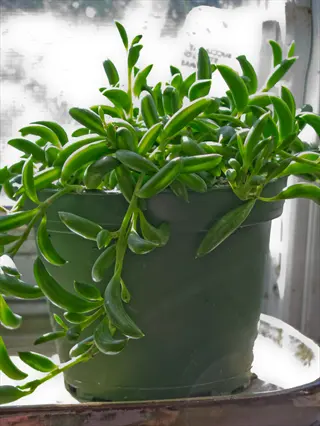
String of Bananas
- Botanical name: Curio radicans produces elongated, curved leaves shaped like small bananas that are about 1/2 inch (1.3 cm) long and a bit larger than classic pearls.
- Growth habit: Trails fast and grows quicker than standard string of pearls, often reaching 3 feet (91 cm) or more with thicker, sturdier stems that resist breakage.
- Light tolerance: Handles more direct sunlight than string of pearls without scorching, making it a good option for brighter south-facing or west-facing windows.
- Watering needs: Follows the same soak-and-dry method as string of pearls, with watering every two to three weeks in summer and once a month in winter.
- Fragrance: Produces small white or lavender flowers with a sweet cinnamon scent similar to string of pearls, though it also blooms more often indoors.
- Best for: Beginners who love the trailing look but want a more forgiving variety that tolerates more light and less precise watering schedules.
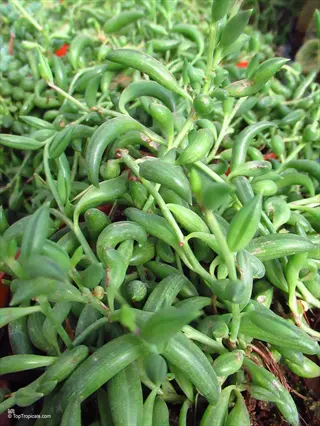
String of Tears
- Botanical name: Curio citriformis (sometimes sold as Senecio citriformis) has teardrop-shaped leaves that taper to a small point, giving a more elongated look than round pearls.
- Leaf size: Each teardrop is a touch larger than a pearl bead, roughly 1/3 inch (8 mm) long, with a visible epidermal window running along the pointed tip.
- Growth habit: Trails a bit shorter than string of pearls, often reaching about 2 feet (61 cm) in length, with a denser, more compact growth pattern overall.
- Color variation: Leaves range from blue-green to grey-green depending on light intensity, developing a slight powdery coating called farina that protects against sun damage.
- Care difference: Tolerates drier conditions and lower humidity than string of pearls, making it a solid choice for homes with dry indoor air from heating systems.
- Best for: Growers who want a subtle twist on the classic string of pearls look with a plant that handles dry indoor environments well.
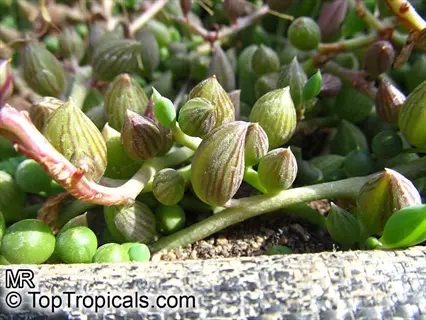
String of Watermelons
- Botanical name: Curio herreanus (formerly Senecio herreanus) has oval beads marked with dark green stripes that resemble tiny watermelons, each about 1/4 inch (6 mm) wide.
- Leaf pattern: The dark longitudinal stripes on each bead are translucent epidermal windows, more pronounced than on classic pearls, creating a striking patterned look.
- Growth habit: Produces shorter trailing stems than string of pearls, often reaching about 2 feet (61 cm), with a tighter clustering of beads along the vine.
- Light preference: Thrives in bright indirect light and shows off its watermelon striping best when it receives about six hours of filtered sunlight each day.
- Watering routine: Follows the same schedule as string of pearls with watering every two to three weeks, but benefits from more frequent watering in very hot weather.
- Best for: Anyone who loves the trailing succulent form but wants a variety with more visual texture and patterning than the smooth, solid-colored classic pearls.
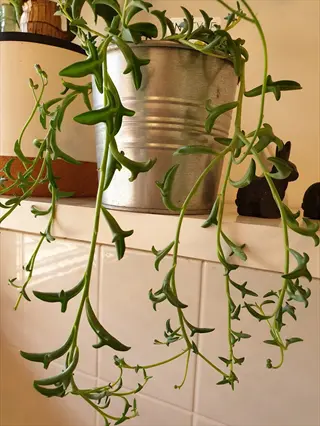
String of Dolphins
- Botanical name: Curio x peregrinus is a hybrid between string of pearls and string of bananas, producing leaves shaped like tiny jumping dolphins with two small fins.
- Leaf shape: Each leaf is about 1/2 inch (1.3 cm) long with a curved body and two small pointed projections that give the unmistakable appearance of a dolphin leaping from water.
- Growth habit: Trails up to 3 feet (91 cm) long with a woodier stem than classic pearls, and the dolphin-shaped leaves pack tight along each trailing vine.
- Light needs: Prefers bright indirect light similar to string of pearls, but the dolphin leaf shape can flatten and lose definition if the plant receives too little light.
- Care difficulty: Harder to find in stores and a bit less drought-tolerant than string of pearls, needing a bit more consistent watering to maintain plump dolphins.
- Best for: Collectors and novelty plant lovers who want a unique conversation starter that combines the charm of two popular trailing Curio species in one hybrid.
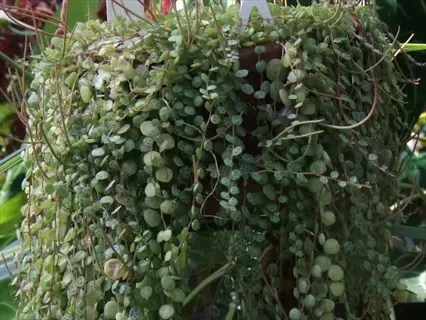
String of Turtles
- Botanical name: Peperomia prostrata is not a Curio species but belongs to the Piperaceae family, yet it is often grouped with string succulents due to its trailing growth habit.
- Leaf pattern: Small round leaves about 1/4 inch (6 mm) across feature intricate vein patterns resembling tiny turtle shells, creating a mosaic-like look along trailing stems.
- Growth habit: Trails at a slower pace and stays shorter than string of pearls, often reaching about 12 inches (30 cm), making it better suited for small pots and terrariums.
- Water needs: Prefers more moisture than true Curio species because it is a tropical plant, not a succulent, so water when the top inch (2.5 cm) of soil feels dry.
- Light preference: Does well in medium to bright indirect light and can handle lower light conditions better than string of pearls, making it more versatile for room placement.
- Best for: Growers who love the trailing string plant look but have lower light conditions or prefer a plant that tolerates more frequent watering.
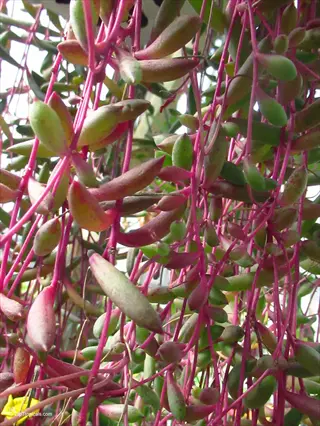
String of Rubies
- Botanical name: Othonna capensis produces small, bean-shaped leaves on long trailing stems that turn deep ruby red or purple when exposed to bright light and cool temperatures.
- Color change: Leaves start green in lower light and shift to vivid red and purple tones under stronger light exposure, making this variety a living color-changing display.
- Growth habit: Trails up to 2 feet (61 cm) long with thin, wiry stems that produce bright yellow daisy-like flowers more often than most other trailing string plants.
- Watering needs: More drought-tolerant than string of pearls and less prone to root rot, making it a more forgiving option for growers who tend to forget watering.
- Temperature note: Cold exposure enhances the ruby coloring, so placing it near a cool window during winter can intensify the red and purple tones for a more dramatic look.
- Best for: Growers who want vibrant color variation in their trailing succulent collection without the higher care demands of variegated string of pearls.
Soil, Pots, and Drainage
Your succulent soil mix can make or break your string of pearls. I lost my first plant because I left it in the dense potting soil it came in from the store. The roots sat in wet soil for days after each watering and turned to mush within 2 months. The ideal ratio for well-draining soil is 1 part organic material to 2 parts mineral like perlite, coarse sand, or pumice.
Think of perlite and pumice like air pockets in a sponge. They create tiny channels in the soil that let extra water drain fast so your roots never sit in moisture. In my experience, you can make your own cactus mix at home with 1 part peat moss, 1 part coarse sand, and 1 part perlite. Or grab a bag of store bought cactus mix and add extra perlite until it feels gritty and loose in your hand.
The best pot for string of pearls is a terracotta pot with drainage holes at the bottom. Terracotta wicks moisture out through its walls, which helps the soil dry faster between waterings. I've switched all my string plants to terracotta and the difference in root health is obvious. Plastic pots trap moisture and raise the risk of root rot, so save those for your tropical plants instead. As Iowa State's Aaron Steil puts it, gravel at the bottom of a pot is not a substitute for drainage holes.
Pick a wide, short pot rather than a deep one for your string of pearls. The roots stay near the surface and a deep pot holds too much wet soil at the bottom where the roots can't reach it. A pot that is 1 to 2 inches wider than the root ball gives enough room to grow without keeping extra damp soil around the edges.
Seasonal Care Calendar
Your string of pearls seasonal care changes with each part of the year. I've found that adjusting your watering schedule and light to the growing season keeps those beads fat and green. This calendar breaks down what to do each season so you can bookmark it and check back when the months change.
The biggest mistake I see people make is treating their plant the same in January as in July. Your string of pearls goes through winter dormancy from late fall through early spring. It needs far less water and zero string of pearls fertilizer during that rest. Getting the string of pearls temperature right each season helps your plant push out strong new growth when spring returns.
Spring (March to May)
- Watering: Increase watering frequency to every two to three weeks as the plant exits winter dormancy and begins actively growing new stems and beads.
- Feeding: Start fertilizing with a balanced liquid fertilizer diluted to one quarter strength, applying once a month from March through May.
- Light: Move the plant to a brighter spot or closer to a window as daylight hours increase, aiming for six to eight hours of bright indirect light daily.
- Repotting: Spring is the ideal time to repot if roots are circling the pot or growth has stalled, using fresh cactus mix in a pot one size larger.
Summer (June to August)
- Watering: Continue watering every two to three weeks using the soak-and-dry method, increasing slightly during heat waves when soil dries faster than usual.
- Feeding: Maintain monthly fertilizing at one quarter to one half strength through August, then stop feeding by early September to prepare for dormancy.
- Light: Protect from harsh direct afternoon sun by using a sheer curtain or moving the plant a foot (30 cm) back from south-facing or west-facing windows.
- Propagation: Take stem cuttings in early summer when the plant is growing vigorously, as cuttings root fastest during the warmest months of the year.
Fall (September to November)
- Watering: Reduce watering to once every three to four weeks as growth slows and the plant transitions toward its winter rest period.
- Temperature: Bring outdoor plants inside before the first frost when nighttime temperatures drop below 50°F (10°C) to prevent cold damage.
- Light: Reposition the plant to catch maximum available light as daylight hours shorten, considering an east-facing or south-facing window for winter placement.
- Pruning: Trim any leggy or bare stems in early fall and use the healthy cuttings for propagation before the plant enters dormancy.
Winter (December to February)
- Watering: Reduce to once a month or less, letting the soil dry out between waterings since overwatering during dormancy is the most common cause of winter root rot.
- Temperature: Keep the plant in a cool room at 55 to 60°F (13 to 16°C) if possible, as this cold rest period can trigger cinnamon-scented flowers the following summer.
- Light: Provide the brightest indirect light available or supplement with a grow light placed 6 to 12 inches (15 to 30 cm) above the plant for 12 to 14 hours per day.
- Avoid: Do not fertilize, repot, or take cuttings during winter dormancy since the plant is not growing and cannot recover from stress as fast.
Propagation Methods
String of pearls propagation isn't just a fun project. It's a must. Your plant has a natural lifespan of 3 to 5 years before it starts to fade and thin out. NC State Extension confirms that plants tend to die back over time. Taking stem cuttings every couple of years keeps your collection alive for decades.
I tested all 4 methods below on the same mother plant last spring to see which one gave the best results. In my experience, soil propagation and layering beat water propagation for long term root strength. Using rooting hormone on the cut end is optional but it can speed things up by about a week. Each method uses 3 to 4 inch stem tip cuttings that root at the nodes in about 3 to 4 weeks.
Soil Propagation
- How it works: Cut a healthy 3 to 4 inch (8 to 10 cm) stem tip, remove the bottom few beads to expose the nodes, let the cut end dry for 24 hours to form a callus, and press the nodes into moist cactus soil.
- Timeline: Roots typically appear at the nodes within three to four weeks when kept in bright indirect light with soil lightly misted every few days to maintain slight moisture.
- Success rate: Soil propagation has the highest success rate for string of pearls because the nodes root directly into their permanent growing medium without transplant shock.
- Pro tip: Dipping the cut end in rooting hormone powder before planting can speed up root development by about a week, though it is optional and not required for success.
Water Propagation
- How it works: Place a 3 to 4 inch (8 to 10 cm) cutting with the bottom beads removed into a small jar of room-temperature water, submerging only the stripped nodes while keeping the beads above water.
- Timeline: Roots become visible in about two to three weeks, and the cutting is ready to transfer to soil once roots reach roughly 1 inch (2.5 cm) in length.
- Advantage: Lets you watch root development in real time, which is helpful for beginners who want visible confirmation that propagation is working before committing to soil.
- Caution: Change the water every three to four days to prevent bacterial buildup, and transition to soil promptly because prolonged water rooting produces weaker roots that struggle in potting mix.
Stem Layering
- How it works: Coil a long trailing stem back onto the surface of the mother plant's pot (or a new pot of moist cactus soil) and pin the nodes against the soil using small U-shaped wire clips.
- Timeline: Roots develop at the pinned nodes within two to four weeks, after which you can cut the new section free from the mother plant to create an independent plant.
- Advantage: The cutting stays attached to the mother plant during rooting, receiving water and nutrients the whole time, which gives it the highest survival rate of any propagation method.
- Best use: Ideal for filling in bare spots at the top of the pot where older growth has thinned out, creating a fuller, denser plant appearance without waiting for a separate cutting to establish.
Division During Repotting
- How it works: When repotting a mature plant, separate the root ball into two or more sections, each with several healthy trailing stems attached, and plant each section into its own pot with fresh cactus soil.
- Timeline: Divided sections already have established roots, so they recover within one to two weeks and resume normal growth much faster than cuttings that need to develop roots from scratch.
- Advantage: Division gives you multiple established plants right away with no rooting wait period, making it the fastest way to multiply your collection from a single healthy mother plant.
- Best use: Works best on mature plants that have become crowded in their pot, allowing you to refresh the soil and give each section more room to grow while doubling or tripling your plant count.
Troubleshooting Problems
String of pearls troubleshooting starts with one key question: is the problem too much water or too little? NC State Extension calls this plant very picky about its conditions. The tricky part is that overwatering signs and underwatering both cause wilting. In my experience, the table below helps you match what you see on your plant to the right cause and fix.
I get asked about string of pearls dying more than any other succulent topic. The secret to a fast diagnosis is squeezing a bead between your fingers. If it feels soft and squishy, you have an overwatering problem. If it feels firm but wrinkled, your plant needs a drink. Shriveled leaves and yellowing leaves are two of the most common warning signs, and the fix depends on which problem you're dealing with.
Root rot symptoms deserve special attention because they're the leading cause of death for this plant. If you spot brown mushy stems at the soil line, act fast. Cut all healthy green stems above the rot, let them dry for a day, and stick them in fresh dry cactus mix. You can save most of the plant this way even if the roots are gone.
Pests and Treatment
String of pearls pests can sneak up on you if you don't check your plant on a regular basis. I make it a habit to look over my plants every time I water, and that simple routine has caught problems before they spread. NC State lists 5 pest types that target this plant: aphids, whiteflies, fungus gnats, ants, and mealybugs. Spider mites are another common threat that Iowa State flags for indoor succulents.
The best defense against all these pests is good airflow around your plant and a proper watering routine. Wet soil invites fungus gnats and creates the damp conditions where mealybugs thrive. Below you'll find each pest with clear signs to look for and the best treatment options, including neem oil and insecticidal soap.
Mealybugs
- Identification: Small white cottony masses that cluster at stem joints, leaf bases, and the underside of beads, often mistaken for mold or mineral deposits from watering.
- Damage: Mealybugs suck sap from stems and leaves, causing yellowing, stunted growth, and a sticky residue called honeydew that attracts ants and promotes sooty mold.
- Treatment: Dip a cotton swab in 70% rubbing alcohol and dab each visible mealybug, then follow up with a neem oil spray covering all stems and beads.
- Prevention: Inspect new plants for white cottony spots before bringing them near your collection, and maintain good airflow around the plant to discourage infestations.
Aphids
- Identification: Tiny soft insects about 1/8 inch (3 mm) in green, black, or white clusters found on new growth tips and the undersides of beads near stem joints.
- Damage: Aphids drain plant sap from tender new growth, causing curled or distorted beads and stems, and they excrete honeydew that leads to sooty mold on leaves.
- Treatment: Spray the plant with a strong stream of water to knock off aphids, then apply insecticidal soap or neem oil every 5 to 7 days until the problem clears.
- Prevention: Keep the plant healthy with proper light and watering since stressed plants attract aphids more, and remove any infested stems by pruning.
Fungus Gnats
- Identification: Tiny dark flying insects about 1/8 inch (3 mm) hovering around the soil surface, most active when you water or disturb the pot, with larvae living in the top layer of soil.
- Damage: Adult gnats are a nuisance, but their larvae feed on organic matter and fine roots in the soil, which can weaken young or stressed string of pearls plants.
- Treatment: Let the soil dry out between waterings to kill larvae, and place yellow sticky traps near the pot to catch adults before they can lay more eggs.
- Prevention: Use a mineral-heavy soil mix with the 1:2 organic to mineral ratio and avoid letting saucers collect standing water under the pot.
Spider Mites
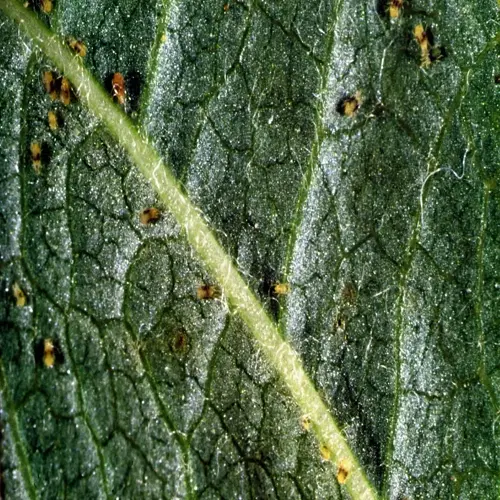
- Identification: Almost invisible reddish-brown or translucent specks on the undersides of beads, often first noticed by the fine webbing they spin between stems and leaves.
- Damage: Spider mites pierce cells to feed on sap, causing small yellow or brown dots on beads that can lead to dried out, shriveled leaves over time.
- Treatment: Wipe stems and beads with a damp cloth to remove mites and webbing, then spray with insecticidal soap or neem oil every 5 to 7 days for 3 weeks.
- Prevention: Spider mites thrive in hot dry conditions, so keeping moderate humidity around the plant and good air flow discourages them from moving in.
5 Common Myths
You need to mist string of pearls regularly to keep the beads plump and prevent them from shriveling up.
Misting increases humidity around the crown and soil surface, which promotes fungal growth and crown rot rather than helping the plant.
A gravel layer at the bottom of the pot provides enough drainage so you do not need drainage holes.
Gravel layers create a perched water table that actually keeps roots wetter. Drainage holes are essential and gravel is not a substitute.
String of pearls is a desert cactus that thrives in full direct sunlight all day long without any shade.
String of pearls grows under bushes and between rocks in its native South African habitat and prefers bright indirect light, not harsh direct sun.
If your string of pearls looks wilted and droopy, the best response is to give it a thorough deep watering immediately.
Wilting can signal either overwatering or underwatering. Check soil moisture first because adding water to already soggy soil worsens root rot.
String of pearls plants live forever as long as you care for them properly and never need to be replaced.
String of pearls naturally declines after three to five years. Propagating stem cuttings every couple of years is the best way to keep the plant going.
Conclusion
String of pearls care boils down to 3 simple habits. Give it 6 to 8 hours of bright indirect light each day. Water every 2 to 3 weeks using the soak and dry method. Plant it in fast draining soil inside a pot with drainage holes. Those 3 steps handle root rot prevention before it ever starts.
In my experience, overwatering kills more of these plants than anything else. Wisconsin Extension backs this up and calls root rot the leading cause of death. A terracotta pot with the right succulent care routine does most of the work for you. Once you stop giving it too much water, your trailing succulent will reward you with thick green strands.
Start with the classic green variety if you're new to this plant. It's the most forgiving and teaches you the watering rhythm that all the string varieties need. Once you feel good about the basics, try a string of dolphins or bananas for more fun on your shelf.
Take a few stem cuttings every year or two for propagation. This isn't just a fun hobby. It's how you keep the plant going since it fades after 3 to 5 years on its own. A fresh cutting rooted in spring grows strong while the older plant slows down. That one simple step means you'll always have a healthy string of pearls on display.
External Sources
Frequently Asked Questions
How do you take care of a string of pearls?
Provide bright indirect light for six to eight hours, water every two to three weeks when soil is fully dry, use well-draining cactus soil in a terracotta pot with drainage holes, and fertilize at quarter strength during spring and summer.
How often should you water a string of pearls?
Water every two to three weeks during the growing season and once a month in winter, allowing soil to dry completely between waterings.
Does string of pearls need direct sunlight?
String of pearls thrives in bright indirect light and tolerates a few hours of gentle morning sun, but direct afternoon sunlight can scorch the leaves.
Is string of pearls a good indoor plant?
Yes, string of pearls grows well indoors near a bright east-facing or south-facing window, making it a popular trailing houseplant for shelves and hanging baskets.
How long do strings of pearls last?
String of pearls typically lives three to five years before naturally declining, but regular propagation from cuttings lets you keep the plant going indefinitely.
How hard is it to keep a String of Pearls alive?
String of pearls is moderately challenging because overwatering quickly causes root rot, but once you master the soak-and-dry watering method it becomes straightforward.
How long can strings of pearls go without water?
Healthy string of pearls can survive two to three weeks without water in the growing season, and up to four weeks during winter dormancy thanks to water stored in their bead-shaped leaves.
How long does a String of Pearls take to root?
Stem cuttings typically develop roots in three to four weeks when placed on moist, well-draining soil in bright indirect light.
What are some common mistakes beginners make when caring for succulents?
The most common mistakes include overwatering, using soil that retains too much moisture, placing pots without drainage holes, and giving too little light.
What to feed a String of Pearls plant?
Feed with a balanced liquid fertilizer diluted to one quarter of the recommended strength, applied only during spring and summer.