

Introduction
Millions of people fight creeping charlie in their yards each year. What most folks don't know is that settlers brought this invasive lawn weed to America on purpose in 1672. They used ground ivy to flavor beer and treat common ailments. Now this mint family plant, Glechoma hederacea, has spread across 46 states.
I've spent over a decade working on lawns taken over by this weed. Think of it as an uninvited houseguest who brought a sleeping bag and won't leave. It roots in at every spot where its stems touch dirt. The Invasive Plant Atlas lists it in at least 7 National Parks and calls it invasive in over 14 states across the country.
Most guides out there tell you one thing: how to kill it. This guide goes much further than that. You'll learn why it's so hard to remove and which control methods work best. You'll also learn about its history as a brewing herb and research backing its antioxidant power.
Small patch or full yard takeover, the sections below give you what you need. You'll get tips on how to identify, control, and prevent this weed from taking over your lawn.
How to Identify Creeping Charlie
Proper creeping charlie identification starts with knowing what to look for in your yard. I've seen dozens of homeowners pull the wrong weed by mistake. This plant goes by over 8 names like alehoof, cat's foot, field balm, and runaway robin. All those names make it tough to find good info online.
The quickest test is the crush and smell method. Pick a leaf and crush it between your fingers. If you get a strong mint smell, you're dealing with a member of the Lamiaceae family. No other common lawn weed gives off that same scent.
Next check the stems and leaves. Creeping charlie has square stems you can feel by rolling one between your thumb and finger. The kidney-shaped leaves have scalloped leaves that grow in pairs on each side of the stem. Most leaves measure 0.8 to 1.2 inches across. Blue-violet flowers show up from March through July at the leaf joints.
One thing most guides won't tell you is that this plant fights dirty. It releases chemicals into the soil that hold back the growth of nearby plants. This trick gives it a big edge over your grass and makes bare spots spread faster around each patch.
Leaves and Shape
- Shape: Leaves are round to kidney-shaped with scalloped or crenate edges, growing opposite each other on the stem in matched pairs.
- Size: Each leaf measures 0.8 to 1.2 inches (2 to 3 cm) across, though leaves can reach up to 3 inches (7.6 cm) in rich moist soil conditions.
- Color: Bright green on top with a slightly purple tint on the underside, remaining evergreen through winter in many regions.
Stems and Growth Habit
- Structure: Stems are distinctly square or four-angled, a defining trait of the mint family that you can feel by rolling a stem between your fingers.
- Spread: Long horizontal stolons creep along the soil surface and root at every node, allowing one plant to cover several feet in a single season.
- Texture: Stems may have fine hairs and feel slightly rough, with new growth emerging bright green before darkening with age.
Flowers and Seeds
- Appearance: Small funnel-shaped flowers are blue-violet to lavender, appearing in clusters of two to three at leaf joints from March through July.
- Size: Each flower measures roughly 0.4 inches (0.9 cm) long with a two-lipped tubular shape that attracts long-tongued bees and other pollinators.
- Seeds: Each flower produces four flat egg-shaped seeds called nutlets, though the plant spreads far more aggressively through its stolons and rhizomes.
Root System and Smell
- Roots: A fibrous root system develops at every node where stolons contact the soil, plus underground rhizomes that allow regrowth even after surface stems are removed.
- Smell: Crushing any leaf or stem releases a strong minty or slightly pungent aroma, which is the most reliable quick identification test in the field.
- Persistence: The combination of stolon fragments, rhizome pieces, and seeds means this plant can regenerate from even small pieces left behind during removal.
6 Look-Alike Plants Compared
Getting the ID wrong wastes your time and money on the wrong treatment. I've seen homeowners spray for creeping charlie when they had henbit in their yard. These creeping charlie look-alikes share some traits but each one has a quick tell that sets it apart.
The 6 plants below are the ones you'll confuse with creeping charlie the most. I'll walk you through the creeping charlie vs henbit difference first. Then you'll learn how to spot purple dead nettle, wild violet, common mallow, heal-all, and creeping Jenny.

Henbit
- Key Difference: Henbit has triangular upper leaves that clasp directly around the stem without a leaf stalk, while creeping charlie leaves always grow on long petioles.
- Growth Habit: Henbit is a winter annual that dies in summer heat, unlike creeping charlie which is a perennial that persists year after year through stolons.
- Stems: Both have square stems as members of the mint family, but henbit grows upright to 16 inches (40 cm) tall rather than creeping along the ground.
- Flowers: Henbit flowers are pink to purple and emerge from the upper leaf axils in a more tubular shape, compared to the blue-violet funnel-shaped blooms of creeping charlie.
- Leaves: Henbit leaves have deeper, more rounded lobes and a coarser texture, while creeping charlie leaves are smoother with soft scalloped edges.
- Control: Since henbit is an annual weed, it responds to pre-emergent herbicides applied in early fall, which do not work against perennial creeping charlie.
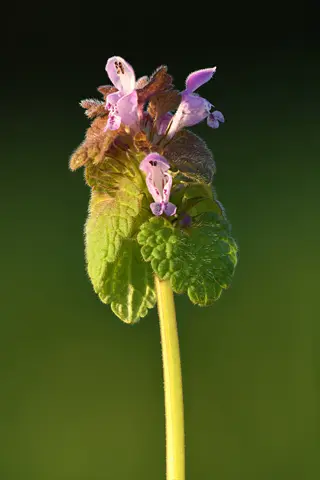
Purple Dead Nettle
- Key Difference: Purple dead nettle has triangular, pointed leaves that become purplish-red near the top of the plant, while creeping charlie leaves stay round and green.
- Growth Habit: Purple dead nettle grows upright in a compact cluster reaching 6 to 12 inches (15 to 30 cm) tall, while creeping charlie sprawls flat along the ground.
- Stems: Both share square stems from the mint family, but purple dead nettle stems are more hairy and grow in a more vertical pattern.
- Flowers: Pink to purple tubular flowers appear at the top of the plant among the colored upper leaves, creating a layered appearance unlike creeping charlie.
- Season: Purple dead nettle is a winter annual that germinates in fall and dies by early summer, so it dies off when hot weather arrives.
- Confusion Factor: The purple coloring of the upper leaves is the quickest way to distinguish it from creeping charlie, which never develops purple foliage.
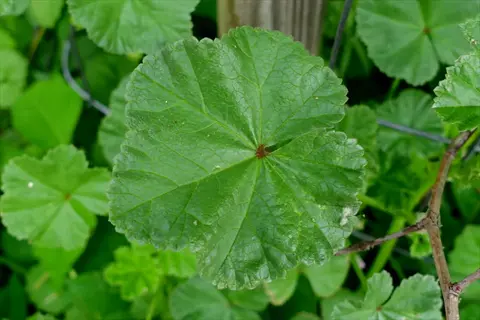
Common Mallow
- Key Difference: Common mallow leaves have five to seven distinct lobes radiating from the center like a palm, while creeping charlie leaves are round with gentle scalloped edges.
- Growth Habit: Common mallow grows from a deep taproot and can reach 6 to 24 inches (15 to 61 cm) tall with a branching habit, unlike the flat mat-forming growth of creeping charlie.
- Stems: Mallow stems are round in cross-section and sometimes hairy, providing a clear contrast to the square stems of creeping charlie.
- Flowers: Common mallow produces white to pale lavender five-petaled flowers that look nothing like the tubular blue-violet blooms of creeping charlie.
- Leaves: Mallow leaves are much larger, typically 2 to 4 inches (5 to 10 cm) across, with a wavy rather than scalloped margin and a rougher texture.
- Smell Test: Crushing a mallow leaf produces no minty scent, which is the fastest field test to rule out creeping charlie in seconds.
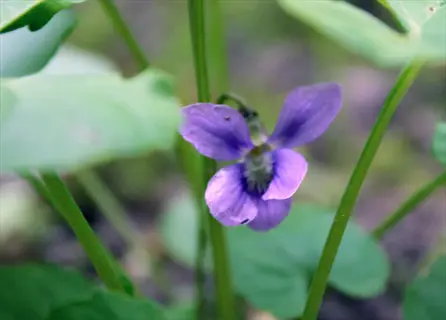
Wild Violet
- Key Difference: Wild violet leaves are heart-shaped with smooth edges and a pointed tip, while creeping charlie leaves are round to kidney-shaped with scalloped edges.
- Growth Habit: Wild violets grow in rosette clusters from a thick rhizome system, not as a creeping mat with visible above-ground stolons like creeping charlie.
- Stems: Wild violet leaf stalks are round, not square, and emerge straight from the soil rather than from horizontal creeping stems.
- Flowers: Violet flowers are larger and more showy with five distinct petals, appearing in shades of blue, purple, or white, blooming most often in spring.
- Texture: Wild violet leaves feel thicker and more waxy compared to the thinner, slightly rough leaves of creeping charlie.
- Control Difficulty: Wild violets are also very persistent in lawns and resist many common broadleaf herbicides, requiring triclopyr-based products similar to creeping charlie treatment.
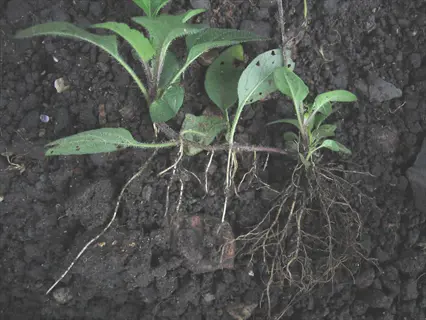
Heal-All
- Key Difference: Heal-all produces dense cylindrical flower spikes at the stem tips that look like small purple pinecones, which creeping charlie never produces.
- Growth Habit: Heal-all can creep along the ground like creeping charlie but also sends up flowering stems 6 to 12 inches (15 to 30 cm) tall during bloom.
- Stems: Both plants have square stems, but heal-all stems tend to be thicker and more erect when the plant is in bloom during summer.
- Leaves: Heal-all leaves are more elongated and lance-shaped with smooth or small toothed edges, unlike the round scalloped leaves of creeping charlie.
- Family Connection: Both belong to the mint family Lamiaceae, which explains the square stems and opposite leaf arrangement that cause initial confusion.
- Season: Heal-all blooms from June through September, later than creeping charlie, and its distinctive flower heads make identification straightforward during bloom.
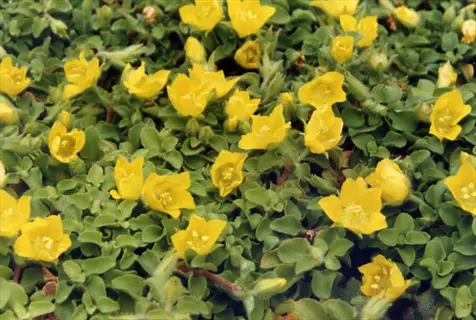
Creeping Jenny
- Key Difference: Creeping Jenny has round, coin-shaped leaves arranged opposite on round stems, while creeping charlie has scalloped kidney-shaped leaves on square stems.
- Growth Habit: Both plants form low-growing mats along the ground, but creeping Jenny is sold as an ornamental groundcover and is not related to the mint family.
- Stems: Creeping Jenny stems are smooth and round in cross-section, making the finger-roll test an instant way to distinguish it from the square-stemmed creeping charlie.
- Flowers: Creeping Jenny produces bright yellow cup-shaped flowers, a dramatic contrast to the blue-violet blooms of creeping charlie.
- Color: The foliage of creeping Jenny, like the popular golden variety, tends toward chartreuse or yellow-green rather than the darker green of creeping charlie.
- Uses: Unlike creeping charlie, creeping Jenny is sold at garden centers all over as a ground cover for moist areas and is planted on purpose in many landscape designs.
How to Remove Creeping Charlie
Knowing how to get rid of creeping charlie starts with honest goals. Doug Soldat of UW Madison says creeping charlie control takes real work. It's often not 100% successful. In my years of lawn care, the homeowners who win this fight treat it as a process and not a one time event.
Start small if you can. For patches under 10 square feet, hand pulling works when you trace every stolon to its end. Bigger areas call for smothering with black plastic. Use a postemergence herbicide on bigger areas for faster results.
Triclopyr is the top pick for a fall herbicide application on this weed. Apply it when temps sit between 65 and 80°F for the best uptake. Mid August to mid September works best since the plant moves energy into its roots. A second spray 2 weeks later catches what the first round missed.
You can remove creeping charlie for good with the right plan. The table below breaks down your herbicide options so you can pick the right product for your yard.
Natural and Organic Control
If you want natural ways to kill creeping charlie without harsh sprays, you have a few solid options. I tested most of these non-chemical control methods on my own lawn over 3 full summers. Iron chelate and solarization gave me the best results for organic weed control.
One big warning before you start: skip the borax for creeping charlie trick you'll find all over the internet. UW and Iowa State research both found that borax doesn't work well and can poison your soil for years with toxic boron levels. Fe-HEDTA iron chelate products are a much safer and more effective choice.
Science may bring more help in the future. A rust fungus called Puccinia glechomatis showed up in Syracuse, New York in 1998. It now lives in 46 of 48 lower states and attacks creeping charlie without harming other plants. Researchers are still looking at it as a long term option.
Iron Chelate Products (Fe-HEDTA)
- How It Works: Iron chelate overloads broadleaf weeds with iron, causing them to turn dark brown and die within days while most turfgrasses remain unharmed.
- Application: Apply liquid iron chelate products to creeping charlie foliage during active growth when temperatures are between 65 and 80°F (18 to 27°C).
- Advantage: Classified as a non-synthetic option, making it suitable for lawns where you want to avoid traditional herbicides around children and pets.
Solarization with Black Plastic
- How It Works: Covering creeping charlie with black plastic sheeting for 4 to 6 weeks during summer heat deprives the plant of light and raises soil temperature enough to kill roots.
- Best For: This method works best on defined patches where you can anchor the plastic edges with rocks or landscape staples to prevent wind from lifting it.
- Drawback: Solarization kills everything underneath including turfgrass, so you will need to reseed or resod the treated area after removing the plastic.
Hand Removal Technique
- How It Works: Use a dethatching rake or your hands to loosen and lift the entire network of stolons before pulling them from the soil, following every runner to its end.
- Critical Detail: You must remove every stolon fragment and root node because creeping charlie can regenerate from even a small piece of stem left behind in the soil.
- Best For: Small patches under 10 square feet where you can trace and remove the entire connected network of stems.
Why Borax Does Not Work
- Research Findings: Studies at both the University of Wisconsin and Iowa State found that borax treatments are not effective at killing creeping charlie in lawn settings.
- Soil Damage Risk: Boron from borax builds up in the soil and does not break down, meaning repeated use can raise boron to levels toxic to all plants for good.
- Better Alternative: Instead of borax, use iron chelate products which target broadleaf weeds without the risk of long term soil damage to your yard.
Prevention and Lawn Health
The best creeping charlie prevention plan starts before you ever see a single leaf show up. I tell every client the same thing: thick healthy turf is your number one defense. UW Extension backs this up. Dense grass blocks the light and space that this weed needs to get started.
Your mowing height matters more than most people think. Set your mower to 3 inches or taller and you shade the soil enough to stop stolons from rooting. Overseed thin spots with shade-tolerant turfgrass each fall to fill in gaps. Every bare patch is an open door for creeping charlie.
Good lawn maintenance goes beyond just mowing and watering. Test your soil every 2 to 3 years and fix any drainage problems you find. Prune tree branches to let more sunlight reach your turf. In my experience, a seasonal plan gives you the best shot at keeping this weed out. Here's how to prevent creeping charlie all year long.
History and Medicinal Uses
The creeping charlie history most people miss is that this weed was once a prized plant. In my years of studying lawn weeds, this one has the best back story. European settlers brought ground ivy to New England in 1672. They called it alehoof and used it in beer brewing before hops took over. It was also a go to plant in traditional herbal medicine.
You might be shocked to learn about ground ivy medicinal uses. Healers made tea from the leaves to treat breathing problems, stomach issues, and joint pain. The plant served as a source of vitamin C when fresh produce was hard to find. Modern lab studies now back up some of those old claims with real data.
Here's what surprised me most when I dug into the research. A 2023 study found 177.64 milligrams per gram of phenolic acids in ground ivy extract. The key compound is rosmarinic acid. Its antioxidant power beat vitamin E analogs by 14.01% in lab tests. Your weed is full of useful stuff.
European Origins and Beer Brewing
- Before Hops: For centuries in Europe, ground ivy was the main bittering agent used to flavor and preserve beer, earning the plant its common name alehoof.
- Introduction: European settlers brought creeping charlie to New England as early as 1672, valuing it as both a useful brewing herb and a groundcover for shady areas.
- Transition: Once hops became the standard brewing ingredient in the 1600s and 1700s, creeping charlie lost its value and began spreading unchecked across the continent.
Traditional Medicine Applications
- Historical Uses: European and early American herbalists used ground ivy tea to treat breathing conditions, digestive problems, skin issues, headaches, and joint pain.
- Vitamin Content: The plant was valued as a source of vitamin C during periods when fresh produce was scarce, though modern analysis shows modest vitamin levels.
- Safety Note: While people consumed it as tea for ages, modern research notes that large amounts can be toxic to horses and may cause liver and kidney issues in animals.
Modern Phytochemical Research
- Antioxidant Power: A 2023 study in Nutrients found total phenolic acids of 177.64 milligrams per gram and total flavonoids of 115.8 milligrams per gram in ground ivy extract.
- DNA Protection: Researchers at the University of Zagreb found that ground ivy extract preserved 95.89% of supercoiled DNA against hydroxyl radical damage at 0.25 milligrams per milliliter.
- Antimicrobial Activity: The same 2023 study showed effects against both E. coli and S. aureus at all tested levels, plus a prebiotic effect on good bacteria.
Key Compounds Identified
- Rosmarinic Acid: The dominant phenolic compound at 63.72 milligrams per gram, rosmarinic acid drives much of the antioxidant and anti-inflammatory activity seen in lab tests.
- Apigenin: This flavonoid was identified as a major factor in the plant's ability to reduce protein damage by about 50% compared to controls.
- Practical Note: All current research is based on lab studies using concentrated extracts, and no clinical trials have confirmed these benefits in human subjects yet.
5 Common Myths
Borax is an effective natural remedy for killing creeping charlie in your lawn.
University of Wisconsin and Iowa State research found that borax treatments are typically not effective and can permanently damage soil by accumulating toxic levels of boron.
Creeping charlie only grows in shady areas and will not survive in sunny spots.
While creeping charlie prefers partial shade and moist conditions, it thrives in USDA Hardiness Zones 3a through 10b and can establish in full sun when soil stays moist.
Mowing your lawn shorter will help get rid of creeping charlie by cutting its stems.
Mowing short actually weakens your turfgrass and gives creeping charlie less competition, since it grows as a low-creeping mat under most mowing heights.
One thorough herbicide application in spring is enough to kill creeping charlie for good.
Multiple herbicide applications are typically needed because creeping charlie regrows from stolon and rhizome fragments, and fall applications are more effective than spring treatments.
Creeping charlie is purely a nuisance weed with no useful qualities whatsoever.
Creeping charlie provides essential early spring nectar for pollinators, has documented antioxidant and antimicrobial properties, and was historically used in beer brewing before hops.
Conclusion
Beating creeping charlie takes more than one tool in your shed. You need proper ID skills, realistic goals for removal, strong prevention habits, and respect for what this plant can do. Ground ivy control works best when you attack the problem from all sides at once.
Your most powerful move is a triclopyr herbicide sprayed in mid fall when temps stay between 65 and 80°F. Pair that with year round lawn weed management and you give your grass the best shot at winning. Keep your mower set high, overseed bare spots each fall, and test your soil on a regular basis. Creeping charlie prevention is an ongoing job, not a one time fix.
Don't forget the other side of this story. In my experience, even the worst weeds have a silver lining. Creeping charlie feeds bees in early spring when few other flowers bloom. The 2023 research proves it holds real antioxidant and germ fighting traits. This weed has earned some respect even if you don't want it around.
Looking ahead, the Puccinia glechomatis rust fungus could change the game for you. This natural enemy now lives in 46 states and targets creeping charlie without harming your lawn. Until then, stick with the steps in this guide and you'll keep this tough weed under control.
External Sources
Frequently Asked Questions
Is creeping Charlie harmful?
Creeping charlie is not harmful to humans through casual contact, but it is toxic to horses in large quantities and aggressively crowds out desirable lawn grasses and native plants.
Should I pull creeping Charlie?
Hand-pulling can help manage small patches, but you must remove every stolon fragment or the plant will regrow from leftover nodes.
What are the benefits of creeping Charlie?
Creeping charlie provides early spring nectar for pollinators, has documented antioxidant properties, and was historically used in brewing and herbal medicine.
Is creeping Charlie the same as ground ivy?
Yes, creeping charlie and ground ivy are the same plant, Glechoma hederacea, with over eight common names including alehoof and gill-over-the-ground.
What is the best creeping Charlie killer?
Triclopyr-based postemergence herbicides applied in mid-fall when temperatures are between 65 and 80 degrees Fahrenheit are the most effective option.
Can creeping Charlie take over a yard?
Yes, creeping charlie can take over an entire yard because it spreads through stolons that root at every node, produces rhizomes underground, and drops seeds that remain viable in soil for years.
Does creeping Charlie give you a rash?
Creeping charlie does not typically cause skin rashes in most people, though individuals with plant sensitivities may experience mild irritation from handling it.
Is creeping Charlie fast growing?
Creeping charlie grows rapidly through stolons that root at every node, and a single plant can spread several feet in one growing season.
What is the most invasive ground cover?
Creeping charlie ranks among the most invasive ground covers in North America, present in 46 states and listed as invasive by organizations in over 14 states.
What looks like creeping Charlie but isn't?
Henbit, purple dead nettle, common mallow, wild violet, heal-all, and creeping Jenny are frequently confused with creeping charlie.