Tree · Pinaceae
Eastern White Pine
Pinus strobus
Tall, soft, and fast-growing, eastern white pine builds a graceful evergreen backbone when you give it room and acidic ground.
Full sun
Every 7–14 days
USDA 3–8
50–80 ft · 15.2–24.4 m
Overview
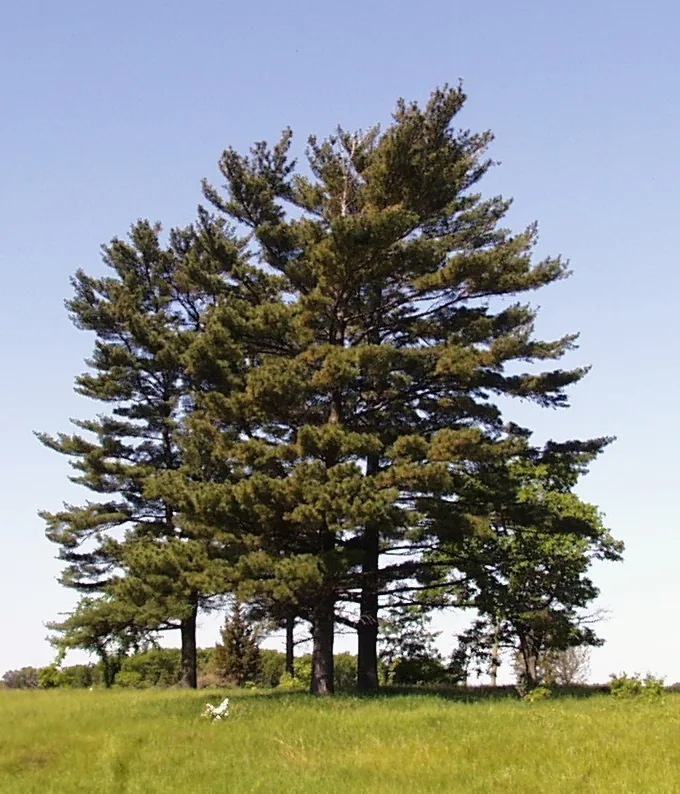
Eastern white pine is the tall, soft-needled conifer of the northern woods, the one with bluish-green needles in bundles of five that catch the wind with a quiet hush. It grows fast and lives long, often reaching well over 100 feet given the centuries to do it. As a landscape tree it works as a screen, a windbreak, or a single specimen with a lot of presence.
It wants moist, acidic, well-drained soil and a spot with full sun to a little shade. The roots dislike heavy, wet, or compacted ground, and the tree resents road salt and dirty air, so a clean rural or open suburban site suits it best. Hardy from zone 3 to zone 8, it shrugs off cold down to -40°F (-40°C).
Two things shape how you grow it: the soft wood breaks in storms and ice, and the leader is a target for pests and disease. Plant it well away from buildings, walks, and roads, give the roots room to spread, and most of the rest takes care of itself.
Care
The short version: full sun to part shade, in moist, acidic, well-drained soil, with steady water while the tree is young and plenty of open room away from salt and roads.
Light
Eastern white pine grows best in full sun but takes partial shade without complaint, holding an open, layered crown either way. Deep shade thins it out and weakens the form, so give it plenty of sky.
Water
Keep young trees in steadily moist, well-drained soil and water them through dry spells while the roots take hold. Once established, the tree handles drought fairly well, though it will not forgive wet, compacted, or poorly drained ground. Plan to water roughly every 7 to 14 days early on, adjusting to the weather.
Soil
This pine wants moist, fertile, acidic loam or sandy soil that drains freely. A pH of 4.5 to 6.0 suits it, well on the acidic side, and the roots suffer in heavy or alkaline ground.
Temperature
It is tough across a wide range, from -40°F to 95°F (-40°C to 35°C), which carries it through zones 3 to 8. Brutal cold is no problem, but combined heat and drought on a poor site will stress it.
Humidity
Ordinary outdoor humidity is all it needs, so there's no figure to hit. Good air movement matters more, since still, damp air around the needles helps blister rust and other fungi get going.
Feeding
An established tree on good native soil rarely needs feeding at all. Only if growth is poor should you add a balanced or slow-release acidic tree fertilizer in spring, and even then sparingly.
Pruning
Keep pruning light, working in late winter to cut out dead, damaged, or weevil-killed leaders and to train a single central leader. Skip heavy shearing, which spoils the natural layered shape.
Repotting
not applicable as a landscape tree
Size & spacing
This is a very large tree, running roughly 50 to 80 feet (15 to 24 m) tall and spreading 20 to 40 feet (6 to 12 m) wide, with old specimens topping 100 feet. Give it that full footprint and keep it clear of buildings, walks, and roads.
When to plant
There's no flowering season to chase with a conifer, so timing is about getting the tree in the ground. Plant in spring or fall while the soil is cool and damp, and start seed from a cold-stratified batch in late winter. The tree sheds pollen in late spring and ripens its slender cones in their second year.
Northern hemisphere
Southern hemisphere
Typical months for a temperate climate: start earlier in warm zones, later where spring frosts linger.
- Sow: Late winter after cold stratification of seed
- Plant: Spring or fall
- Harvest: Non-flowering conifer; sheds pollen in late spring and produces slender 4-8 in cones that mature in the second year
Hardiness
USDA hardiness zones: 3–8
Temperature: down to -40°C
Troubleshooting
Most white pine trouble lands on the needles or the top leader, and the worst of it traces back to a wrong site or a nearby host plant. Read the early signs and you can prune or move before a problem turns fatal. Match what you see below, then act while it still does some good.
Yellowing needles with swollen, sap-oozing cankers on the branches
This is white pine blister rust, the most dangerous disease this tree faces, and it can kill once a canker girdles the main stem. The fungus needs a currant or gooseberry (Ribes) growing nearby to finish its life cycle. Prune infected branches at least 4 inches into clean wood, clear out any Ribes within reach, and give the tree room for air to dry the foliage.
Fix:
- Prune out infected branches at least 4 in into healthy wood below the canker
- Remove or avoid planting near currants and gooseberries (Ribes)
- Improve air circulation to reduce needle wetness
- Plant rust-resistant stock where available
Top leader wilts into a drooping shepherd's crook
The culprit is the white pine weevil, whose larvae bore into and girdle the terminal leader, leaving a dead, curled top and often a forked tree. Cut out and destroy the infested leader before the adults emerge in mid-July, then train a side branch up to take over as the new central leader. Trees grown under a light overstory get hit far less often.
Fix:
- Prune out and destroy infested leaders before adult weevils emerge in mid-July
- Train a side branch up as a new central leader
- Apply registered insecticide to terminals in early spring where infestations are chronic
Crown slowly thins and the tree fades with no obvious pest
This pattern points to white pine decline, a stress problem rather than one disease. It shows up on the wrong site, where soil is compacted, wet, droughty, or too alkaline for a tree that wants moist, acidic, well-drained ground. Ease the stress by improving drainage, mulching, and watering through dry spells, and keep traffic and grade changes away from the root zone.
Fix:
- Improve drainage and avoid soil compaction over the root zone
- Mulch and water during drought to relieve stress
- Avoid disturbing roots and grade changes near the trunk
Browned, scorched needle tips facing a road
Eastern white pine is thin-skinned about road salt and dirty air, and burned needle tips near a roadway are the tell. De-icing salt in spray or runoff is the usual cause, with sulfur dioxide and ozone a close second in urban spots. The real answer is placement, so keep this tree away from salted roads, walks, and driveways, and flush the soil with deep spring watering if salt has built up.
Fix:
- Avoid planting near roads, walks, or driveways treated with de-icing salt
- Leach salts from soil with deep irrigation in spring
- Site away from sources of sulfur dioxide and ozone
Toxicity
Eastern white pine is safe to have around pets, birds, and people, and it is not the pine tied to needle-induced abortion in cattle. The one real caution is for grazing livestock and horses, where steady needle eating is best avoided, especially for pregnant cows. The stickiest practical problem is the sap, which is hard to clean out of fur and off skin.
Toxic to
Horses · Livestock
Safe for
People · Cats · Dogs · Rabbits · Birds
Horses Caution
Eastern white pine isn't the abortifacient pine, but grazing horses are still better off browsing elsewhere. Treat steady needle eating as a mild caution and offer better forage instead.
Livestock Caution
White pine sits apart from ponderosa and lodgepole, the pines tied to needle-induced abortion, yet pregnant cattle should still be kept from grazing the needles as a precaution. Keep cattle, sheep, and goats on proper feed and fence them off from fallen branches.
Cats None
Eastern white pine is safe around cats. A cat that nibbles a soft needle might drool or feel a little queasy, and the worst of it is usually sticky sap caught in the fur.
Dogs None
Dogs are fine near this tree. Chewing on needles may bring on a brief upset stomach at most, so the main nuisance is the tacky sap rather than any real poison.
Rabbits Safe
Rabbits aren't poisoned by white pine. The needles hold little for them and the resin tastes off, so they tend to leave it alone on their own.
Birds Safe
Birds are in no danger here. They shelter and nest in the dense canopy and pick at the seeds in the cones with no harm done.
People Safe
Eastern white pine poses no poisoning risk to people. The needles have long been steeped into a vitamin-rich tea, though the sap is messy and best kept off skin and clothes.
The soft needles and sap are at most a mild mechanical or gastrointestinal irritant if chewed; sticky sap can be hard to remove from fur. Eastern white pine is a very large landscape tree, not a houseplant.
Helpline numbers

United States
ASPCA Animal Poison Control: (888) 426-4435 (fee applies)

United Kingdom
Animal PoisonLine: 01202 509000 (fee applies)

Australia
Animal Poisons Helpline: 1300 869 738
Varieties
The species itself is the giant most people plant, but a few named forms stay smaller or take a different shape. These are the ones worth knowing.
Pendula
A weeping form whose long branches cascade and drape all the way to the ground.
Nana
The dwarf, slow-growing mounded selections of the Nana Group stay small enough for a tight garden.
Fastigiata
A narrow, columnar tree that reaches roughly 40 feet (12 m) tall while holding to about 8 feet (2.4 m) wide.
How to propagate
You can raise eastern white pine from seed or, for the named forms, by grafting. One is slow but simple, the other quick but demanding.
SeedModerate
Sow stratified seed in spring; cones mature in the second autumn · Several years to establish; slow the first year or two then fast
Seed is the standard way to grow the true species. Give the seed a cold, moist stratification over winter, then sow in spring once it has chilled. Be patient through the start, because a seedling takes several years to establish and creeps along for the first year or two before it picks up speed and races ahead.
GraftingDemanding
Late winter under glass · 1-2 seasons
Named cultivars like Pendula, Nana, and Fastigiata won't come true from seed, so growers graft them to lock in the weeping, dwarf, or columnar form. The work is done in late winter under glass, and a graft takes about one to two seasons to knit and establish. It's demanding, fiddly work, which is why grafted cultivars cost more than seedling trees.
Myths
Every pine causes abortion in cattle, so eastern white pine is a danger to livestock.
Pine needle abortion comes from isocupressic acid, and that compound sits in ponderosa pine, lodgepole pine, and a handful of related conifers, not in eastern white pine. Eastern white pine is not one of the abortifacient pines. Even so, pregnant cattle are best kept off the needles as a sensible precaution.
Eastern white pine and ponderosa pine are basically the same tree.
They are two different species that don't even look alike up close, since eastern white pine carries soft, flexible bluish-green needles in bundles of five. Their toxicology differs too: ponderosa is a hard yellow pine tied to cattle abortion, while eastern white pine is not.