Tree · Pinaceae
Deodar Cedar
Cedrus deodara
Give it full sun and ground that drains, and this Himalayan cedar grows into a soft, sweeping evergreen for decades.
Full sun
Every 7–14 days
USDA 6–9
30–50 ft · 9.1–15.2 m
Overview
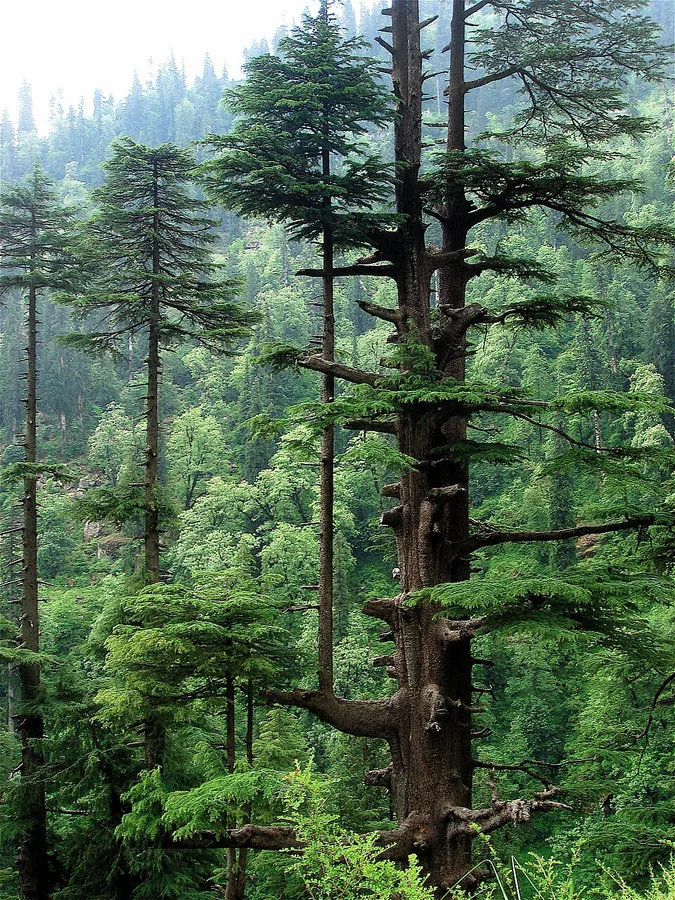
The deodar cedar is a fast-growing evergreen from the western Himalayas, and one of the few true cedars in the genus Cedrus. It carries soft, blue-green to gray-green needles in tufts along arching branches, with a drooping leader at the top that gives the whole tree a graceful, weeping line. Given room, it reaches 30 to 50 feet (9 to 15 meters) tall and spreads nearly as wide.
This is a tree for open space, not a pot or a tight corner. It wants full sun and soil that drains freely, and once it has settled in it shrugs off dry spells with ease. The needles end in sharp points, so it earns a little distance, but it asks for very little once established.
Gardeners reach for it as a specimen tree or a screen, and several cultivars push its range colder than the wild species. The biggest mistake is planting it where water pools, since wet feet are the one thing it won't forgive.
Care
The short version: full sun and free-draining soil are everything. Water it well while it's young, then let it fend for itself, give it plenty of room to spread, and keep it out of any spot where the ground stays wet.
Light
Plant a deodar cedar in full sun for the densest, best-shaped tree. It will take partial sun or light shade, but the canopy thins and the form opens up where the light runs short.
Water
Water it regularly through the first year or two while the roots reach out, soaking deeply every 7 to 14 days. After that it turns genuinely drought tolerant and needs little extra, and the real danger flips to overwatering, which invites root rot.
Soil
It isn't fussy about texture, growing in anything from sandy to clay loam, and handles a wide pH of 5.5 to 7.5. The one rule that matters is drainage, since soil that stays soggy will rot the roots.
Temperature
This is a tough tree across a broad span, holding from about 0°F to 100°F (-18°C to 38°C). Hardy cultivars stretch the cold end further, while late frosts can still nip the tender new growth in spring.
Humidity
Ordinary outdoor air suits it fine, so there's no humidity figure to manage. Good air movement around the branches matters more, since stagnant, damp conditions are what let tip blight take hold.
Feeding
Feed lightly in spring with a balanced slow-release tree fertilizer, on a seasonal schedule. An established tree growing well needs little or no feeding and does just fine on what the soil provides.
Pruning
This tree needs almost no pruning to keep its shape. In late winter, take out any dead, damaged, or crossing branches, along with growth killed by cold or tip blight, and otherwise leave its natural sweeping form alone.
Repotting
Grown as a landscape tree, it's rarely a candidate for a container, and an established one is best left undisturbed. If you do hold a young one in a pot, move it up only when roots circle the inside, growth stalls, or water runs straight through without soaking in.
Size & spacing
360–600 in (914–1524 cm) tall
When to plant
The deodar cedar goes in the ground during the mild shoulders of the year. Plant in spring or fall, while the soil is workable and the heat or hard cold is off, and give the roots a season to take hold before the weather turns.
Northern hemisphere
Southern hemisphere
Typical months for a temperate climate: start earlier in warm zones, later where spring frosts linger.
- Plant: spring or fall
Hardiness
USDA hardiness zones: 6–9
Temperature: down to -23°C
Troubleshooting
A healthy deodar cedar has few problems, and most trouble traces back to wet soil or a tree under stress. Read the branches and the canopy for the first signs. Catch them early and you can usually turn things around before a limb or the whole tree is lost.
A thinning, wilting canopy on a tree in wet ground
Soggy soil points to Phytophthora root and crown rot, which suffocates and rots the roots from below. Dig in near the base and you may find dark, mushy roots instead of firm white ones. There is no rescue once the rot is advanced, so fix the drainage, ease off the water, and replant somewhere the ground never stays wet.
Fix:
- Improve drainage or relocate to a well-drained site
- Reduce irrigation
- Remove severely affected trees
Flagging branches, weeping resin, and bare cases hanging in the limbs
A stressed tree draws the deodar weevil, a bark beetle that bores in and bleeds resin from the wounds, while bagworms and borers add to the damage. Look for small holes, sawdust, and the hanging spindle-shaped bags that give bagworms away. Most attacks hit trees already weakened by drought, so the best defense is steady water, a layer of mulch, and pruning out and burning anything infested.
Fix:
- Keep trees vigorous with proper watering and mulch
- Remove and destroy infested branches and bagworm bags
- Consult local extension for targeted insect management
Browning branch tips and dying-back twigs
This is usually tip blight from the Sphaeropsis or Diplodia fungus, which moves in after wet weather and starts at the very ends of the branches. A late frost can mimic it by killing the tender new growth. Cut the affected tips well below the dead wood, disinfect your pruners between cuts, and keep water off the foliage.
Fix:
- Prune out and dispose of affected tips well below the dead tissue
- Disinfect tools between cuts
- Improve air circulation and avoid overhead watering
Toxicity
The deodar cedar is safe to plant around a household. It carries no toxin that harms pets, livestock, or people, and it doesn't appear on the ASPCA poison lists. The one thing to mind is the sharp-pointed needles, which can prick small hands working close to a young tree.
Safe for
People · Cats · Dogs · Horses · Rabbits · Livestock · Birds
Cats None
Safe to have around cats, with nothing in the needles or wood that poisons them. A cat that chews on a branch might cough up a bit of plant matter, but that's the sharp tips at work, not a toxin.
Dogs None
No toxic compounds here, so a dog can sniff and brush against the tree without worry. Gnawing on fallen twigs is harmless, though a mouthful of needles may cause a little drool.
Horses Safe
Nothing about the deodar cedar threatens a horse grazing nearby. The tree carries no poison, so it's fine to plant around paddocks and pasture edges.
Rabbits Safe
Rabbits are in no danger from this tree. The needles are not toxic, and a curious nibble does no harm.
Livestock Safe
Cattle, goats, and sheep can share ground with a deodar cedar safely. It holds no toxin that troubles the stomach or nerves.
Birds Safe
Birds nest and perch in the dense branches without any risk. The tree is non-toxic, and its cones and cover are a welcome part of the garden for them.
People Safe
There's nothing poisonous about a deodar cedar for people. The needles end in sharp points, so the only real caution is handling young plants with care.
No special handling needed; needles are sharp-pointed so handle young plants with care.
Varieties
Beyond the wild species, a handful of named selections stand out for hardier cold tolerance or a distinct color and shape. These are the ones you're most likely to find at a nursery.
Karl Fuchs
One of the most cold-hardy selections, holding up to zone 6 with steely blue-green needles on graceful, drooping branches.
Shalimar
Grown from seed of the Shalimar Gardens, this blue-green form takes the cold better than the ordinary species.
Kashmir
Hardier than the species to around zone 6, it ranks among the best true cedars for southern gardens.
Pendula
A weeping form whose branches cascade strongly toward the ground for a soft, draped shape.
Aurea
A golden form that pushes bright yellow new growth in spring before settling toward green as it ages.
How to propagate
You can raise a deodar cedar from seed or take the route nurseries use for the fancy forms. Each path suits a different goal, and one takes far more patience and skill than the other.
SeedModerate
Fall to spring after cold stratification · Several years
The species grows readily from seed once it has had a spell of cold stratification, started anytime from fall to spring. Expect to wait several years for a real tree, and know that seedlings vary in form and color, so no two come out quite the same.
GraftingDemanding
Late winter · 1 to 2 years
The named cultivars, including the weeping and golden forms, are grafted in late winter because seed won't reliably pass on their traits. It's demanding work that takes 1 to 2 years to settle, which is why grafted plants cost more at the nursery.
Myths
Every tree called a cedar is a true cedar like the deodar.
Only members of the genus Cedrus, the deodar among them, are true cedars. Many North American trees that go by the name, such as eastern red cedar (Juniperus virginiana) and northern white cedar (Thuja occidentalis), sit in entirely different genera and aren't cedars at all.