Tree · Sapindaceae
Tamukeyama Japanese Maple
Acer palmatum
A weeping laceleaf maple that pours out deep red, finely cut foliage from spring to a fiery fall.
Partial shade
Every 3–7 days
USDA 5–8
6–8 ft · 1.8–2.4 m
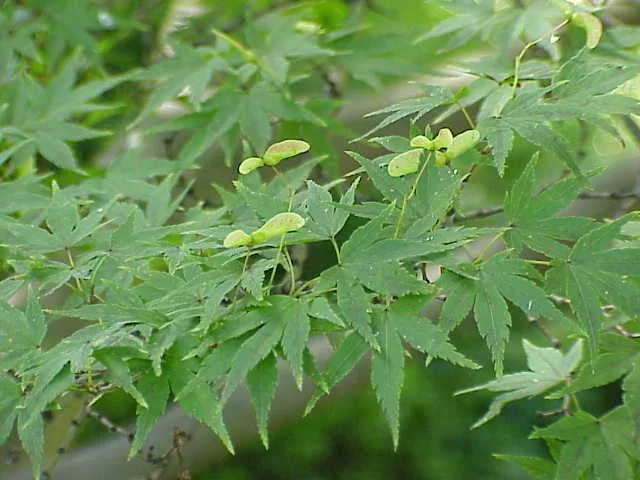
Overview
The Tamukeyama Japanese maple is a small weeping tree grown for its leaves rather than its flowers. The foliage is a laceleaf, cut so deeply that each leaf looks almost feathery, and it carries a rich purple-red from the moment it opens. Reaching only 6 to 8 feet (183 to 244 cm) tall but spreading wider than it is high, it forms a low, cascading mound that suits a courtyard, a patio container, or a spot near the door.
What sets this cultivar apart from the many other laceleaf maples is its toughness. It holds its color through the heat of summer where lesser forms fade to bronze, and it shrugs off sun better than most. The tree grows slowly, so it stays in scale for years, and the same dissected leaves that glow red all season turn scarlet to bright red in fall before they drop.
Like all Japanese maples it asks for a little care over a careless planting. Give it dappled light, moist soil, and shelter from harsh afternoon sun, and the delicate leaves stay crisp and colorful. Get the site wrong and the fine foliage scorches at the edges, which is the one problem you'll meet most often.
Care
The short version: part shade with shelter from hot afternoon sun, soil kept evenly moist and slightly acidic, a layer of mulch to cool the roots, and little pruning beyond shaping in the dormant season.
Light
Give it dappled or part shade, with shelter from the hottest afternoon sun. It tolerates full sun in cooler regions and as long as the soil stays moist, but harsh, dry sun is what scorches the fine leaves.
Water
Keep the soil consistently moist, watering roughly every 3 to 7 days and more in a heat wave. The fine foliage scorches if the roots dry out, so a layer of mulch to hold moisture and keep the roots cool pays off all summer.
Soil
Plant in moist, rich, well-drained loam on the acidic side, with a pH of 5.5 to 6.5. High-pH soils lock up iron and turn the leaves yellow with chlorosis, so work in plenty of organic matter and avoid limey ground.
Temperature
The tree is hardy across a wide range, from about -20°F to 95°F (-29°C to 35°C), which covers USDA zones 5 through 8. It takes real cold in stride, while the upper end is where heat and sun start to stress the leaves.
Humidity
Ordinary outdoor humidity suits it, so there's no number to chase. What the leaves really want is moist roots and a break from drying wind, both of which matter far more than the air around them.
Feeding
Feed lightly with a balanced slow-release fertilizer in early spring, once a season. Japanese maples are not heavy feeders, and pushing them with too much fertilizer brings soft, weak growth that scorches more easily.
Pruning
This tree needs little pruning, mostly just light shaping to keep its cascading form. Do any cutting in late fall to midwinter while it's dormant, since pruning in spring or summer makes the wounds bleed sap.
Repotting
A container specimen needs repotting every 2 to 3 years, done in late winter while the tree is dormant. Roots circling the pot, growth that stalls, and water running straight through are the signs it's time to move up a size.
Size & spacing
Expect a mature height of 6 to 8 feet (183 to 244 cm) with a wider spread of 8 to 12 feet (2.4 to 3.7 m), so give it room to cascade. Its slow growth means it stays in scale for years before it fills that space.
When to plant
This is a tree you plant once and keep for decades, so timing matters less than placement. Set it out in spring or fall, after the danger of hard frost has passed, when the cooler weather lets the roots settle in before they face summer heat or winter cold.
Northern hemisphere
Southern hemisphere
Typical months for a temperate climate: start earlier in warm zones, later where spring frosts linger.
- Plant: Spring or fall, after frost danger has passed.
- Harvest: Insignificant reddish-purple flowers in April; grown for foliage with scarlet to bright red fall color.
Hardiness
USDA hardiness zones: 5–8
Temperature: down to -29°C
Troubleshooting
Most trouble with a Japanese maple shows up on the leaves, and scorched edges in summer are by far the most common complaint. Catch the early signs and most issues come down to where the tree sits and how wet its roots stay. Match what you see below, then adjust the site or watering before the damage spreads.
Branches dying back with wilting leaves on one side
When dieback and yellowing strike one side of the tree, suspect verticillium wilt, a soil fungus that plugs the wood from the inside. Peel the bark off a wilting branch and look for dark streaks running along the grain, then send a sample to a diagnostic lab to be sure. There is no cure, so prune out the dead wood, keep the tree well fed and watered to hold its vigor, and don't replant a susceptible species in the same ground.
Fix:
- Prune out dead and dying wood
- Maintain vigor with proper irrigation and slow-release fertilizer
- Consult a certified arborist for hazard assessment
- Remove severely affected plants and avoid replanting susceptible species in infested soil
Crispy brown leaf edges in hot, dry weather
This is leaf scorch, and it shows up first on the leaves facing the most sun and wind. The fine, dissected foliage of a laceleaf maple dries out fast when the soil goes dry or the afternoon sun beats down. Move the worst of the heat off the plant with afternoon shade, keep the root zone evenly moist, and lay down mulch to hold water and cool the soil.
Fix:
- Provide afternoon shade
- Keep soil consistently moist
- Apply mulch to retain moisture and cool roots
- Shelter from drying winds
Sticky leaves, sooty black film, and curled new growth
The sticky coating is honeydew from aphids or scale feeding on the sap, and the black film that follows is sooty mold growing on that residue. Check the undersides of the leaves and along the stems to confirm. A hard spray of water knocks the aphids off, and horticultural oil or insecticidal soap clears a heavier infestation without harming the tree.
Fix:
- Hose off aphids with a strong stream of water
- Treat heavy infestations with horticultural oil or insecticidal soap
- Encourage beneficial predators
Toxicity
Good news for pet owners: the Tamukeyama Japanese maple is safe. Acer palmatum isn't on the ASPCA toxic list, and unlike red and silver maple, whose wilted leaves can poison horses, this tree carries no such risk. You can plant it freely around cats, dogs, horses, and other animals.
Safe for
People · Cats · Dogs · Horses · Rabbits · Livestock · Birds
Cats Safe
Japanese maple is safe around cats and isn't on the ASPCA toxic list. A cat that nibbles a leaf has nothing to worry about, though a big mouthful of any greenery can bring on a little drooling or a brief upset stomach.
Dogs Safe
Dogs can be near this tree without risk. The foliage holds no toxin, so the worst a curious chewer might face is mild, passing stomach upset from eating a lot of leaves at once.
Horses Safe
Unlike red and silver maple, whose wilted leaves can destroy a horse's red blood cells, Japanese maple is not tied to that poisoning. It is considered safe to have near horses.
Rabbits Safe
There's no toxin here that would harm a rabbit. The leaves are not a normal part of their diet, so keep any nibbling occasional rather than letting it replace hay and greens.
Livestock Safe
Goats, sheep, and cattle can graze near a Japanese maple safely, since it carries none of the maple toxins that put horses at risk.
Birds Safe
The tree poses no danger to birds. Many will perch and shelter in its branches without any concern.
People Safe
Japanese maple is not poisonous to people. No part of it is grown to be eaten, but a child who tastes a leaf is in no danger.
No special handling required; minor stomach upset is possible if pets chew large amounts of any plant material.
Varieties
Tamukeyama is one of a family of weeping laceleaf maples, and a few close relatives turn up at the same nurseries. These are the ones worth knowing.
Tamukeyama
A vigorous, heat-tolerant weeping laceleaf maple whose deeply cut purple-red leaves hold their color well into summer before turning bright red in fall.
Crimson Queen
A cascading cutleaf cultivar with finely dissected crimson foliage that keeps its rich color right through the summer.
Dissectum Atropurpureum
The classic red-purple laceleaf, grown for its low, mounded, weeping shape.
Seiryu
An unusual upright cutleaf that breaks from the mounding red laceleaf habit, carrying green foliage through the summer instead.
How to propagate
This is not a plant for the casual propagator. Tamukeyama is a named cultivar that only stays true to type when it's grafted, which is skilled nursery work rather than a backyard project.
GraftingDemanding
Late winter to early spring while dormant. · 1-2 years for the graft union to establish.
Tamukeyama is a grafted cultivar, not a plant you can grow true from seed or strike from a cutting. Nurseries join a cutting onto Acer palmatum seedling rootstock in late winter or early spring while the plant is dormant, which is demanding work that takes a steady hand. The graft union then needs a year or two to knit firmly before the young tree is ready to plant out.
Myths
Japanese maples are poisonous to cats and dogs.
Acer palmatum isn't on the ASPCA toxic list, and it's safe around cats and dogs. The poisoning people worry about belongs to red maple, a different species whose wilted leaves harm horses, and that danger doesn't carry over to the Japanese maple.
Japanese maples have to be grown in full shade.
They handle anything from full sun to part shade. In hot regions the real need is afternoon shade and steady moisture to keep the delicate leaves from scorching, not the deep, dark shade the myth suggests.