Houseplant · Orchidaceae
Slipper Orchid
Paphiopedilum
Keep it in steady warmth, soft light, and evenly moist compost, and a slipper orchid rewards you with a bloom that lasts for months.
Medium indirect
Every 5–7 days
55–81°F · 13–27°C
USDA 10–12
Overview
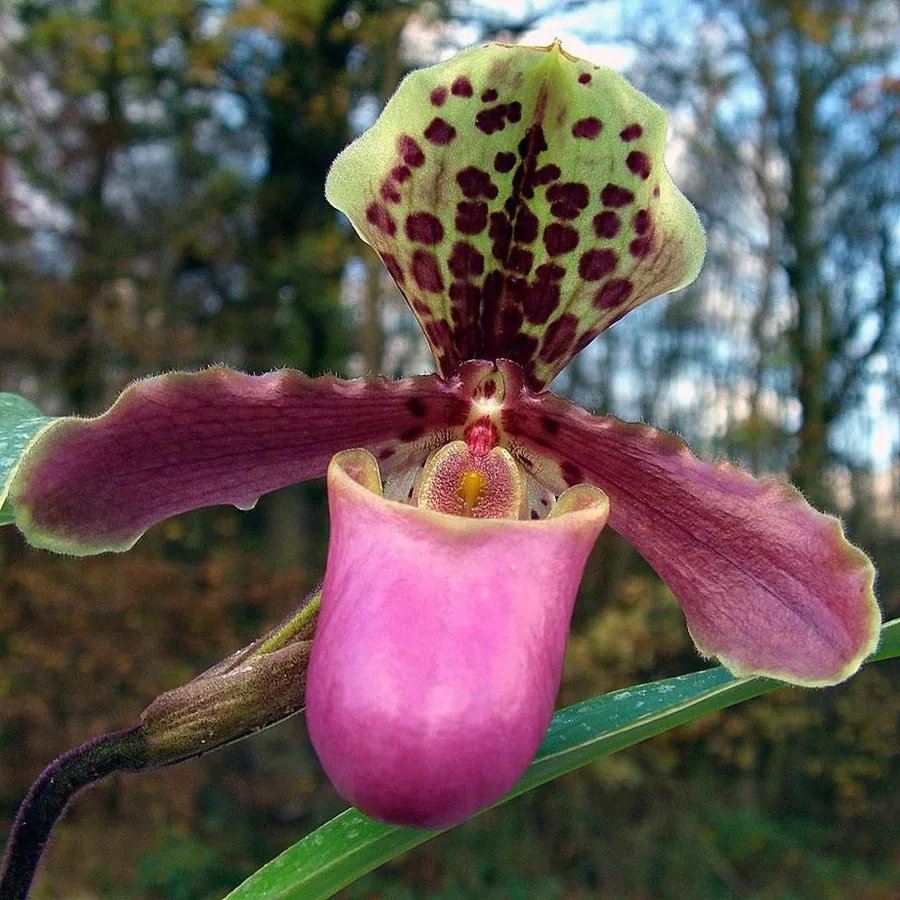
The slipper orchid earns its name from the pouch-shaped lip that gives each flower the look of a tiny shoe. Botanists know the genus as Paphiopedilum, and unlike the tree-dwelling orchids most people picture, these grow with their roots in the ground as terrestrial plants. That difference shapes everything about how you care for one.
What sets a slipper orchid apart from its showier cousins is its appetite for steady moisture. It has no plump pseudobulbs to bank water in, so it can't coast through a dry spell. The payoff for keeping it happy is a single waxy flower that can hold for up to three months, far longer than most blooms in the house.
These are patient plants. They grow slowly, stay compact at 6 to 18 inches (15 to 45 cm) tall, and ask for soft light rather than a sunny sill. Give a slipper orchid even moisture, warmth, and humid air, and it settles in for years.
Care
The short version: medium indirect light, compost kept evenly moist all year, warmth between 55°F and 81°F (13°C to 27°C), and humid air around 50% to 70%, with a weak feed through the growing season.
Light
Slipper orchids want medium indirect light and burn in direct sun. An east window or a spot back from a brighter one suits them, and the mottled-leaved kinds cope with lower light than most orchids. Pale, floppy growth means too little light; scorched patches mean too much.
Water
Keep the compost evenly moist all year and never let it dry out completely, since there are no pseudobulbs to fall back on. Water every 5 to 7 days, easing off a little in winter. Pour at the compost level and keep water out of the crown.
Soil
Pot in a free-draining terrestrial orchid mix of fine-grade bark with perlite or crushed bark worked in. The roots need air as much as moisture, so the blend should hold water without turning to sludge. A slightly acidic pH of 5.5 to 6.5 is ideal.
Temperature
Aim for 55°F to 81°F (13°C to 27°C), the comfortable range of an ordinary heated room. Steady warmth matters more than hitting an exact number, and sudden cold draughts are what trigger dropped buds.
Humidity
These orchids like it humid, 50% to 70%, which is higher than most homes run. Group plants together, sit the pot on a tray of damp pebbles, or run a humidifier nearby. Pair the moist air with good airflow so the leaves dry between waterings.
Feeding
Through the growing season from spring to autumn, feed weekly with a balanced orchid fertilizer at quarter to half strength. Always apply it after watering so the weak feed never hits dry roots. Ease off over winter while growth slows.
Pruning
There's little to do here. Once a flower spike is spent, cut it back to the base, and trim away any dead or yellowed leaves as they appear. Beyond that, leave the plant be.
Repotting
Repot every 1 to 2 years, ideally in spring after flowering, into fresh mix. Do it when roots crowd the rim, the compost has broken down, or the plant wobbles loose. Old mix turns dense and waterlogged, which is exactly what the roots can't take.
Size & spacing
A slipper orchid stays small, reaching 6 to 18 inches (15 to 45 cm) tall and spreading 8 to 16 inches (20 to 40 cm) across. Its compact size makes it an easy fit for a windowsill or a shelf with room for air to move around the leaves.
Troubleshooting
Almost every problem with a slipper orchid traces back to water in the wrong place, whether that's a soggy root ball or a drop sitting in the crown. Catch the early signs and most of it is fixable. Match what you see below, then act before the rot spreads.
Soft brown rot at the centre of the fan
This is crown rot, and it sets in when water sits trapped where the leaves meet. The base of the fan turns brown and soft, often with a foul smell, and it can kill the plant if left. Cut away every affected part with sterile tools, let the crown dry out, and water at the compost only from now on.
Fix:
- Cut away all affected tissue with sterile tools
- Allow the crown to dry and keep water out of the centre
- Improve air movement around the plant
Leaves turning yellow
Most often this is root rot from compost that stays too wet, though the lowest leaf going yellow on its own is just old age. Slide the plant out of its pot and look at the roots: soft and blackened means rot, firm and pale means it's fine. Cut away any mushy roots, repot into fresh free-draining mix, and water evenly from then on.
Fix:
- Remove the plant from its pot and cut away soft, rotten roots with clean tools
- Repot into fresh, free-draining terrestrial orchid compost
- Resume even moisture without letting the mix become waterlogged
Buds shrivel and fall before they open
Gardeners call this bud blast, and it usually follows a move, a cold draught, or a spell when the compost dried out. The buds yellow and drop while the leaves stay healthy. Settle the plant in a stable, draught-free spot, lift the humidity to 50% to 70%, and keep the mix evenly moist while it's in bud.
Fix:
- Move the plant to a stable, draught-free spot
- Raise humidity to 50-70%
- Keep the compost evenly moist
Toxicity
Good news for a home with pets and children: the slipper orchid is non-toxic right across the board. Nothing in the leaves or flowers will poison a cat, dog, or curious toddler, and the worst a nibble brings is a mildly upset stomach. The only thing to keep in mind is that the fine glandular hairs on the leaves and stems can lightly irritate sensitive skin, so rinse your hands after handling.
Safe for
People · Cats · Dogs · Horses · Rabbits · Livestock · Birds
Cats None
Safe to share a home with. A cat that nibbles a leaf might drool or bring up a little, but the plant carries no toxin and there's nothing to treat.
Dogs None
No real risk here. A curious dog that chews a leaf may get a mildly upset stomach, yet the orchid holds nothing poisonous.
Horses Safe
Not toxic to horses. There is no poisonous compound in the leaves or flowers, so a stray mouthful does no harm.
Rabbits Safe
Safe around rabbits. The foliage is harmless, though as with any new green it's wise to keep portions small.
Livestock Safe
No danger to grazing animals. Cattle, goats, and sheep can brush against or sample it without any toxic effect.
Birds Safe
Safe for pet and backyard birds. Nothing in the plant is poisonous to them.
People Safe
Harmless to handle and grow around children. The one small caveat is that the fine glandular hairs on the leaves and stems can mildly irritate sensitive skin, so rinse your hands after repotting if you're prone to that.
Non-toxic, but ingesting plant material may cause mild gastrointestinal upset, so it is still best kept out of reach.
Varieties
Thousands of slipper orchid species and hybrids exist, but a few turn up again and again on windowsills. These are the ones worth knowing by name.
Paphiopedilum Maudiae gx
A popular hybrid with mottled leaves and crisp green-and-white striped flowers.
Paphiopedilum insigne
A cool-growing species with plain green strap leaves that ranks among the easiest and most forgiving for a home grower.
Paphiopedilum spicerianum
Stands out for its white dorsal sepal marked with a central purple stripe and folded margins.
How to propagate
A slipper orchid is multiplied by splitting an established clump rather than from seed at home, and patience is the price of admission.
DivisionModerate
At repotting in spring, after flowering · 1-2 years to re-establish and resume blooming
Multiply a slipper orchid by division at repotting time in spring, once flowering has finished. Split the clump into pieces with at least 3 to 4 fans each, because anything smaller is slow to recover and can take 1 to 2 years to settle in and bloom again.
Myths
Orchids are toxic to cats and dogs.
The ASPCA lists orchids such as the Phalaenopsis orchid as non-toxic to cats, dogs, and horses, and no poison is reported for the slipper orchid. At worst a nibble causes a passing stomach upset, not poisoning.
Slipper orchids should dry out completely between waterings like a cactus.
Paphiopedilum carry no pseudobulbs to bank water, so they can't ride out a drought the way many orchids do. Keep the compost evenly moist and never let it dry out completely.