Houseplant · Orchidaceae
Cymbidium Orchid
Cymbidium
Give it bright light and cool fall nights, and the cymbidium answers with long, arching sprays of bloom.
Bright indirect
Every 5–7 days
50–86°F · 10–30°C
USDA 10–12
Overview
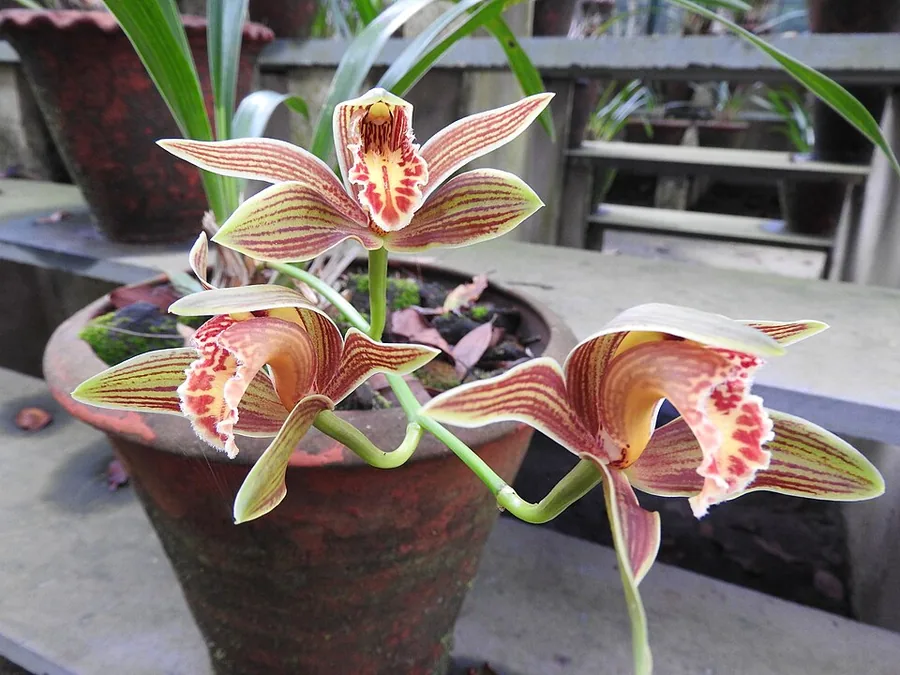
The cymbidium, sometimes called the boat orchid, is one of the easier orchids to keep happy indoors. It grows from fat storage stems called pseudobulbs and sends up long, strap-shaped leaves and arching flower spikes that can carry blooms for weeks in late winter and spring. Unlike many orchids, it is terrestrial at heart, grown in a loose bark mix rather than clinging to a tree.
What sets the cymbidium apart is its taste for a chill. The plant needs a stretch of cool fall nights to set its flower spikes, which is why a healthy specimen kept too warm all year often grows beautiful leaves and nothing else. Get the seasonal rhythm right, with bright light through the year and that autumn cool-down, and the flowering takes care of itself.
It is a forgiving plant once you learn its two habits: it likes its bark moist but never waterlogged, and it likes to be a touch crowded in its pot. Treat it well and a single clump can live for many years, growing wider and flowering more freely each season.
Care
The short version: bright indirect light all year, a bark mix kept moist but never soggy, and a run of cool fall nights to set the blooms. Feed weekly through the growing season at a weak dilution and repot only every couple of years.
Light
Cymbidiums want bright indirect light, with strong full light through winter and bright filtered light in summer to spare the leaves from scorch. Light that is too dim is the second most common reason a plant skips flowering.
Water
Water thoroughly with tepid water every 5 to 7 days, keeping the bark moist but never soggy, and let all the excess drain away. The medium should hold dampness without staying wet, since standing water at the roots is the fastest route to rot.
Soil
Plant in a bark-based orchid mix that drains freely rather than ordinary potting soil, which smothers the roots. A slightly acidic pH of 5.5 to 6.5 suits it, and the chunky bark keeps air moving around the roots.
Temperature
Cymbidiums handle a wide range, from about 50°F to 86°F (10°C to 30°C). The real key is the seasonal swing, because a stretch of cool fall nights is what tells the plant to set its flower spikes.
Humidity
Aim for 50% to 70% humidity, which is higher than most rooms run in winter. A pebble tray or a nearby humidifier helps, and steady airflow keeps the damp leaves from turning into pest and rot trouble.
Feeding
Feed weekly from spring through fall with a balanced fertilizer cut to quarter or half strength, applied right after watering so it never hits dry roots. Ease off through winter while growth slows.
Pruning
There is no structural pruning to do. Cut spent flower spikes back to the base once the blooms fade, and pull off any yellowed or dead leaves to keep the plant tidy and airy.
Repotting
Repot only every 2 to 3 years, in spring after flowering, since cymbidiums actually flower better a little crowded. Move up when the leading pseudobulb reaches the pot edge, the roots crowd or escape, or the old bark has broken down and stays wet.
Size & spacing
A mature clump stands 1 to 4 feet (30 to 120 cm) tall and spreads 9 to 35 inches (23 to 90 cm) wide, the leaves and arching spikes accounting for most of the height. Give it a spot with room for those spikes to arch out without crowding.
Troubleshooting
Most cymbidium trouble traces back to one of three things: too little light or warmth at the wrong season, common houseplant pests, or a pot that stays too wet. Match what you see below and act early, before a setback turns into lost roots.
Mushy blackened roots and a soggy crown
This is root rot, brought on by a medium that stays too wet, often because old bark has broken down and stopped draining. Slide the plant out and check the roots: firm and pale is healthy, brown and mushy is gone. Cut away the dead roots, repot into fresh bark, and water less often.
Fix:
- Remove rotted roots and repot into fresh well-draining bark medium
- Reduce watering frequency and ensure free drainage
Plenty of leaves but no flower spikes
A cymbidium that grows well yet never blooms is almost always missing its cool fall nights, the day-to-night temperature drop that triggers spike formation. Weak winter light holds it back too. Give it strong seasonal light and a stretch of chilly autumn nights, and the spikes follow.
Fix:
- Expose to cool fall nights with a marked day-night temperature drop
- Increase light to full winter light and bright filtered summer light
Speckled, yellowing leaves with webbing or sticky film
Fine stippling and faint webbing point to spider mites, while clusters of soft insects and a sticky residue mean aphids. Both gather on leaf undersides and new growth. Rinse the foliage, wipe the pests off, and follow up with insecticidal soap or horticultural oil until they clear.
Fix:
- Rinse foliage and wipe off pests
- Treat with insecticidal soap or horticultural oil, repeating as needed
Toxicity
Good news for pet owners and parents: the cymbidium is non-toxic. The ASPCA lists orchids as safe for cats, dogs, and horses, and the same holds for the other animals in a home. A curious pet that takes a bite of leaf might get a brief stomach upset from the roughage, but there is no poison to worry about.
Safe for
People · Cats · Dogs · Horses · Rabbits · Livestock · Birds
Cats None
Safe for cats. A cat that nibbles a leaf might get a brief upset stomach from the roughage, nothing more.
Dogs None
Safe for dogs. The most a curious chewer risks is a little mild, passing tummy trouble.
Horses Safe
No toxin here for horses. Cymbidium foliage holds nothing that would harm them.
Rabbits Safe
Rabbits are fine around it, though it isn't part of their diet and shouldn't replace proper greens.
Livestock Safe
Cattle, goats, and sheep face no poisoning from this orchid.
Birds Safe
Pet birds can perch near it without worry, since the plant carries no toxic compounds.
People Safe
Harmless to people, including children. It simply isn't grown to be eaten.
Although non-toxic, eating large amounts of any plant material may cause mild, temporary stomach upset.
Varieties
Cymbidiums come in hundreds of species and hybrids, from cool-growing wild types to award-winning crosses bred for color and form. These are a few worth knowing.
Cymbidium erythraeum
A cool-growing species that has earned the RHS Award of Garden Merit for its reliable garden performance.
Cymbidium lowianum
A large species that throws long arching sprays of green flowers, each with a red-marked lip, and it too holds an Award of Garden Merit.
Cymbidium Sarah Jean gx 'Ice Cascade'
A white-flowered hybrid with a cascading habit that looks its best spilling over the edge of a raised pot or shelf.
Cymbidium Tiger Tail gx
An Award of Garden Merit hybrid grown for its dependable, patterned blooms.
How to propagate
Cymbidiums are multiplied by division rather than from seed at home, splitting one mature clump into several new plants.
DivisionModerate
Spring, after flowering and at repotting · 1-2 years to re-establish and flower again
Divide a crowded clump in spring, right after flowering when you repot. Cut it so each piece keeps at least three healthy pseudobulbs and a leading growth, which gives the division enough stored energy to recover. Be patient afterward, since a fresh division usually takes one to two years to settle in and bloom again.
Myths
All orchids are poisonous to cats and dogs.
The ASPCA lists orchids as non-toxic to cats, dogs, and horses, and cymbidiums are no exception. A pet that chews a leaf risks nothing worse than a mild, short-lived stomach upset.
Orchids are parasites that live off other plants.
Cymbidiums are terrestrial and semi-terrestrial orchids that grow in their own bark medium and make their own food through their leaves. They take nothing from a host and never have.