Shrub · Hamamelidaceae
Chinese Fringe Flower
Loropetalum chinense
Plant it in acidic soil with good drainage, and loropetalum gives you colored foliage and fringed blooms with almost no fuss.
Full sun
Every 5–10 days
USDA 7–9
6–8 ft · 1.8–2.4 m
Overview
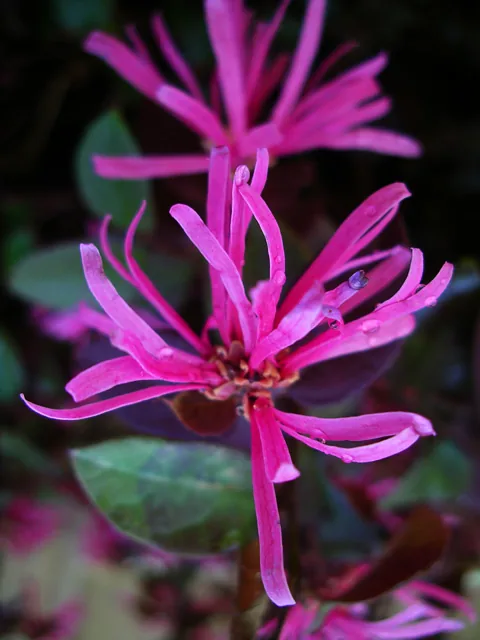
Loropetalum, or Chinese fringe flower, is an easygoing evergreen shrub grown for two things at once: its colored foliage and the spidery, fringed flowers that cover it in spring. The leaves on the popular forms run from burgundy to deep plum to near-black, holding that color through the year while green-leaved types fade into the background. The blooms look like little tassels and come in pink, red, or white.
It earns its keep because it asks for so little. Once a plant settles in it shrugs off drought, takes full sun or part shade, and rarely needs more than a tidy-up after flowering. The one thing it insists on is acidic soil, and most of the trouble people run into traces straight back to ground that's too alkaline.
Size is the catch worth knowing up front. The cultivar names hint at neat little mounds, but many grow far bigger than expected, and a vigorous type can climb toward small-tree size in a few years. Match the variety to the space and you'll save yourself a lot of pruning later.
Care
The short version: full sun to part shade, rich and acidic soil that drains well, steady water while it establishes and far less after, and a light prune right after the spring bloom.
Light
Loropetalum flowers best and holds its leaf color most strongly in full sun, but it takes partial sun or partial shade in stride. In deep shade the dark-leaved types fade and bloom thins out.
Water
Water it regularly while it's getting established, roughly once a week and more often in fierce heat. Once the roots are down it turns drought tolerant and needs little extra; let the top inch or so of soil dry between waterings, and mulch to hold what moisture there is.
Soil
This is the make-or-break detail. Loropetalum wants rich, moist, well-drained soil that runs acidic, ideally a pH between 5.0 and 6.5, with plenty of organic matter worked in. Neutral or alkaline ground locks up iron and turns the leaves yellow.
Temperature
It's hardy across a wide band, taking lows near 5°F (-15°C) and heat up to about 100°F (38°C). That range covers USDA zones 7 through 9, where it lives outdoors year-round.
Humidity
Ordinary outdoor humidity suits it, so there's no figure to hit. Far more useful is keeping the roots out of standing water, which is where its real troubles begin.
Feeding
Feed once in spring with an acidic, azalea- or camellia-type fertilizer; it responds well to a medium dose. The same feed also helps hold the soil on the acidic side it prefers.
Pruning
Pruning is light work. Since the flowers form mostly on old wood, prune right after the spring bloom finishes so you shape the plant without cutting off next year's display.
Repotting
Container plants rarely need moving. Repot only when you see roots circling or escaping the drainage holes, water running straight through, or new growth stalling in the pot.
Size & spacing
Expect a shrub of about 6 to 8 feet (183 to 244 cm) tall and roughly as wide, though vigorous types push well past that. Give each plant room for its full spread so air moves freely and you're not fighting its size every season.
When to plant
Loropetalum is a woody shrub you plant once and keep for years, so the timing that matters is getting it in the ground. Set new plants out in spring or fall, after frost danger has passed, and the main flush of fringed flowers arrives from late March into April, with scattered reblooming through the warmer months.
Northern hemisphere
Southern hemisphere
Typical months for a temperate climate: start earlier in warm zones, later where spring frosts linger.
- Plant: Spring or fall after frost danger passes
- Harvest: Late March to April with sporadic rebloom into fall
Hardiness
USDA hardiness zones: 7–9
Temperature: down to -18°C
Troubleshooting
Loropetalum stays healthy in the right soil, so most problems are really soil problems wearing a disguise. The leaves and roots tell you what's wrong early. Match what you see below and fix the cause, not just the symptom.
Wilting and dieback with dark, mushy roots
Soggy ground brings on root rot, which shows up as wilting and branch dieback even though the soil is wet. Dig down and the roots come up dark and soft. Cut back on water, fix the drainage, and move survivors into a raised, well-drained bed; a badly rotted plant is best pulled and replaced.
Fix:
- Improve drainage and reduce watering
- Remove and discard severely rotted plants
- Replant in raised, well-drained beds amended with organic matter
Swollen, corky lumps on branches that die back
Rough, swollen galls at the branch nodes with dieback above them point to bacterial gall disease. Prune the affected branches well below each gall and burn or bin what you remove, wiping your tools with disinfectant between cuts so you don't carry it along. A heavily infected shrub is worth pulling out entirely.
Fix:
- Prune out and destroy galled branches well below the gall
- Disinfect pruning tools between cuts
- Remove and replace severely infected plants
Yellow leaves with veins that stay green
This is chlorosis, and it almost always means the soil pH has crept too high for the roots to pull up iron. It shows on the newest growth first. Test the soil, work in elemental sulfur or an acidic fertilizer to bring the pH down, and use chelated iron for a quick fix while the soil slowly corrects.
Fix:
- Acidify soil with elemental sulfur or an acidic fertilizer
- Apply chelated iron as a temporary correction
- Mulch with organic matter to lower pH over time
Toxicity
Good news for households with pets and children: loropetalum is not toxic. It doesn't appear in the major poison databases or on the ASPCA list, and the bitter tannins in the leaves tend to put animals off before they eat much. You can plant it without worrying about who wanders past.
Safe for
People · Cats · Dogs · Horses · Rabbits · Livestock · Birds
Cats None
Cats can brush against the foliage or nibble a leaf without harm. The bitter tannins usually stop them well before they eat enough to matter.
Dogs None
A dog that chews on a stray branch is in no danger. There's no toxin to worry about, though a big mouthful of any plant can leave a sensitive stomach unsettled for a bit.
Horses Safe
Horses can graze near this shrub without concern, since it carries nothing that would poison them.
Rabbits Safe
Rabbits face no risk from the leaves or flowers. The bitter foliage tends to keep them from making a meal of it anyway.
Livestock Safe
Cattle, goats, and sheep can browse around the plant safely. Nothing in it is known to cause poisoning.
Birds Safe
Garden birds perch and forage among the branches with no trouble at all.
People Safe
The plant is safe to have around children. No part of it is poisonous, so a curious child who tastes a leaf is fine.
No special handling needed; foliage contains bitter tannins that discourage browsing.
Varieties
Most of what's sold is named for its leaf color and habit rather than its flowers. These are the cultivars you're most likely to meet.
Ruby (var. rubrum 'Ruby')
New leaves come out a deep burgundy-red and the shrub throws hot-pink fringe flowers against them.
Purple Pixie
A low, weeping dwarf with purple foliage and pink blooms that works as well in a container or trailing over a wall as it does for groundcover.
Plum Delight
Carries reddish-purple foliage that sets off its bright pink flowers.
Ever Red (Chang Nian Hong)
The darkest of the bunch, with near-black red foliage, red blooms, and a strong habit of flowering again later in the season.
Zhuzhou
A vigorous purple-leaved type that grows large enough to reach tree-like size if you let it.
Companions
Loropetalum pairs naturally with the other acid-loving shrubs, which want the same rich, well-drained ground and gentle shade it does.
How to propagate
You can make more loropetalum at home without much trouble, either by rooting cuttings or by pinning a low branch down to the soil and letting it root in place.
Stem cuttingsModerate
Late spring through summer · Roots in roughly 15 days to several months depending on cultivar and warmth
From late spring through summer, take semi-hardwood cuttings from growth that has started to firm up. Warm soil around 75°F (24°C) moves things along, and roots come anywhere from about 15 days to a few months out depending on the cultivar and how warm you keep them.
LayeringEasy
Spring to summer · Several months to root
The easiest route is layering in spring or summer. Bend a low branch down, pin it into the soil, and leave it attached to the parent while it roots over several months before you cut it free as its own plant.
Myths
Loropetalum is poisonous to cats and dogs.
It doesn't appear in the toxic-plant databases or on the ASPCA list. Loropetalum is treated as non-toxic to pets, so a pet that nibbles the foliage isn't at risk.
Dwarf Loropetalum cultivars stay small forever.
Plenty of so-called dwarfs outgrow the label, and the species and vigorous types can reach 10 to 20 feet or more. Give every plant room for its true mature size and check the cultivar before you commit to a spot.