Shrub · Aquifoliaceae
Inkberry Holly
Ilex glabra
A tough native shrub that takes wet ground, hard winters, and shade and stays green right through.
Full sun
Every 3–7 days
USDA 4–9
5–10 ft · 1.5–3 m
Overview
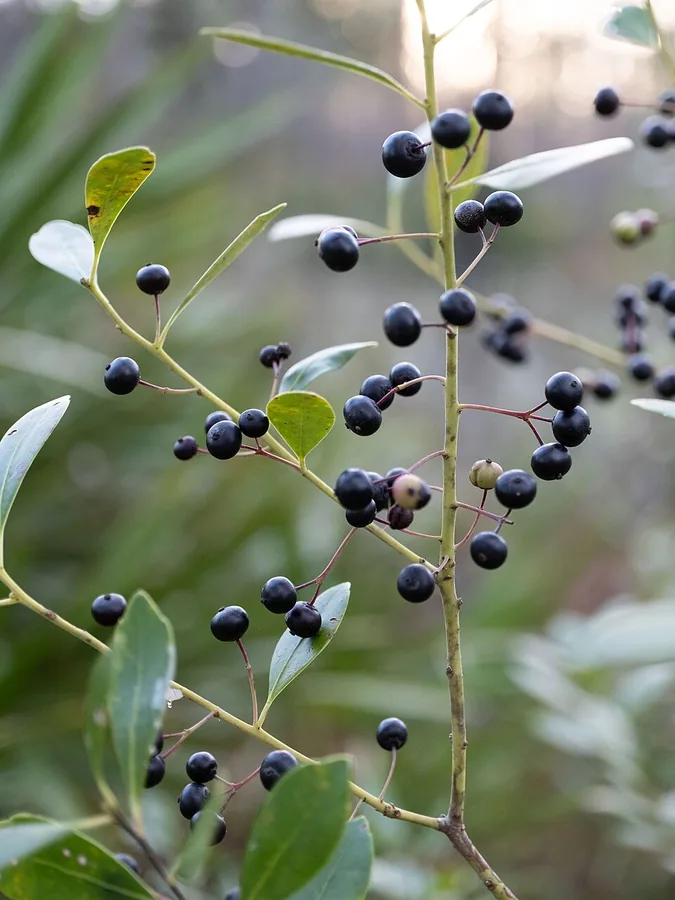
Inkberry holly is a slow, dependable evergreen shrub from eastern North America, named for the black berries that gave the dye its old country use. Unlike the spiny English hollies most people picture, its leaves are smooth and small, which makes it an easy plant to grow near a path. It earns its place as a low, year-round green backbone in a bed or hedge.
What sets it apart is how much it puts up with. It thrives in acidic, wet ground where fussier shrubs sulk, handles winters down to roughly -29°F (-34°C), and takes full sun or part shade in stride. The trade-off is its habit: the wild species spreads by suckers and thins out at the base over time, which is why so many gardeners reach for the tidier named cultivars.
It's a female-and-male plant, so a lone shrub won't fruit and you need a male nearby to get the berries. Those berries feed birds deep into winter, and the flowers draw honeybees, which is part of why it shows up on so many native-plant lists. Plant it once and it asks for very little.
Care
The short version: acidic, consistently moist soil in full sun to part shade, little feeding, and an occasional spring prune to keep an older plant from going bare at the base.
Light
Inkberry takes full sun to part shade, and more sun gives you a denser, fuller shrub. In deep shade it grows thin and leggy and loses its shape, so give it as much light as the spot allows.
Water
This shrub likes its soil consistently moist and even shrugs off wet to boggy ground that would rot most plants. It runs moderately drought tolerant once established, but a young plant needs steady water, roughly every 3 to 7 days, until the roots take hold.
Soil
Plant it in acidic, organically rich soil, ideally a pH of 5.0 to 6.0. It adapts to clay or sand and copes with wet sites, but neutral to alkaline ground leads straight to yellow leaves, so steer clear of limed soil.
Temperature
Inkberry is genuinely cold-hardy, taking lows near -29°F (-34°C) and summer heat up to about 100°F (38°C). That range covers most temperate gardens without any winter protection.
Humidity
Ordinary outdoor humidity suits it, so there's no number to manage. As a native of damp woods and bogs, it's far more concerned with moisture at the roots than with the air.
Feeding
It barely needs feeding. A single dose of balanced or acidifying holly or azalea fertilizer in early spring is plenty, and an acidifying type doubles as a way to hold the soil on the sour side it prefers.
Pruning
Most years it asks for very little. Prune to shape in early spring just before new growth starts, and when an older plant goes bare and woody at the base, cut it back hard to force fresh, dense growth from low down.
Repotting
Grown in a container, inkberry rarely needs moving. Pot it up only when roots circle the pot, push out the drainage holes, or water races straight through, which signals the plant has outgrown its home.
Size & spacing
Expect a mature shrub of 5 to 10 feet (1.5 to 3 m) tall, spreading 5 to 8 feet (152 to 244 cm) wide. Space plants by that mature width so a hedge knits together while each shrub still gets airflow.
When to plant
Inkberry is a hardy shrub with no real planting season to wait out. Set new plants in the ground in spring or fall while the soil is workable and moist, expect greenish-white flowers in late spring, and watch the black drupes ripen in fall and hang on through winter.
Northern hemisphere
Southern hemisphere
Typical months for a temperate climate: start earlier in warm zones, later where spring frosts linger.
- Plant: spring or fall
- Harvest: May to June (greenish-white flowers); black drupes mature September and persist into winter
Hardiness
USDA hardiness zones: 4–9
Temperature: down to -34°C
Troubleshooting
Inkberry stays out of trouble most years. The few problems it does run into show up on the leaves or in the shape of the plant, and each has a clear cause. Match what you see below, then fix the root of it rather than the symptom.
Yellow leaves with veins that stay green
This is iron chlorosis, and on inkberry it almost always means the soil has drifted out of the acidic range the plant needs. When the pH climbs toward neutral or alkaline, the roots can't pull up iron even when it's there. Test the soil, work in acidic organic matter to bring the pH back toward 5.0 to 6.0, and skip the lime.
Fix:
- Acidify soil and lower pH toward 5.0-6.0
- Apply iron/chelated micronutrients per label
- Improve organic matter and avoid liming
Bare, leggy stems with growth only at the top
Older inkberry plants thin out at the base on their own, and shade speeds it up. This is the wild species showing its age rather than a disease. Renewal-prune in early spring to push fresh growth low down, move the plant into fuller sun, or replace it with a tidy cultivar like Shamrock, Compacta, or Gem Box that holds its shape.
Fix:
- Renewal-prune in early spring to encourage dense basal growth
- Site in fuller sun
- Choose compact cultivars such as 'Shamrock', 'Compacta', or Gem Box
Blotches, winding trails, or fine speckling on the leaves
Winding or blotchy trails point to a leaf miner tunneling inside the leaf, while fine pale stippling usually means spider mites, and waxy bumps on stems and leaves are scale. None of these kill a healthy inkberry. Pull off badly chewed leaves, treat mites or scale with a suitable horticultural control, and keep the plant well watered so it shrugs the damage off.
Fix:
- Remove and destroy heavily infested leaves
- Monitor and treat mites/scale with appropriate horticultural controls per label
- Maintain plant vigor with proper water and soil
Toxicity
Inkberry is only mildly toxic, but it isn't harmless. Like other hollies, the leaves and berries hold saponins and related compounds that upset the stomach if eaten, and the berries are the main worry. A nibble means an upset gut rather than an emergency, yet it's still worth keeping the berries and trimmings away from pets and small children.
Toxic to
Cats · Dogs · Horses · Rabbits · Livestock · People
Safe for
Birds
Cats Mild
A cat that chews the leaves or berries usually drools and then vomits, with some diarrhea to follow. It tends to look dull and off its food for a day. The berries are the part most likely to cause trouble.
Dogs Mild
Dogs react much like cats, with an upset stomach, vomiting, and loose stools after a mouthful of berries or foliage. The saponins and the spiny eaten leaves do most of the irritating. Signs are mild and usually pass on their own.
Horses Mild
Horses rarely bother with inkberry, but a horse that grazes the foliage can get colicky and dull. Keep clippings out of the paddock to be safe.
Rabbits Mild
The leaves and berries can upset a rabbit's gut and leave it quiet and off its feed, so they don't belong in the hutch or the run.
Livestock Mild
Grazing animals such as goats, sheep, and cattle may get a sour stomach from the saponins in the foliage, though serious poisoning is uncommon. Fence the shrubs off or clear the trimmings rather than let stock browse them.
People Caution
The berries and leaves are mildly toxic to people and shouldn't be eaten, with the berries the bigger worry, especially for small children who might be tempted by them. A few swallowed berries tend to bring on vomiting and diarrhea rather than anything dangerous. Keep them out of reach and wash up after pruning.
Birds Safe
Birds eat inkberry drupes through the winter without harm, and the shrub is grown partly to feed them. What turns a stomach in a pet is simply food for a songbird.
Keep berries and trimmings away from pets and children; wash hands after handling.
Helpline numbers

United States
ASPCA Animal Poison Control: (888) 426-4435 (fee applies)
Poison Control: (800) 222-1222



Canada
Poison Centres: 1-844-764-7669
Varieties
The wild species can get leggy, so most gardeners plant a named cultivar bred to stay neat. These are the ones worth knowing.
Shamrock
A compact, mounded selection that keeps a neat shape and stays far less leggy than the wild species.
Compacta
A female cultivar that holds denser and lower than the species, so it fills in without the bare ankles.
Gem Box
A small, rounded grower with fine dark leaves that's sold as a tougher stand-in for boxwood.
Nigra
Prized for deep green foliage that keeps its color well through the seasons.
How to propagate
You can make more inkberry from cuttings, from its own suckers, or from seed, and the route you pick depends on how patient you are and whether you care which plant you end up with.
Stem cuttingsModerate
Early to mid summer (June-July) · Several weeks to months to root, then a season or more to establish
Cuttings are the standard way to grow inkberry, and the only one that keeps a named cultivar true to type. Take semi-hardwood or softwood tips from the branch ends in early to mid summer, around June or July. They root over several weeks to a few months, then need a season or more to settle in.
DivisionEasy
Early spring · One growing season
Inkberry spreads by suckers, sending up rooted shoots around the parent that you can slice away and replant. Lift them in early spring and they take about one growing season to find their feet. This is the easiest route if you just want more of a shrub you already have.
SeedDemanding
After cleaning ripe fruit · Slow; seed has dormancy and can be slow to germinate
Growing from seed tests your patience. Clean the seed out of ripe fruit before sowing, then wait, because the seed carries a built-in dormancy and germinates slowly. The seedlings come up mixed, male and female, so you'll need at least one male in the batch for any of the females to fruit.
Myths
One inkberry plant on its own will give you a crop of black berries.
Inkberry is dioecious, meaning each plant is either male or female. Only female plants carry the black drupes, and they set fruit only when a male grows close enough to pollinate them. Plant a male nearby, or a lone shrub will never berry.