Shrub · Gelsemiaceae
Carolina Jessamine
Gelsemium sempervirens
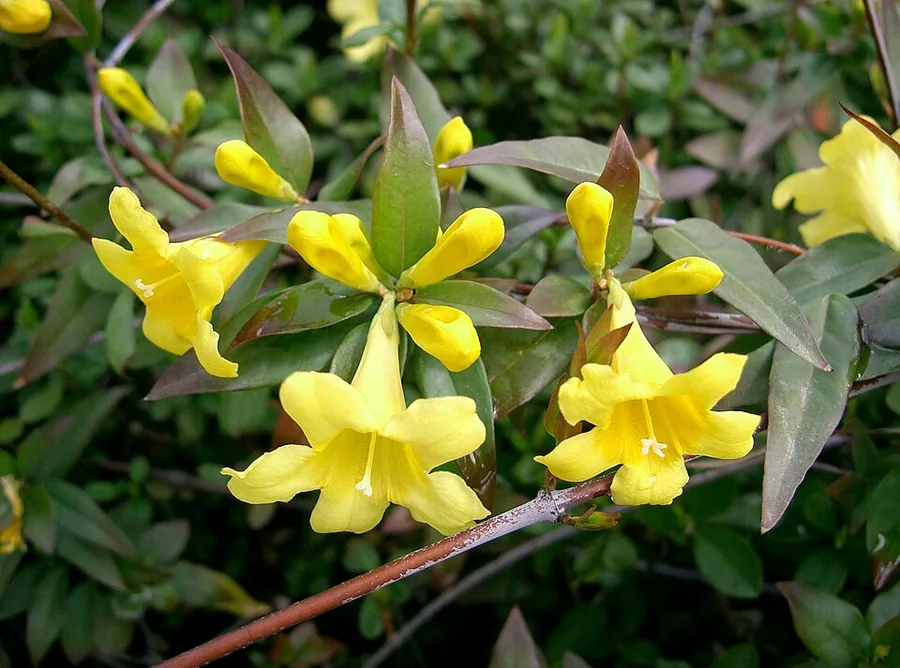
Give it full sun and a sturdy support, and this evergreen vine pours out fragrant yellow trumpets in late winter.
Full sun
Every 7–14 days
USDA 7–10
10–20 ft · 3–6.1 m
Overview
Carolina jessamine is the evergreen vine that lights up the South with fragrant yellow trumpets while much of the garden is still asleep. It twines its way up fences, arbors, and mailboxes, and in a single fast season it can throw stems 12 to 20 feet long. South Carolina liked it enough to make it the state flower.
It earns its keep with almost no fuss. Hardy through zones 7 to 10, it shrugs off heat, takes drought once it's settled in, and rarely bothers with pests or disease. The one thing it asks is full sun, since a vine left in shade grows plenty of leaves and few flowers.
There's a catch worth knowing before you plant it. Despite the jasmine in its common name, this is not a true jasmine, and every part of it is dangerously poisonous. The leaves, stems, roots, and even the sweet nectar carry strychnine-related alkaloids, so it belongs well away from children, pets, and grazing animals.
Care
The short version: full sun for the best bloom, rich well-drained soil, and a steady drink while it's young, then prune hard right after it flowers and give it a sturdy support to climb.
Light
Plant it in full sun for the heaviest bloom. It will take partial shade and stay green there, but a shaded vine trades flowers for foliage and looks thin on color.
Water
Keep the soil moist while the plant is young, watering every 7 to 14 days as it gets established. Once its roots are down it handles drought well, though a vine kept bone-dry will shed leaves and bloom less.
Soil
It is easy to please, growing in rich, well-drained ground across a wide pH range of 5.0 to 8.0. Good drainage matters far more than the exact soil type.
Temperature
Hardy from about 10°F to 100°F (-12°C to 38°C), it weathers both Southern heat and a fair cold snap. That range is what makes it dependable across zones 7 to 10.
Humidity
Ordinary outdoor air suits it fine, so there's no humidity target to hit. It is at home in the humid Southeast and just as content in drier gardens.
Feeding
A balanced slow-release feed in spring is all it needs, applied seasonally. This is not a hungry plant, and heavy feeding does more for leaves than for flowers.
Pruning
Prune right after flowering, while there's still time for new growth to set next year's buds. Cut to control size and head off a top-heavy tangle, and on old leggy vines you can take the whole thing back to a few feet above the ground to force fresh growth from the base.
Repotting
rarely
Size & spacing
Expect a fast vine that climbs 10 to 20 feet (3 to 6 m) and spreads 3 to 6 feet (91 to 183 cm) across. Give it a sturdy support and room to run, since it twines and piles on growth quickly.
When to plant
Carolina jessamine flowers early, often opening in February while the rest of the garden waits. Set new plants out in spring or fall, prune as soon as the bloom fades, and you may catch a lighter second flush of flowers come autumn.
Northern hemisphere
Southern hemisphere
Typical months for a temperate climate: start earlier in warm zones, later where spring frosts linger.
- Plant: spring or fall
- Harvest: late winter to early spring (February-April), with sporadic fall rebloom
Hardiness
USDA hardiness zones: 7–10
Temperature: down to -18°C
Troubleshooting
This vine is refreshingly trouble-free, with no serious pests or diseases to fight. The few problems that do crop up come down to how it's pruned and how much sun it gets. Match what you see below and the fix is usually simple.
Top-heavy tangle of growth with bare, woody stems below
Left unpruned for a few years, the vine piles new growth on old until the top turns into a dense mat and the base goes leggy and leafless. The cause is simply skipped pruning and stems that were never trained onto a support. Cut the old top-heavy growth back to a few feet above the ground right after flowering, then tie the remaining stems onto the support so the plant fills in evenly.
Fix:
- Prune hard right after flowering, cutting older top-heavy vines back to a few feet above ground level
- Train remaining stems onto the support to spread growth evenly
Plenty of leaves but barely any flowers
A jessamine that grows lush and green but won't bloom is almost always sitting in too much shade. The vine needs full sun to flower well. Move it or train it toward a brighter spot, and open up any overhead branches that are casting it into shade.
Fix:
- Relocate or train the vine into a position receiving full sun
- Thin overhead shade where possible
Toxicity
This is a beautiful plant and a genuinely dangerous one. Every part holds strychnine-related alkaloids, including the sweet nectar that has poisoned children who mistook the flowers for honeysuckle. No part of it is safe to eat, suck, or chew, and the same toxin threatens dogs, cats, horses, livestock, birds, and even the honeybees that visit the blooms.
Toxic to
Cats · Dogs · Horses · Rabbits · Livestock · Birds · People
Cats Severe
A cat that chews any part can go weak and wobbly within hours, with drooping muscles, trouble swallowing, and breathing that slows and grows shallow. The pupils may change, the body temperature drops, and seizures or death can follow. There is no safe nibble here.
Dogs Severe
Watch for sudden muscle weakness, staggering, and difficulty swallowing after a dog mouths the leaves, stems, or flowers. As the alkaloids take hold, breathing slows, the body cools, and seizures, paralysis, or death can follow. Get to a vet at once.
Horses Severe
Grazing horses can show muscle tremors and weakness that build into convulsions and failing breath. Every part of the vine is dangerous, and a fatal dose is not large. Keep it well clear of pastures and paddocks.
Rabbits Severe
The same nerve poison that fells larger animals is far too much for a small rabbit, bringing on weakness, tremors, and collapse. None of the plant is safe to offer or to let one reach.
Livestock Severe
Cattle, goats, and sheep that browse the foliage face muscular weakness, convulsions, and respiratory failure, and a small amount can kill. Fence it out of any area where stock graze.
Birds Severe
The alkaloids hit birds hard, and even honeybees are poisoned by the nectar and pollen. Pet birds should never have access to the leaves, stems, or blooms.
People Caution
No part of this plant is food. Children have been poisoned sucking the sweet nectar after mistaking the yellow flowers for honeysuckle, and even small amounts can cause weakness, dizziness, slowed breathing, and seizures. Keep it away from children and wash your hands after pruning.
Treat as a deadly poisonous plant: keep all parts away from children, pets, and livestock; do not let anyone suck or eat the flowers, and wash hands after handling since the sap can irritate sensitive skin.
Helpline numbers

United States
ASPCA Animal Poison Control: (888) 426-4435 (fee applies)
Poison Control: (800) 222-1222



Canada
Poison Centres: 1-844-764-7669
Varieties
A few named selections improve on the wild vine, and one close relative is worth knowing if your ground stays wet.
Margarita
An extra cold-hardy selection that carries slightly larger flowers than the species.
Pride of Augusta (Plena)
A double-flowered form that holds its bloom over a longer stretch of the season.
Gelsemium rankinii (swamp / Rankin's jessamine)
A related native species with scentless flowers that rebloom heavily in both spring and fall and put up with wetter soil.
How to propagate
You can multiply Carolina jessamine three ways, though the toxic sap means every method calls for clean hands afterward.
Stem cuttingsEasy
Late spring to summer · Several weeks to a few months
Semi-hardwood cuttings are the reliable way to copy a named cultivar true to type. Take them in late spring or summer, and they root over several weeks to a few months into a plant identical to the parent.
SeedModerate
Fall or spring · One or more seasons
You can grow it from seed sown in fall or spring, but a named cultivar won't come true this way and a plant takes one or more seasons to establish. Every seed and seedling is toxic, so handle them with care.
LayeringEasy
Spring to summer · A few months
Where a low twining stem rests against the soil in spring or summer it will root on its own within a few months, and you can then sever the rooted section and move it.
Myths
Carolina jasmine is a true jasmine, so its fragrant flowers are safe to touch or taste.
It is not a jasmine at all, which is why it carries the name false jasmine, and it ranks among the most poisonous common garden vines. Every part, down to the sweet nectar, holds strychnine-related alkaloids, and children sucking the flowers have been seriously poisoned alongside pets and livestock. Never treat its yellow blooms as honeysuckle or any other edible plant.