Houseplant · Marantaceae
Calathea White Fusion
Goeppertia lietzei 'White Fusion'
Get the water and humidity right and this living watercolour rewards you with brushstroked leaves.
Bright indirect
61–75°F · 16–24°C
USDA 11–12
4–20 in · 10–50 cm
Overview
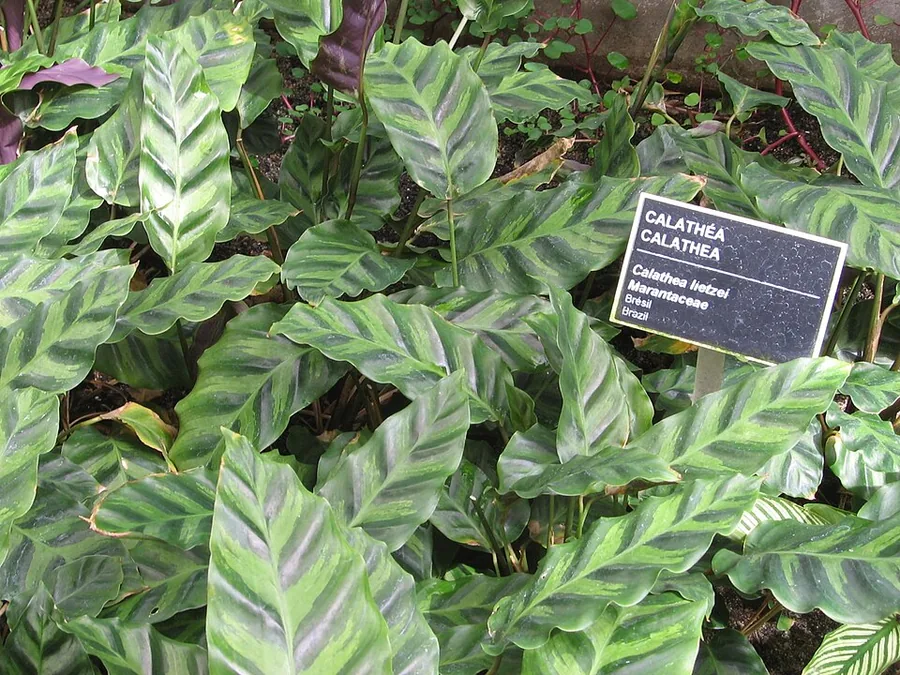
Calathea White Fusion is the showstopper of the prayer plant family, its leaves painted in marbled streaks of green, white, and a lilac flush on the underside. The accepted name is now Goeppertia lietzei 'White Fusion', after the genus was split off from Calathea, but most growers still know it by the older name. It comes from the Brazilian rainforest floor, and that shaded, humid home explains nearly everything about how to keep it happy.
This is a plant with a reputation, and it earns it. The white parts of the leaf hold little chlorophyll, which makes them gorgeous and also fragile, quick to scorch in sun and quick to brown at the edges in hard water or dry air. Add slow growth and a low tolerance for mistakes and you have a plant best suited to someone who likes a bit of fuss.
Get past the fussiness, though, and there's real charm here. The leaves fold up at night and open again by day, a habit called prayer movement that gives the family its common name. Keep the humidity high, the water clean, and the light bright but never direct, and you'll be paid back with some of the most striking foliage you can grow indoors.
Care
The short version: bright indirect light with no direct sun, clean water that isn't straight from the tap, soil kept evenly moist, and humidity above 60% held as steady as you can manage.
Light
Give it bright indirect light and keep it out of direct sun, which scorches the pale white tissue fast. It also takes partial shade or medium indirect light, but too little light leaves the new leaves small and weak with their colour washed out. An east or west window, or a few feet back from a bright one, hits the sweet spot.
Water
Keep the compost evenly moist through spring and summer, easing back to just moist in winter. Water from below or at the soil line and keep it off the leaves. The big thing is what you pour: tap water salts, chlorine, and fluoride brown the edges, so use distilled water, rainwater, or tap water left to stand for 24 hours.
Soil
Plant in a moist but well-drained mix, peaty or loam-based, with perlite worked in for drainage. A peat-free compost works fine too. The plant isn't fussy about pH and handles anything from 6.0 to 8.0.
Temperature
Keep it warm and steady, between 61°F and 75°F (16°C to 24°C). It hates cold draughts and sudden swings, so steer it clear of doorways and chilly windowsills. Never let it sit below 16°C.
Humidity
This is the make-or-break factor. Aim for humidity above 60%, the higher the better, since dry air is what crisps the leaf edges and invites spider mites. A humidifier holds the most reliable level, though a pebble tray or grouping it with other plants helps too.
Feeding
Feed monthly through the growing season, April to September, with a balanced liquid fertiliser at the usual strength. Stop over winter while growth slows. This is a slow grower, so it never needs heavy feeding.
Pruning
Pruning is light work here. Snip off any dead, browned, or damaged leaves at the base, and cut away leaves with extensive crispy edges or scorched white patches to keep the plant looking sharp. That's about all it asks.
Repotting
Repot every few years in spring or summer, when you spot roots circling the pot or poking out of the drainage holes, the plant drying out faster than usual, or weak new growth. Move it up just one pot size into fresh mix. Repotting is also the natural moment to divide it.
Size & spacing
This is a compact plant, reaching only 4 to 20 inches (10 to 50 cm) tall and about as wide, and it gets there slowly over several years. That modest size makes it easy to fit on a shelf, a desk, or a grouped display where the humidity stays up.
Troubleshooting
Almost every problem with this plant shows up on the leaves, and most trace back to water, light, or humidity. Read the early signs and you can usually fix the cause before the damage spreads. Match what you see below to find the likely culprit.
Wilting and yellowing while the soil stays wet
A plant that droops in soggy soil is the classic sign of root rot from overwatering. The roots turn brown and soft instead of firm and pale, and they can no longer drink. Ease off the watering and let the pot drain fully, then repot into fresh, well-drained mix and cut away any rotted roots, making sure the pot has drainage holes.
Fix:
- Reduce watering frequency and let excess drain fully
- Repot into fresh, well-drained mix, removing rotted roots
- Ensure the pot has drainage holes
Scorched, bleached patches on the white parts of the leaves
The white tissue on this cultivar carries little chlorophyll, so direct sun scorches it far sooner than it would damage a green leaf. You'll see the worst marks on the brightest leaves, right across the pale zones. Move the plant out of direct light to a spot with bright indirect light, or soften a strong window with a sheer curtain.
Fix:
- Move out of direct sun to a bright spot with indirect light or light shade
- Use an east/west-facing position or diffuse strong light with a sheer curtain
Stippled, silvery leaves with fine webbing underneath
Fine webbing on the leaf undersides and a stippled, silvery cast point to spider mites, which take hold fast in dry air. Rinse the foliage and wipe the undersides, raise the humidity to make the plant less inviting, and treat with insecticidal soap or horticultural oil, repeating as the label says.
Fix:
- Rinse foliage and wipe undersides of leaves
- Raise humidity, as mites thrive in dry conditions
- Treat with insecticidal soap or horticultural oil, repeating per label
Brown, crispy edges and tips on the leaves
This is the most common complaint, and the usual culprit is tap water. Salts, chlorine, and fluoride build up in the leaf tissue and burn the margins, while dry air and patchy watering make it worse. Switch to distilled water, rainwater, or tap water left to stand a full day, keep humidity above 60%, and trim the worst edges to tidy the plant.
Fix:
- Switch to distilled water, rainwater, or tap water left to stand 24 hours so chlorine evaporates
- Raise humidity above 60% with a pebble tray, grouping, or humidifier
- Keep compost evenly moist, never letting it fully dry out
- Trim severely browned edges for appearance
New leaves coming in green, small, or weak
When new growth emerges greener and smaller than the older foliage, the plant is short on light. Too little light also leaves it sparse and leggy. Move it to a brighter spot with bright indirect light and keep it out of dim corners, and the fresh leaves come back with their colour.
Fix:
- Move to a brighter spot with bright indirect light
- Avoid deep shade or low-light corners
Toxicity
Good news for pet owners: this is a safe plant to live with. The ASPCA lists Calathea and prayer plants as non-toxic to cats and dogs, with no poisonous compounds, so a stray nibble won't harm a curious pet. The only minor note is that the sap can irritate sensitive skin, so rinse your hands after pruning.
Safe for
People · Cats · Dogs · Horses · Rabbits · Livestock · Birds
Cats Safe
The ASPCA lists this plant as non-toxic to cats, so a curious nibble is nothing to fear. A cat that eats a lot of any houseplant might get a brief upset stomach, but there's no poison at work here.
Dogs Safe
Dogs are safe around it too. A pup that chews a leaf may drool or have a loose stool for a day, the way it would with any plant, but the foliage holds nothing harmful.
Horses Safe
Prayer plants in this family are listed non-toxic to horses, with no toxic principles. It's an indoor plant a horse would rarely meet, and it poses no danger if one did.
Rabbits Safe
A rabbit can taste a leaf without harm. There are no toxins to worry about, though large amounts of any unfamiliar greenery can loosen a rabbit's gut for a short while.
Livestock Safe
Grazing animals face no toxic compounds in this plant. As a tropical houseplant it stays well out of their reach, and it would cause no poisoning if eaten.
Birds Safe
Pet birds are in the clear. The leaves carry nothing toxic, so a bird that perches on the plant or pecks at a leaf comes to no harm.
People Safe
Safe to keep around children. The one small caveat is that the sap can leave a faint skin irritation on sensitive people, so rinse your hands after pruning.
Although classified non-toxic, NC State notes the sap may cause minor skin irritation/contact dermatitis in sensitive individuals; ingestion of any plant material can still cause mild gastrointestinal upset
How to propagate
There's just one way to make more of this plant, and it doubles as a chance to refresh a crowded pot.
DivisionModerate
Late spring, typically at repotting · Several weeks to a few months
Division is the only way to multiply this plant, since it won't grow from a stem or leaf cutting. The best time is late spring, usually when you're already repotting. Tease the rhizomatous clump apart into sections, each carrying its own roots and shoots, and pot them up separately. Give the new divisions warmth and humidity and they settle in over the next few weeks to a few months.
Myths
Calatheas, including this prayer plant, are poisonous to cats and dogs.
The opposite is true. The ASPCA lists Calathea and Prayer Plant, both in the Marantaceae family, as non-toxic to cats and dogs alike. You can keep one in a home with pets without worry.
The correct botanical name for this plant is Calathea lietzei.
That name is now out of date. Kew's Plants of the World Online gives Goeppertia lietzei as the accepted name, with Calathea lietzei as a synonym. Many plants once grouped under Calathea have since moved to Goeppertia, Ctenanthe, and Stromanthe.
You can water a Calathea with ordinary tap water.
Tap water is often what causes those brown leaf edges. The salts, chlorine, and fluoride in it collect in the tissue and burn the margins. Use distilled water or rainwater, or let tap water stand for 24 hours so the chlorine can escape.