Houseplant · Marantaceae
Peacock Plant
Goeppertia makoyana
Give it warmth, humidity, and soft water, and the peacock plant unfurls some of the boldest leaves you can grow indoors.
Bright indirect
65–75°F · 18–24°C
USDA 11–12
12–24 in · 30–60 cm
Overview
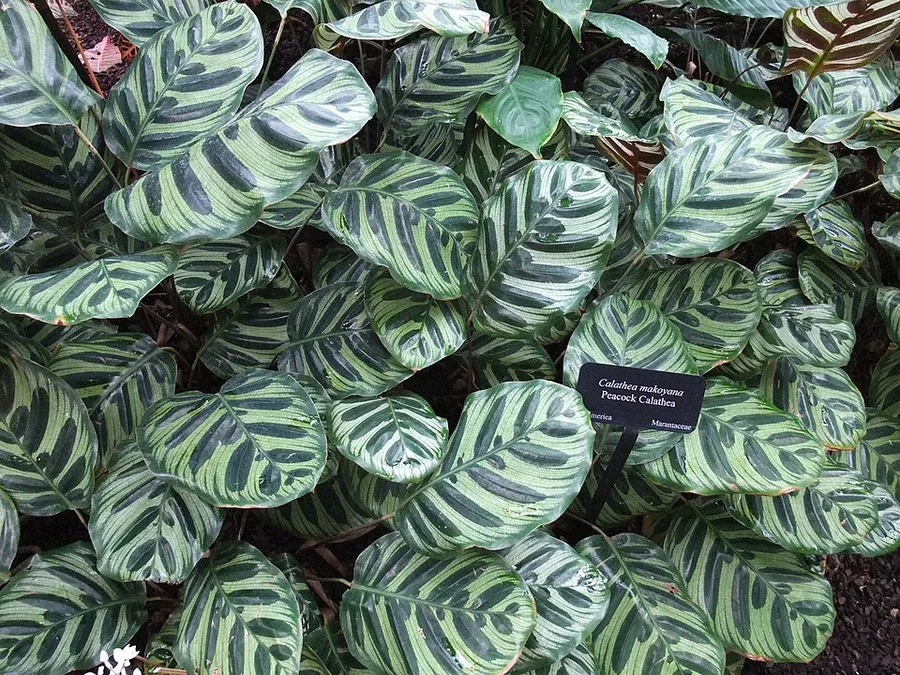
The peacock plant earns its name with every leaf. Bold green brushstrokes fan out from the midrib over a paler ground, with deep purple-red on the underside, so the markings read like the eye of a peacock feather. It belongs to the prayer plant family, the Marantaceae, and comes from the rainforest floor of eastern Brazil.
Like its relatives, it moves. The leaves fold upward in the evening and open again at dawn, a habit called nyctinasty that gives the plant a quiet rhythm through the day. That tropical home also sets the terms for growing it: warm air, steady moisture, and the kind of humidity you'd find under a forest canopy.
None of this makes it a beginner's plant. It is fussy about water and dry air, and it tells you in brown leaf edges the moment either slips. Get the conditions right, though, and few houseplants match the patterning on those leaves.
Care
The short version: bright indirect light, never direct sun, with soft water that keeps the soil moist but never soggy, warmth in the 65°F to 75°F (18°C to 24°C) range, and humidity at 60% or higher.
Light
Give the plant bright, indirect light, the kind you'd find a few feet from a window rather than on the sill. It also takes part shade or even full shade, but direct sun scorches the leaves and bleaches out the pattern that makes it worth growing.
Water
Keep the soil moist but never waterlogged through spring and summer, then ease off from fall into late winter. Use distilled or rain water, because the fluoride in tap water browns the leaf edges. Too much water is the fastest way to rot the roots.
Soil
Plant it in a well-drained, humusy mix rich in organic matter, with perlite worked in to keep it open. Aim for a pH on the acidic side of 8.0, and make sure the pot drains freely so the roots never sit wet.
Temperature
Hold the room between 65°F and 75°F (18°C to 24°C). This is a tropical plant with no tolerance for cold drafts, so keep it clear of chilly windows and air vents.
Humidity
Humidity is the part most people get wrong. The plant wants 60% or higher, and dry indoor air shows up fast as crisp brown edges, so a humidifier or a pebble tray usually earns its keep.
Feeding
Feed with a balanced fertilizer monthly through the growing season, spring into summer. Stop entirely in winter, when growth slows and the plant has no use for the extra nutrients.
Pruning
There's little to prune. Snip off any damaged or browned leaves as they appear, and wipe the broad leaves now and then with a damp cloth so dust doesn't dull the surface or block the light.
Repotting
Plan to divide and repot roughly every two years, in late spring. That refreshes the mix and splits the rhizome at the same time, which is also how you make new plants.
Size & spacing
It stays compact, reaching about 12 to 24 inches (30 to 60 cm) tall with a spread of 8 to 12 inches (20 to 30 cm). That tidy footprint makes it an easy fit for a shelf, a desk, or a grouping of other humidity-lovers.
Troubleshooting
Almost every problem with a peacock plant shows up on the leaves, and most trace back to water or air. Read the edges and the patterning, and you can usually name the cause before it spreads. Match what you see below, then fix the condition behind it.
Wilting and mushy stem bases even though the soil is wet
When a plant droops in soil that stays soggy, the cause is root rot from overwatering rather than thirst. Lift the plant, cut away the brown, soft roots, and repot into fresh, well-drained mix. From then on water only enough to keep the soil moist, never waterlogged.
Fix:
- Remove from wet soil and trim rotted roots
- Repot into fresh well-drained mix
- Water only to keep soil moist, never waterlogged
Fine webbing and speckled yellow stippling on the leaves
Dry indoor air invites spider mites, which spin fine webs on the undersides and leave the surface flecked with pale dots. Rinse the foliage and wipe the leaves down, then treat with insecticidal soap or horticultural oil. Raising the humidity makes the plant far less inviting to them.
Fix:
- Rinse foliage and wipe leaves
- Treat with insecticidal soap or horticultural oil
- Increase humidity to discourage mites
Brown, crispy edges around the leaves
This is tip burn from the fluoride, chlorine, and salts in tap water building up in the leaf tissue, and dry air makes it worse. Switch to distilled or rain water and push the humidity to 60% or higher. You can trim the worst margins to tidy the plant, but the browning won't reverse.
Fix:
- Switch to distilled water or rain water
- Raise ambient humidity to 60% or above
- Trim off badly browned margins for appearance
Faded pattern and bleached patches on the leaves
Too much direct sun scorches the foliage and washes the peacock-feather markings to a flat pale green. Move the plant back into bright indirect light or part shade, and pull off any leaves that are badly burned. The pattern returns on the new growth.
Fix:
- Move the plant to bright indirect light or part shade
- Remove severely scorched leaves
Toxicity
Good news for pet owners and parents: the peacock plant is safe. The ASPCA lists Calathea as non-toxic to cats, dogs, and horses, and there are no harmful compounds in the leaves for other animals or for people. You can set it anywhere in the home without worrying about a curious nibble.
Safe for
People · Cats · Dogs · Horses · Rabbits · Livestock · Birds
Cats None
The ASPCA lists this plant as non-toxic to cats, so a curious nibble won't poison them. A cat that gorges on any houseplant might still vomit from the roughage, but the leaves carry nothing harmful.
Dogs None
Dogs are in the clear here. The ASPCA rates the peacock plant safe for them, and there are no toxic compounds in the foliage to worry about if one takes a bite.
Horses None
Horses can graze near it without risk, since the ASPCA and NC State Extension both list the plant as non-toxic to them.
Rabbits None
Nothing in the leaves will harm a rabbit. It isn't a normal part of their diet, so a stray nibble is fine while their real food stays hay and greens.
Livestock None
Goats, sheep, and cattle face no poisoning from this Marantaceae plant. As a tropical houseplant it rarely crosses their path anyway.
Birds None
The peacock plant holds no toxins that would trouble a pet bird, so a tug at the foliage is harmless.
People None
Safe to keep in a home with children. The plant is grown for its leaves rather than for eating, but a mouthful won't poison anyone.
How to propagate
There's just one way to make more peacock plants, and it doubles as routine maintenance. You divide the rhizome when you repot, rather than rooting a cutting.
DivisionModerate
Late spring · Several weeks to a few months to establish new growth
The only way to multiply this plant is by dividing the rhizome, which fits naturally with the repotting it needs about every two years. Do it in late spring, easing the root ball apart into clumps that each keep a few healthy shoots, then pot them up and keep them warm and humid. New growth takes anywhere from a few weeks to a few months to settle in. Stem and leaf cuttings simply won't root.
Myths
The peacock plant is grown for its showy flowers.
The small purple-to-white flowers are easy to miss and rarely show up on a plant kept indoors. The real show is the foliage, where the markings spread across each leaf like the eye on a peacock feather. People grow it for those leaves, not for any bloom.
The peacock plant is toxic to pets.
The ASPCA lists Calathea as non-toxic to cats, dogs, and horses, and NC State Extension says the same for Goeppertia makoyana. You can keep this one in a house full of pets without worry.
Its correct botanical name is Calathea makoyana.
That name still turns up on plant tags everywhere, but it's now a synonym. Kew lists the accepted name as Goeppertia makoyana, following the 2012 reclassification that moved many Calathea into the genus Goeppertia.