
Introduction
Japanese barberry sits in yards all over the eastern United States. Most folks have no idea what this invasive shrub does to the ground beneath it. It looks like a safe hedge, but it rewires your soil and rolls out a welcome mat for ticks that spread Lyme disease.
I first saw the problem when Berberis thunbergii took over a corner of my test garden in under 2 seasons. The native plants around it died off fast. I kept finding ticks on my boots each time I worked near the shrubs. Studies back up what I saw. Forests with this barberry invasive species hold up to 12 times more ticks that carry Lyme disease.
The damage runs deeper than most people think. Japanese barberry shifts soil chemistry through a nitrogen loop that chokes out native plants. It now grows in 31 states and 4 Canadian provinces. Dense colonies keep 95% to 96% of their stems alive each year.
In my experience, most folks don't act until the ticks show up. This guide shows you how to spot japanese barberry in your yard and why it poses real health risks. I also cover the best proven ways to remove it and share native shrub options that give the same look without the harm.
Japanese Barberry Identification
You can spot this deciduous shrub from across your yard if you know what to look for. The easiest clue is the arching branch shape that bows out wider than it stands tall. In fall and winter, bright red berries hang from those branches and stay on the plant long after the japanese barberry leaves drop.
I teach barberry identification to new gardeners with one quick test. Scrape the bark on any stem with your thumbnail. If you see yellow inner bark right away, you've got a barberry. A single spine at each leaf node confirms it. Common barberry has 3 spines per node, so that single spine tells you it's the Japanese kind.
Leaves and Branches
- Leaf Shape: Small spoon-shaped leaves measuring 0.5 to 2.5 centimeters (0.2 to 1 inch) long with smooth, untoothed margins that distinguish them from common barberry.
- Leaf Color: Green varieties turn yellow, orange, or red in autumn, while purple-leaved cultivars like Crimson Pygmy maintain deep reddish-purple foliage all season.
- Branch Pattern: Multiple arching stems grow outward from the base, creating a mounded shape that is typically wider than it is tall at 1 to 2.5 meters (3 to 8 feet) spread.
Spines and Stems
- Spine Structure: Each node bears a single sharp spine, unlike common barberry which produces clusters of three spines per node at each leaf attachment point.
- Spine Composition: Spine tips are finer than a hypodermic needle and made of silicate material that decomposes very slowly if broken off under the skin.
- Stem Color: Outer bark appears rusty brown to grayish, but scraping the surface reveals distinctive bright yellow inner wood and cambium tissue.
Flowers and Fruit
- Flower Appearance: Small pale yellow to creamy flowers bloom in drooping clusters of two to five during April and May, each measuring about 6 millimeters (0.25 inches) across.
- Berry Description: Bright red berries measuring 7 to 11 millimeters (0.3 to 0.4 inches) long appear in late summer and often persist on branches through winter.
- Fruiting Rate: Wild-type plants produce approximately 1,135 seeds per plant, while the purple-leaved variety atropurpurea can produce around 3,000 seeds per plant.
Growth Habit and Size
- Mature Height: Typically reaches 1 to 2 meters (3 to 6 feet) tall, though some specimens in favorable conditions can grow up to 3 meters (10 feet) in height.
- Growth Rate: Adds approximately 30 to 60 centimeters (1 to 2 feet) of new growth per year under average garden or woodland conditions.
- Root System: Fine-root biomass is approximately 3 times greater than that of native blueberry shrubs growing in the same area, giving it a competitive underground advantage.
I've found one more detail that helps confirm the ID across seasons. Japanese barberry leaves pop out about 1 month before native shrubs like highbush blueberry. If a shrub in your yard turns green while everything else is still bare, check the stems for that telltale yellow wood.
6 Native Barberry Alternatives
You don't have to give up curb appeal when you pull out your barberry. I've tested dozens of native shrub alternatives over the years. These 6 barberry replacement plants match or beat japanese barberry across the board. Each one works as a non-invasive hedge that supports local birds instead of ticks.
I picked these based on how well they fill the same role in your yard. Plants like winterberry holly and ninebark give you red berries, dense form, and fall color without the damage. You can find every plant on this list at garden centers in most states. Spicebush rounds out the list as a great shade option for wooded yard borders.
Winterberry Holly
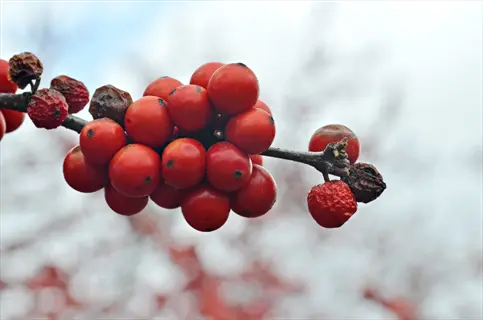
- Scientific Name: Ilex verticillata is a native deciduous holly that produces stunning clusters of bright red berries persisting through winter, a close match for the berry display of Japanese barberry.
- Growing Conditions: Thrives in USDA zones 3 through 9 in full sun to partial shade, preferring moist acidic soils but tolerating a wide range of conditions including clay and poorly drained areas.
- Mature Size: Reaches 1.8 to 4.5 meters (6 to 15 feet) tall and 1.8 to 3.6 meters (6 to 12 feet) wide, forming a dense rounded shape ideal for hedges and property borders.
- Wildlife Value: Berries provide critical winter food for cedar waxwings, robins, and at least 48 other bird species, unlike barberry berries which most native birds avoid.
- Deer Resistance: Rated moderate for deer resistance, and unlike barberry its presence does not create tick habitat or harbor white-footed mice populations.
- Ornamental Appeal: Brilliant red berries against bare winter branches create a striking seasonal display that many gardeners consider more dramatic than the barberry fruit it replaces.
Spicebush
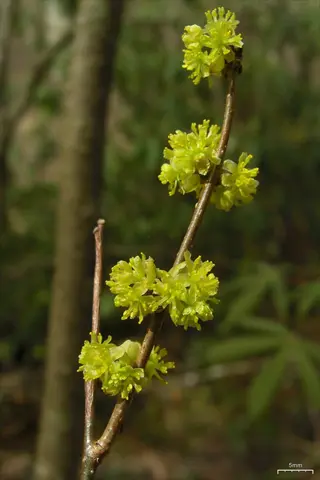
- Scientific Name: Lindera benzoin is a native aromatic shrub that offers year-round interest with fragrant yellow spring flowers, glossy summer foliage, and brilliant golden-yellow fall color.
- Growing Conditions: Grows in USDA zones 4 through 9 in partial to full shade, making it an excellent understory replacement for barberry in wooded areas and shaded garden borders.
- Mature Size: Typically reaches 1.8 to 3.6 meters (6 to 12 feet) tall and wide, forming a rounded multi-stemmed shape that provides similar screening and structure to barberry hedges.
- Wildlife Value: Serves as the host plant for the spicebush swallowtail butterfly, and its red drupes are a preferred fall food source for migrating songbirds including wood thrush.
- Deer Resistance: Strong deer resistance due to its aromatic oils, and the open branching structure does not create the dense humid microhabitat that promotes tick survival.
- Ornamental Appeal: Crushed leaves and stems release a pleasant spicy fragrance, and the tiny yellow flowers appear in early spring before leaves emerge, adding color when most gardens are still dormant.
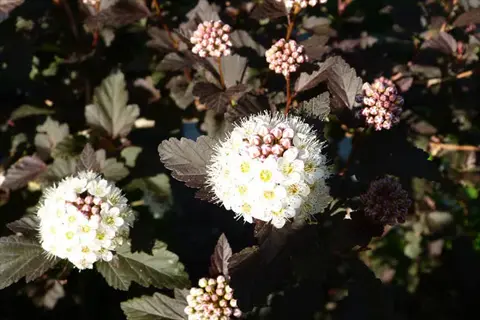
Ninebark
- Scientific Name: Physocarpus opulifolius offers deep burgundy to purple foliage in cultivars like Diablo and Summer Wine, providing the same rich color that draws homeowners to purple-leaved barberry varieties.
- Growing Conditions: Very adaptable in USDA zones 2 through 8, growing in full sun to partial shade and tolerating drought, clay soils, urban pollution, and salt spray along roadways.
- Mature Size: Reaches 1.5 to 3 meters (5 to 10 feet) tall and wide with a graceful arching form, and can be pruned to maintain a compact hedge similar in scale to Japanese barberry.
- Wildlife Value: White to pink flower clusters in late spring attract native pollinators including bees and butterflies, and the peeling bark provides winter habitat for beneficial insects.
- Deer Resistance: Top rated deer resistance with no known issues, and its open branching habit allows air flow that discourages the humid conditions ticks need to survive.
- Ornamental Appeal: Exfoliating bark peels in layers to reveal reddish-brown inner bark, adding multi-season visual interest that Japanese barberry cannot match during the winter months.
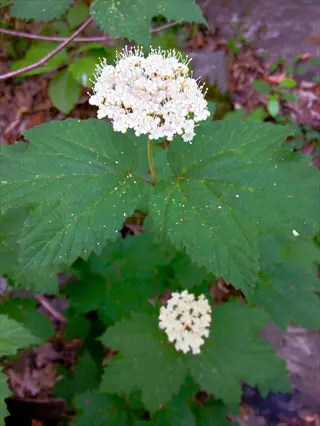
Mapleleaf Viburnum
- Scientific Name: Viburnum acerifolium is a compact native shrub with maple-shaped leaves that turn vivid pink to rose-purple in autumn, offering outstanding fall color for shaded landscape areas.
- Growing Conditions: Performs best in USDA zones 3 through 8 in partial to full shade, growing in dry to medium woodland soils where it would compete alongside or replace Japanese barberry.
- Mature Size: Grows 1.2 to 1.8 meters (4 to 6 feet) tall and wide, making it a direct size match for most Japanese barberry plantings in foundation beds and borders.
- Wildlife Value: Clusters of blue-black berries ripen in fall and are eaten by at least 35 bird species, while the flowers support native pollinators and beneficial insects in spring.
- Deer Resistance: Moderate deer resistance and spreads at a slow pace by root suckers to form attractive colonies, unlike barberry which spreads fast through bird-dispersed seeds and layering.
- Ornamental Appeal: Flat-topped clusters of creamy white flowers in late spring give way to colorful fruit and spectacular fall foliage that rivals any ornamental barberry cultivar.
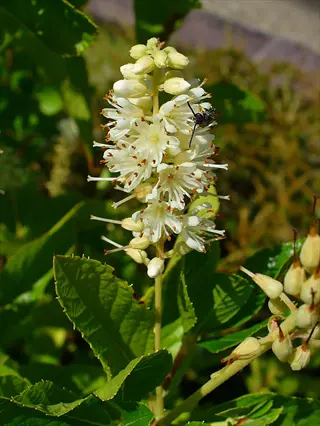
Sweet Pepperbush
- Scientific Name: Clethra alnifolia produces fragrant white or pink flower spikes in mid to late summer when few other native shrubs are blooming, filling a seasonal gap in the garden.
- Growing Conditions: Thrives in USDA zones 3 through 9 in full sun to partial shade, excelling in moist to wet acidic soils and tolerating salt spray, making it versatile for coastal and inland gardens.
- Mature Size: Reaches 1.5 to 2.4 meters (5 to 8 feet) tall and 1.2 to 1.8 meters (4 to 6 feet) wide, forming a dense upright colony that provides effective privacy screening.
- Wildlife Value: The strong fragrant summer flowers are a major nectar source for butterflies and native bees, earning it the common name summersweet for its sweet scented blooms.
- Deer Resistance: Strong deer resistance and does not harbor tick populations, making it a safe choice for properties where Lyme disease risk is a concern in tick zones.
- Ornamental Appeal: Golden-yellow fall foliage combines with persistent brown seed capsules for extended seasonal interest well beyond the spectacular summer flowering period.
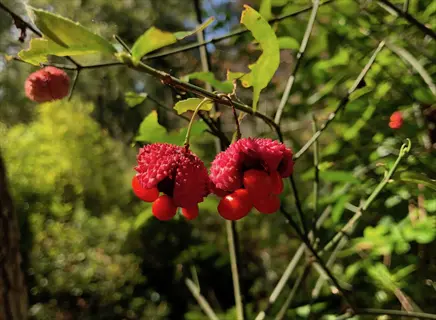
Strawberry Bush
- Scientific Name: Euonymus americanus is a native understory shrub with bumpy textured pink to red fruit capsules that split open in fall to reveal bright orange seeds inside.
- Growing Conditions: Grows in USDA zones 6 through 9 in partial to full shade, preferring moist well-drained soils in woodland settings where Japanese barberry often invades the understory.
- Mature Size: Reaches 1.2 to 1.8 meters (4 to 6 feet) tall with an upright spreading habit, fitting into the same landscape spaces where compact barberry varieties are often planted.
- Wildlife Value: The distinctive fruit is eaten by wild turkeys, songbirds, and other wildlife, and the green stems provide year-round photosynthesis even after the leaves drop in autumn.
- Deer Resistance: Sometimes browsed by deer, which is how it earned the folk name hearts-a-bustin, but it bounces back fast and does not create dense tick habitat like barberry.
- Ornamental Appeal: The warty textured fruit capsules bursting open to display orange seeds are unlike anything else in the native plant palette and create a memorable conversation piece in fall gardens.
Tick and Lyme Disease Link
The link between japanese barberry ticks and your health is not a guess. Hard data backs it up. Forests with barberry hold 12 times more Lyme carrying black-legged tick counts than clean forests. A Trinity College study tracked these numbers at many test sites.
Here's how barberry lyme disease risk builds in your yard. The dense canopy creates a tick microhabitat that holds in moisture and heat. This stable, humid zone is perfect for the Ixodes scapularis to breed. The white-footed mouse carries the Lyme bacteria and hides in these same thickets. Ticks feed on the mice and pick up the disease.
In my experience, this chain reaction shows up fast on properties with barberry. I've seen tick counts on drag cloths go through the roof near thick barberry patches. A 5 year study in Connecticut proved it on a larger scale. Teams that cleared barberry saw ticks drop to near zero by year 3. Those numbers stayed low through year 5.
This problem keeps reaching new areas. Ohio saw steady increases in Lyme disease cases over the past decade. Two new tick species showed up there in 2020. You should watch for barberry on your land even if ticks never bothered you before.
How Japanese Barberry Spreads
Japanese barberry fights on two fronts at once to take over your land. Above ground, barberry seed dispersal, branch layering, and rhizomes claim new ground fast. Below ground, it wages a hidden war on your soil that most people never see.
Birds eat the red berries and spread seeds far from the parent plant. Those seeds have a 60% to 70% germination rate in the field, so most of them sprout. About 92% of new seedlings pop up within 1 meter of the parent, but bird drops can start new patches more than 100 meters into clean forest. Seeds also stay alive in the soil for up to 9 years, which gives this plant incredible seedbank viability.
Vegetative reproduction does just as much damage. Branches that touch the ground root themselves through branch layering. Underground rhizomes send up new shoots around the base. I've pulled a single barberry and found root connections to 3 or 4 other stems that all looked like separate plants.
The soil pH change angle is what makes barberry so hard to beat. A 2001 study proved that soils under barberry have much higher pH and nitrogen cycling rates. Barberry soaks up nitrate, then drops nitrogen rich leaf litter. That litter pushes nitrification up even more. Earthworm numbers climb in this changed soil, which pushes pH up further. This feedback loop locks native plants out of the ground and gives barberry a permanent edge.
In my experience, you won't fix this problem with a single pull or cut. Fast seed spread, tough roots, and rewired soil chemistry all work together. You need a plan that covers all three fronts at once.
Barberry Removal Methods
Barberry removal works best when you match your method to the size of your problem. Small patches call for manual removal with a mattock and thick gloves. Large colonies need an IPM approach that brings in herbicide for barberry along with cutting tools. I've used every method on this list and can tell you which ones save time and which ones waste it.
The numbers tell the story. Foliar treatment with triclopyr kills 93% of treated plants. A mix of glyphosate plus triclopyr at a 2:1 ratio works even better on big stands. Cut and burn gets you close to 90% cover drop, while flame weeding alone never topped 40%. Check the table below before you pick your approach.
No matter which method you choose, you must come back and check for regrowth. Seeds stay alive in the soil for up to 9 years after you clear the parent plants. Plan on watching your site for new sprouts every spring for at least 3 to 5 years after your first pass.
States That Ban Barberry
More states are making japanese barberry banned from sale every year. In my work with garden centers and land managers, I've seen this shift speed up as the tick data becomes harder to ignore. You need to know your local state regulations before you buy, sell, or even keep barberry on your land.
The barberry prohibited list keeps growing. Some states run a full ban, while others put it on their noxious weed list or set barberry sale restrictions on certain types. A big debate around the sterile cultivar exemption drives a lot of the rule changes. Maryland says no cultivar gets a pass, no matter what the label claims. Here's where things stand state by state right now.
Pennsylvania
- Ban Status: Full ban on sale and cultivation of all Japanese barberry cultivars took effect on October 8, 2021 under the state noxious weed control regulations.
- Enforcement: The Pennsylvania Department of Agriculture enforces the ban, and nurseries caught selling Japanese barberry face fines and loss of their nursery license.
- Homeowner Impact: You don't have to remove existing Japanese barberry on private property, but you cannot replant or purchase new plants anywhere in the state.
Massachusetts
- Ban Status: Massachusetts was among the first states to ban Japanese barberry, with restrictions taking effect on January 1, 2009 after being listed as an invasive species.
- Scope: The ban covers importation, sale, and trade of all Berberis thunbergii cultivars within the state, with no exemptions for marketed sterile varieties.
- Conservation Context: Documented damage to native New England forests drove the state ban after surveys found barberry in 45% of 20th-century secondary hardwood forests.
Maryland
- Ban Status: Maryland classifies Japanese barberry as a prohibited species under state law, and the Maryland Department of Agriculture enforces these rules.
- Cultivar Policy: Regulations apply to all cultivars unless individually granted an exemption, and marketing a variety as sterile does not automatically exempt it from the prohibition.
- Key Detail: Maryland explicitly addressed the sterile cultivar debate in its regulations, setting a precedent that other states have considered when drafting their own barberry policies.
New York and Connecticut
- Regulatory Status: Both states list Japanese barberry as an invasive species with varying levels of sale restrictions depending on the specific cultivar and its documented fertility rate.
- Research Connection: Connecticut is home to the Agricultural Experiment Station that produced the landmark 5-year study proving barberry removal reduces tick populations to near zero.
- Practical Effect: Nurseries in both states face increasing pressure to remove Japanese barberry from inventory as public awareness of the tick connection grows.
Midwestern and Other States
- Growing Awareness: Several midwestern states including Ohio are tracking the expansion of Japanese barberry alongside rising Lyme disease case counts and the arrival of new tick species.
- Noxious Weed Listings: Multiple states have placed Japanese barberry on their noxious weed watch lists, which is often the first step before implementing a full sales ban.
- Range Expansion: Surveys document Japanese barberry in 31 states total, and more states move toward bans as ecological and public health data piles up.
Check with your state's department of agriculture before you make any choices about the barberry on your land. Rules change fast in this area, and staying ahead of a ban saves you trouble down the road.
5 Common Myths
Sterile cultivars of Japanese barberry are safe to plant because they cannot spread or produce viable seeds in the wild.
Research shows that marketed sterile cultivars still produce some viable seeds, and several states including Maryland do not exempt any cultivars from their barberry bans regardless of sterility claims.
Japanese barberry only grows in full sunlight and cannot survive in shaded forest understory conditions.
Japanese barberry thrives in conditions ranging from full sun to deep shade, and its leaves emerge about one month earlier than native competitors, giving it a major advantage in forest understory environments.
Pulling out Japanese barberry by hand once is enough to permanently eliminate it from your property.
Seeds can remain viable in the soil for up to 9 years, and any root fragments left behind can regenerate new shoots, so follow-up monitoring for several years is essential after initial removal.
Japanese barberry is a native North American plant that belongs in eastern United States forests and woodlands.
Japanese barberry is native to Japan and was first introduced to the United States in 1875 as an ornamental replacement for common barberry, which hosted black stem rust of wheat.
The connection between Japanese barberry and increased tick populations is just speculation without any real scientific evidence.
A peer-reviewed study found that forests containing Japanese barberry have up to 12 times more Lyme disease-carrying ticks, and a five-year Connecticut study showed that removing barberry reduced tick levels to near zero by year three.
Conclusion
Japanese barberry hits your property on three fronts at once. It rewires your soil chemistry so native plants can't compete. It boosts tick numbers by up to 12 times, which raises your family's Lyme disease risk. And more states now ban it every year, so keeping it could put you on the wrong side of the law.
The good news is that barberry control works when you use the right tools. Foliar triclopyr gives you 93% kill rates on treated plants. Studies show that japanese barberry removal drops tick counts to near zero within 3 years of clearing. Those are real results you can count on in your own yard.
Keep in mind that invasive species management with barberry is a long game. Seeds sit alive in your soil for up to 9 years after you pull the last plant. You need to check your cleared areas every spring and treat new sprouts right away. Native plant restoration fills the gaps and helps your soil heal from the damage barberry caused.
In my years of working with this plant, I've seen the full arc. People brought japanese barberry to the U.S. in 1875 to fix a wheat disease problem. Now we spend years trying to undo that choice. Start your removal project today to protect your yard, cut your tick risk, and get ahead of the bans headed your way.
External Sources
Frequently Asked Questions
What damage does the Japanese barberry cause?
Japanese barberry displaces native plants by forming dense thickets, alters soil chemistry by increasing pH and nitrogen levels, and creates tick-friendly microhabitats that raise Lyme disease risk.
Should I get rid of my Japanese barberry?
Yes, removing Japanese barberry is strongly recommended because it is invasive, attracts disease-carrying ticks, and is banned or restricted in many states.
Are Japanese barberry berries edible?
Japanese barberry berries are technically edible but extremely tart and contain the alkaloid berberine, making them unpalatable for most people.
What is the difference between barberry and Japanese barberry?
Common barberry has toothed leaf margins and three-pronged spines, while Japanese barberry has smooth-edged leaves and single spines per node.
Is Japanese barberry poisonous to touch?
Japanese barberry is not chemically poisonous to touch, but its spines are finer than a hypodermic needle and contain silicate that decomposes slowly under the skin.
What kills Japanese barberries?
Foliar-applied triclopyr achieves 93 percent mortality, while a combination of glyphosate and triclopyr at a 2:1 ratio is recommended for large infestations.
What is the lifespan of a Japanese barberry?
Japanese barberry shrubs can live for several decades, with individual stems surviving at rates of 95 to 96 percent annually in dense populations.
Why does Japanese barberry attract ticks?
Japanese barberry creates a low, dense canopy that buffers temperature and humidity, providing the moist microhabitat that black-legged ticks need to survive.
Is Japanese barberry good for anything?
Japanese barberry contains berberine, an alkaloid with antibacterial properties, and has been studied as a potential substitute for endangered goldenseal.
Can I burn Japanese barberry?
Burning alone achieves a maximum of 40 percent mortality, but combining cutting with burning reaches nearly 90 percent cover reduction.