
Introduction
Few spring sights match a wave of grape hyacinth in full bloom. You can spot the deep blue drifts from across the garden, spread over beds and borders like a spill of paint. At Keukenhof Gardens in the Netherlands, they form a famous stretch called the Blue River. You get more than pretty photos here, though. The facts come from university and garden experts you can trust.
So what is this plant? The type you want is Muscari armeniacum, and it is the one most gardeners grow. This small spring bulb grows just 6 to 9 inches tall. It shrugs off cold winters and thrives in USDA zones 4 to 8, so it will feel at home in your yard. Its home ground is southeastern Europe and Asia Minor. Each bulb pushes up tight spikes of blue bells that clump like fruit in your beds, and that look gives the plant its name. Plant a few spring bulbs one fall and you get a fresh sheet of blue the next spring.
Most guides walk you through the planting steps but go quiet on two real questions. Is grape hyacinth invasive? Does it feed bees, or just look pretty in a photo? You get straight answers here, backed by sourced facts.
You will learn how to grow grape hyacinth from a single bulb to a full spring show. We cover planting, care, and the best varieties to try. You will also see its real value to bees and the honest choice between this bulb and native plants. Get the basics right and a handful of bulbs turns into a blue carpet within a few short years. Start below, and you will plant with a clear plan.
What Grape Hyacinth Is
So what is grape hyacinth, and why does it earn a spot in your spring garden? The plant you mean is most often Muscari armeniacum. It is a small bulb from southeastern Europe. Each spring it sends up spikes of deep blue in April and May. It sits in the family Asparagaceae, a genus of about 40 species. The common name comes from its flower cluster, which looks to you like a tiny bunch of fruit.
Each bulb sends up 1 to 3 flower stalks, and every stalk carries 20 to 40 urn-shaped florets packed so close they touch. Look closely and you see cobalt blue flowers with a thin white rim around each mouth. They open from the bottom of the spike toward the top. Gardeners and botanists call this kind of spike a raceme, and to you it looks like an upside down bunch of grapes. That is where the name grape hyacinth comes from.
Flowers are numerous, royal blue with a thin white rim on each bell, urceolate, fragrant, and nodding in dense 1"-3" scapose racemes.
For all that detail, the whole plant stays small. In bloom it stands just 6 to 9 inches (15 to 23 cm) tall. That compact size is why you can tuck it into the front of a bed or slip it between rocks in a rock garden. A single flower spike is not much bigger than your thumb.
The leaves tell their own story. These strappy green blades grow longer than the flowers and reach up to 12 inches (30 cm). They push up in fall, ride out the cold, and stay green through winter. So you get blooms as soon as spring arrives, long before you plant much else.
How to Plant Grape Hyacinth
One October I knelt in the damp back corner where my lawn meets the woods edge. I planted armeniacum bulbs one after another, pressing each into cool soil. Every bulb went 3 to 4 inches (8 to 10 cm) down and sat 2 to 3 inches (5 to 8 cm) from its neighbor, pointed end up. Drop, cover, shift my hand a few inches, repeat. My knees got wet and the basket sat empty in under an hour.
When to plant grape hyacinth is the part people fret over, but the window is wide. Set the bulbs in early to mid fall, a few weeks before the ground freezes hard. Plant earlier in cold northern zones and a bit later in mild southern ones. The steps below break down how to plant grape hyacinth, with the right planting depth and bulb spacing for strong spring blooms.
Choose a site with well-drained soil and full sun to partial shade; raise the bed 2 to 3 inches (5 to 8 cm) if drainage is poor.
Set each bulb 3 to 4 inches (8 to 10 cm) deep, roughly three times the height of the bulb, so it roots below frost.
Place bulbs 2 to 3 inches (5 to 8 cm) apart with the pointed end up so the shoots emerge cleanly in spring.
Firm the soil and water once after planting so the bulbs settle into even moisture before winter dormancy.
Do not till the bed deeply after planting. Deep tilling buries self-sown seed too far down and disturbs the shallow bulbs.
Where you plant matters as much as how deep you dig. Grape hyacinth wants well-drained soil, since soggy ground rots the bulbs over winter. Full sun gives you the most vigor and the fullest flowers, while a spot with partial shade trades some punch for blooms that last longer into spring. Mix a little bone meal into each hole, and the bulbs root faster their first fall.
Grape Hyacinth Care Basics
Grape hyacinth care asks less of you than almost any other spring bulb. Once the plants settle in, they shrug off drought, grow fine in poor soil, and even tolerate the juglone that black walnut trees leak into the ground. That toughness is what makes them true low-maintenance bulbs and not just a tidy marketing line.
Watering is the one habit worth getting right. Give the soil a light drink through spring while the flowers are open, then back off once the leaves begin to yellow. Standing water rots a bulb far faster than a dry spell ever will, so good drainage matters more than any feeding routine you follow.
Feeding calls for a light hand, not a heavy one. Too much fertilizer pushes the plant to grow lush leaves while it makes fewer flowers, which is the opposite of what you want. A little bone meal at planting and a modest feed as the blooms fade covers everything the bulb needs to store energy.
Good after bloom care comes down to patience. Let the foliage stand until it yellows in early summer, because those fading leaves feed energy back into the bulb for next spring. Fresh growth returns in mid fall and holds through mild winters. Plan on dividing grape hyacinth every 4 to 5 years. Lift the crowded offsets during summer dormancy, then tuck them back in at the same depth. Start new plants from seed instead and you may wait up to 4 years for the first blooms.
Watering
- Spring growth: Keep soil lightly moist but never waterlogged while the plant is actively flowering in April and May.
- Summer dormancy: Ease off water once foliage yellows, since the resting bulbs prefer drier soil through their dormant weeks.
- Drainage first: Standing water rots bulbs faster than drought harms them, so prioritize a free-draining site above all.
Feeding
- At planting: Work a little bone meal into the hole to support strong root development in the first fall.
- After bloom: A light feed as flowers fade helps the bulb store energy, but go easy to avoid all-leaf, no-flower growth.
- Restraint wins: Overfeeding pushes lush foliage while reducing blooms, so treat grape hyacinth as a light feeder.
After flowering
- Leave the leaves: Let foliage yellow naturally before removing it, because fading leaves recharge the bulb for next spring.
- Deadhead if needed: Snip spent flower stalks before seed sets if you want to slow the plant's self-seeding.
- Fall return: Expect fresh foliage to re-emerge in mid fall and hold through mild winters until the next bloom.
Dividing
- Every 4 to 5 years: Lift crowded clumps and separate the bulb offsets to keep blooms vigorous over time.
- Best timing: Divide during summer dormancy once the foliage has died back, then replant offsets at the same depth.
- Share the extras: Surplus bulbs transplant easily and make simple gifts for other gardeners rather than going to waste.
Resist the urge to cut the floppy leaves early; removing green foliage before it yellows starves the bulb and weakens next spring's display.
Best Grape Hyacinth Varieties
The white Album florets caught the last of the low spring light at the woods edge in my yard. They glowed like small pearls beside the deep cobalt armeniacum I had set right next to them. I tucked the two forms together the fall before, half on a whim. That one patch pulled my eye every time I walked past it for weeks.
Most gardeners think of one thing when they hear grape hyacinth: a short spike of blue grape hyacinth bells. The genus holds about 40 species, and the muscari cultivars you can buy run well past that single shade. You can plant a white grape hyacinth, a bicolor spike with dark and pale florets, and even a fragrant grape hyacinth in warm yellow. The grape hyacinth varieties below cover that full range, so you can build spring beds with more than one flat blue.
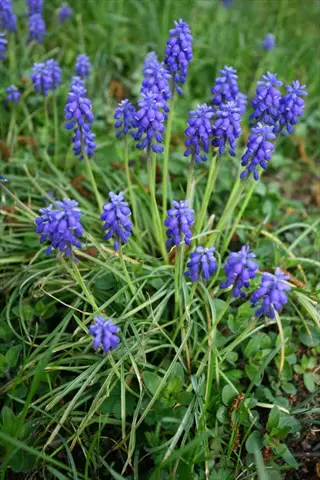
Muscari armeniacum
- Color: The classic cobalt to violet-blue florets with a thin white rim are the image most gardeners picture.
- Size: Compact stalks stand 6 to 9 inches (15 to 23 cm) tall, ideal for edging paths and front borders.
- Bloom: Reliable April and May flowering makes it the workhorse of the spring bulb display.
- Fragrance: The florets carry a soft, musky, grape-like scent that reads best in a warm, sheltered spot.
- Use: Naturalizes into broad drifts, so it suits mass plantings under trees and along slopes.
- Hardiness: Dependable across USDA zones 4 to 8, returning and multiplying year after year with little care.
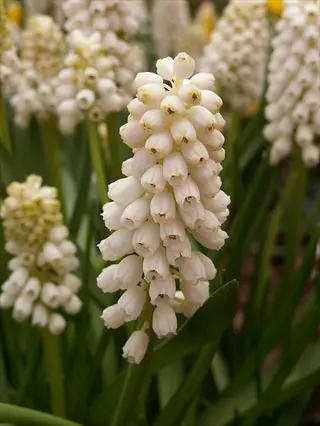
White grape hyacinth (Album)
- Color: Pure white, pearl-like florets give a crisp, luminous look that brightens shady corners.
- Size: Stays low at about 6 to 8 inches (15 to 20 cm), matching the blue forms in scale.
- Bloom: Flowers in mid spring alongside the blue types for an easy two-tone combination.
- Pairing: Sometimes sold as Pearls of Spain, it looks striking woven through the standard cobalt armeniacum.
- Use: Excellent for lighting up the front of a border or the base of dark evergreens.
- Care: Needs the same well-drained soil and fall planting as its blue relatives, with no extra fuss.
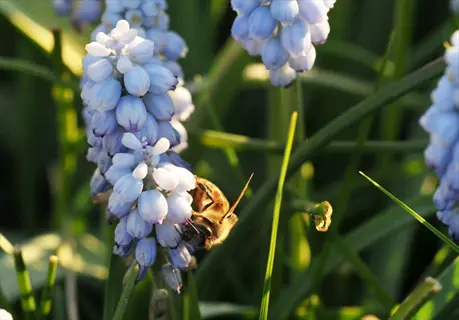
Valerie Finnis
- Color: A soft, powder-ice blue that is paler and more subtle than the intense cobalt of armeniacum.
- Size: Similar compact habit at 6 to 8 inches (15 to 20 cm), a good fit for small spaces.
- Bloom: Mid-spring flowering makes a fine match with tulips, daffodils, and other blue-toned bulbs.
- Design: The muted tone cools down hot color schemes and softens bold spring plantings.
- Use: Works well in containers and window boxes where its gentle color can be seen up close.
- Hardiness: Shares the same zone 4 to 8 toughness and easygoing, low-maintenance temperament.
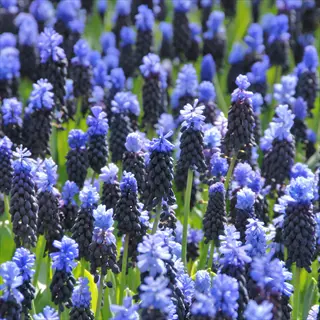
Muscari latifolium
- Color: A two-tone spike with dark violet-blue fertile florets below and paler blue sterile ones on top.
- Size: A touch taller and more upright, making a bold vertical accent in the spring bed.
- Foliage: Distinctive in producing a single broad leaf per bulb, unlike the grassy foliage of other types.
- Bloom: Flowers in mid spring and adds welcome contrast among single-color drifts.
- Use: Its architectural, bicolor spike stands out in containers and at the front of mixed borders.
- Hardiness: Grows dependably in USDA zones 4 to 8 with the same simple care as common grape hyacinth.
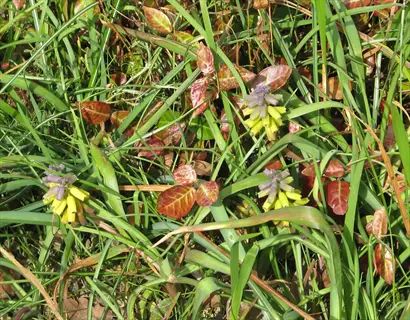
Golden Fragrance
- Color: An unusual warm yellow to olive-and-purple form of Muscari macrocarpum, a break from the usual blues.
- Scent: The most perfumed of the common grape hyacinth types, with a rich, sweet smell.
- Size: Low-growing and best appreciated up close where its scent and coloring can be enjoyed.
- Bloom: Mid-spring flowers bring a rare yellow note to the early bulb palette.
- Use: A standout for containers set near doorways, patios, and paths where people pass by.
- Care: Wants sharp drainage and a warm, sunny position to perform and scent its best.
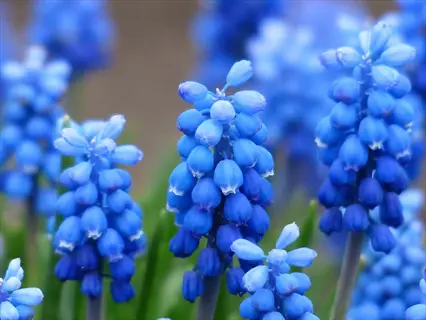
Muscari azureum
- Color: Bright sky-blue florets in a slightly looser, softer spike than the tightly packed armeniacum.
- Size: One of the smallest at just 4 to 6 inches (10 to 15 cm), perfect for rock gardens.
- Bloom: Among the earliest to open, extending the grape hyacinth season at its front end.
- Use: Its diminutive scale suits troughs, alpine beds, and the very front edge of borders.
- Pairing: The clear azure tone combines well with early crocus and dwarf iris.
- Hardiness: Reliable in USDA zones 4 to 8 and just as easy to grow as its larger cousins.
Size is worth a thought too. The smallest, Muscari azureum, tops out at just 4 to 6 inches (10 to 15 cm), while tassel types push taller and looser. Whatever form you pick, plant it in a real drift. When you set out at least 25 bulbs in one block, they read as a single bold sweep of color, while a scattered dozen just looks like dots someone dropped.
Pollinator and Wildlife Value
Grape hyacinth pollinators arrive early, and that timing does the heavy lifting. Bees wake up hungry in spring. The blue florets open across April and May, when most of your garden still sits bare. So grape hyacinth hands you an early spring nectar and pollen source, right when bees need it most.
The plant earns its keep beyond the bee traffic. It is deer resistant enough for yards where deer roam, though NC State Extension says they still nibble it now and then. So treat it as resistant, not a promise against every hungry deer. Rabbits tend to leave it alone too. NC State also lists it non-toxic to pets such as cats, dogs, and horses. So your curious dog or cat is no reason to skip it.
Food for early bees
- Timing: Blooming in April and May, it offers nectar and pollen when few other flowers are open for hungry bees.
- Visitors: Honeybees and other early foragers work the florets, making it a useful pollinator plant for spring gardens.
- Massing: A broad drift concentrates the food source, so bees can work many florets in one short visit.
Deer and rabbit resistance
- Resistant, not immune: Grape hyacinth is mostly left alone, but NC State notes deer damage it now and then.
- Practical upshot: It is a smart choice for browse-prone yards, though no bulb is a guarantee against determined deer.
- Companion planting: Interplanting it with tulips can help mask those more deer-tempting bulbs among the resistant foliage.
Safety around pets
- Non-toxic listing: NC State Extension lists the plant non-toxic to cats, dogs, and horses, easing pet-owner worries.
- Sensible caution: Being non-toxic is not an invitation to let pets chew bulbs, which can still cause stomach upset.
- Reassurance: This resolves the mixed messages online, where some sources call it a bit toxic without any sourcing.
Pollination biology
- Insect-dependent: Research on Muscari relatives shows the genus relies on insects, not wind, to set seed.
- Primary pollinator: Honeybees lead the visitors, with bumblebees and hoverflies playing secondary roles in the studies.
- Why it matters: That dependence on insects ties the plant's seed production to healthy local pollinator activity.
The science backs this up. One 2025 study makes the point. Researchers tested wild Muscari from Turkey. These were not the common garden plant. They found the whole group needs insects to set seed. Honeybees did most of the work. A few bumblebees and hoverflies helped as well. With just wind and no insects, the plants set no fruit at all. So bee traffic matters for the blooms in your garden.
The absence of fruit set in wind-pollination treatments across all species confirms that effective pollination is mediated exclusively by insects, reinforcing the entomophilous nature of these taxa.
Is It Invasive? Native Picks
A ribbon of blue has crept a foot or two toward my lawn over eight springs. I planted just a dozen bulbs in one damp back corner and left them there. I never moved a single one. The self-seeding did the traveling. Each May the ripe seed dropped a little farther, until the drift reached the grass edge.
So is grape hyacinth invasive? The honest answer is that it can be. NC State Extension warns that it naturalizes fast and can turn weedy. Left alone, it may crowd out other plants over the years. The Invasive Plant Atlas of the United States goes further. It names a close cousin, Muscari botryoides, as invasive on some park land. Those parks include Antietam, Harpers Ferry, and Stones River. They sit in Maryland, West Virginia, and Tennessee.
You still keep plenty of control here. NC State Extension says growing it in containers holds the weedy spread in check. The bulbs and seed stay boxed in one place, with no room to wander. Deadheading before the seed sets does the rest. Snip the spent flower stalks once the color fades, and you cut off next year's spread.
Want that spring blue without the risk of invasive grape hyacinth taking over your beds? Several native plants give you the same early color and far better manners. The table below lists strong native alternatives, each a spring bloomer that feeds local pollinators. Virginia bluebell and woodland phlox suit shade, while creeping phlox and bird's-foot violet take sunnier, leaner ground.
Grape hyacinth naturalizes readily and can become weedy, and Muscari botryoides is listed invasive on some U.S. National Park lands; grow it in containers or deadhead to limit spread.
5 Common Myths
Grape hyacinths are true hyacinths and share their heavy perfume and large, showy blooms on a single thick stalk.
They belong to the separate genus Muscari, with small urn-shaped florets in dense clusters and only a light, musky, grape-like scent.
Grape hyacinth is toxic and unsafe around pets, so it should never be planted where dogs or cats can reach it.
NC State Extension lists it non-toxic to cats, dogs, and horses, though no pet should be encouraged to chew on the bulbs.
Grape hyacinth is completely deer-proof and browsing animals will never touch the flowers or the strappy foliage.
It is largely deer-resistant, but NC State notes it is occasionally damaged by deer, so treat it as resistant rather than immune.
Grape hyacinth stays in a neat clump and will never travel beyond the small spot where you first plant it.
It naturalizes readily through bulb offsets and self-seeding and can become weedy, crowding out other plants when left unmanaged.
You should cut grape hyacinth foliage back the moment the flowers fade to keep the garden bed looking tidy.
Leave the leaves until they yellow naturally, because the fading foliage recharges the bulb for next spring's flowers.
Conclusion
You now have everything you need to feel confident growing grape hyacinth in your own yard. This compact spring bulb stands just 6 to 9 inches (15 to 23 cm) tall and shrugs off cold winters across USDA zones 4 to 8. Plant the bulbs in fall, 3 to 4 inches (8 to 10 cm) deep with the pointed end up. Then let them rest. By April and May, each muscari bulb pushes up dense blue spikes right on cue.
The care could hardly be simpler. Grape hyacinth is nearly foolproof, and it feeds hungry bees at a time when little else is in bloom. These low-maintenance bulbs ask for almost nothing once they settle into well-drained soil. Give them full sun for the strongest color, or a bit of shade to stretch the show, and they handle the rest on their own.
That same toughness comes with one honest catch. The plant spreads fast through bulb offsets and self-sown seed, so it can crowd out gentler neighbors if you let it wander. Grow it in containers or tidy borders where you can watch the drift. Would you rather not manage its spread? Plant a native alternative instead. You still get early color, minus the takeover.
Few spring bulbs give back this much for so little effort. Muscari ranks among the most dependable pollinator plants in the early garden. You will find it everywhere, from small home borders to the famous Keukenhof Blue River. Each spring you can look forward to a blue drift that returns a shade wider than before. That steady wave of color arrives just as winter loosens its grip. It is the quiet reward that keeps you thinking about next year's grape hyacinth.
Glossary
- entomophilous
- Pollinated by insects rather than by wind or other means.
- floret
- One of the many small individual flowers that together make up a larger flower cluster.
- Muscari armeniacum
- The botanical name for the common grape hyacinth, a small blue-flowered spring bulb.
- naturalize
- To spread and settle in on its own over time so a planting widens without being replanted.
- offset
- A small bulb that forms beside a parent bulb and can be separated to grow a new plant.
- raceme
- A long flower cluster in which many small florets attach along a single central stalk by short stems.
- scape
- A leafless flower stalk that rises directly from the bulb at ground level.
- urceolate
- Shaped like a small urn or pitcher that narrows at the mouth, as grape hyacinth florets are.
External Sources
Frequently Asked Questions
Is grape hyacinth toxic to dogs and cats?
NC State Extension lists grape hyacinth (Muscari armeniacum) as non-toxic to cats, dogs, and horses, though pets should not be encouraged to eat any bulb.
Do grape hyacinths come back every year?
Yes. Grape hyacinth is a hardy perennial bulb in USDA zones 4 to 8 that returns each spring and multiplies over time.
Do grape hyacinths spread quickly?
They can. Grape hyacinth naturalizes readily through bulb offsets and self-seeding, and NC State notes it can become weedy.
What month do grape hyacinths bloom?
Grape hyacinth blooms in mid-spring, mainly April and May, though the exact timing shifts earlier or later by climate.
What do you do with grape hyacinths after they flower?
Leave the leaves in place until they yellow, and deadhead spent flower stalks if you want to limit self-seeding.
Do grape hyacinths smell good?
Many people find them pleasant. The florets are lightly fragrant with a soft musky scent; the genus name Muscari means musk.
Can you grow grape hyacinths indoors in pots?
Yes. Chill potted bulbs for 8 to 12 weeks at 35 to 45 degrees Fahrenheit, then move them to warmth to force indoor bloom.
Are grape hyacinths better in pots or in the ground?
Both work well. Pots keep the plant tidy and limit spread, while open ground lets it naturalize into drifts.
How long do grape hyacinth flowers last?
The flowers typically hold for a few weeks in spring, and they last longer in cool weather and partial shade.
Is grape hyacinth safe to touch?
Yes. Grape hyacinth is safe to handle and NC State lists it non-toxic; it is not the true hyacinth linked to skin irritation.