Shrub · Polygonaceae
Silver Lace Vine
Fallopia baldschuanica
Cover a fence in a single season with a vine that asks for almost nothing but a sharp pair of loppers.
Full sun
Every 7–14 days
USDA 4–9
20–35 ft · 6.1–10.7 m
Overview
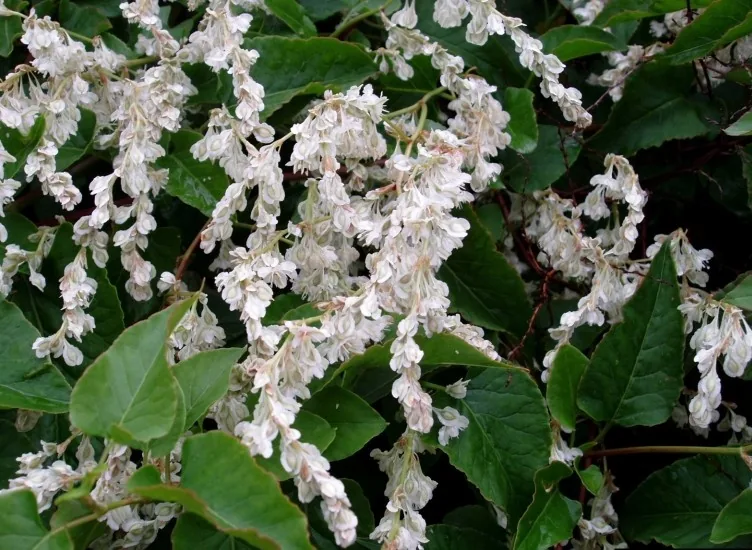
Silver lace vine is the plant you reach for when you need to hide something fast. It throws long twining stems up an arbor or fence and, by late summer, smothers it in frothy, lacy sprays of tiny creamy-white flowers. Hardy from zone 4 to 9, it shrugs off cold, heat, drought, and poor soil alike.
Speed is the whole point and also the whole problem. A single season can add 10 to 15 feet of growth, and the plant doesn't stop at its support, spreading by suckers, rhizomes, and self-sown seed into whatever ground is nearby. It has earned the nickname mile-a-minute vine, and in parts of the midwestern and northeastern US it's treated as weedy or invasive.
Grown with eyes open, it's one of the easiest climbers there is. Give it a sturdy, oversized support set well away from trees, gutters, and prized beds, then commit to cutting it back hard every year. Do that and you get the cover and the bloom; skip it and the vine takes the decision out of your hands.
Care
The short version: plant it in full sun in any well-drained soil, water only while it's young, skip the fertilizer, and prune it hard every late winter to keep its runaway growth in check.
Light
Plant it in full sun for the heaviest bloom, though it puts up with partial sun and even partial shade. More shade simply means fewer of those lacy flower sprays.
Water
Water young plants regularly while they settle, then ease off, because established vines are very drought tolerant. After the first season you only need to step in during a long dry spell, every 7 to 14 days at most.
Soil
Almost any well-drained soil suits it, from loam to silt to sand, across a wide pH range of 5.5 to 8.0. Lean, poor ground is actually a help here, since it slows the vine's tendency to spread.
Temperature
This is a tough, cold-hardy climber that handles anything from -29°F to 100°F (-34°C to 38°C). Heat and cold snaps barely register.
Humidity
Ordinary outdoor humidity is plenty, so there's no number to manage. The plant adapts to whatever the season brings.
Feeding
Hold back on fertilizer. The vine grows so hard on its own that feeding is rarely needed, and a single spring dose of a balanced or low-nitrogen feed only makes sense if growth looks genuinely weak. Too much nitrogen just fuels the rampant growth you're trying to limit.
Pruning
Pruning is the main job with this plant. It blooms on new wood, so cut it back hard in late winter or early spring to control size and renew it, dropping it to 1 to 3 feet for a full renovation. Expect to keep trimming through the season to hold it in bounds.
Repotting
It's rarely grown in a container, and when it is, it seldom needs repotting. Watch for roots circling or escaping the pot, soil that dries out fast, or stunted top growth, all signs it has outgrown its space.
Size & spacing
Give it serious room and a strong structure. The vine climbs 20 to 35 feet (6 to 10.5 m) tall and spreads anywhere from 2 to 25 feet (61 cm to 7.5 m) wide, so site it well clear of anything it could overwhelm.
When to plant
Silver lace vine goes in during spring after the last frost, or in early fall while the soil is still warm. It blooms on the current year's wood from mid to late summer into fall, which is also why the heavy pruning happens in late winter, before the new growth that carries the flowers begins.
Northern hemisphere
Southern hemisphere
Typical months for a temperate climate: start earlier in warm zones, later where spring frosts linger.
- Sow: Late winter to early spring, 6-8 weeks before last frost (seed propagation is uncommon; cuttings and layering are easier).
- Plant: Spring after last frost, or early fall.
- Harvest: Mid/late summer into fall (roughly July to frost).
Hardiness
USDA hardiness zones: 4–9
Temperature: down to -34°C
Troubleshooting
This vine has few real pests, and its biggest fault is simply doing too well. Most of what goes wrong is about reining in its growth rather than nursing it back to health. Match what you see below and act before the vine gets further ahead of you.
Vine swallowing its support and creeping into the rest of the garden
This is the extreme vigor that defines silver lace vine, and it is the plant doing exactly what it does best. New shoots can run 10 to 15 feet in one season, and the crown throws suckers and self-seeds into nearby ground. Cut it back hard each late winter, keep cutting through summer, and pull the seedlings and suckers before they settle in.
Fix:
- Prune hard in late winter and again through the growing season to keep it in bounds
- Cut back to 1-3 ft for full renovation when overgrown
- Remove suckers and pull or mow seedlings as they appear
- Install a sturdy, oversized support and keep it clear of trees, shrubs, and gutters
Leaves chewed full of ragged holes in summer
Most of this is Japanese beetles, which skeletonize the foliage and show up as metallic green-and-bronze insects on the leaves. Pale winding trails inside the leaves point instead to leaf miners. Hand-pick the beetles into soapy water early in the morning, strip off any mined leaves, and let the rest go, because a vine this fast simply grows past the damage.
Fix:
- Hand-pick Japanese beetles into soapy water in early morning
- Tolerate minor damage, as the vine outgrows it
- Remove and dispose of mined leaves
Toxicity
Good news for households with pets and children: silver lace vine isn't listed as toxic, and it's regarded as safe for cats, dogs, and people alike. The hazard with this plant is never poisoning. It's the relentless growth, so the real caution is the heavy pruning rather than anything in the leaves.
Safe for
People · Cats · Dogs · Horses · Rabbits · Livestock · Birds
Cats Safe
Silver lace vine isn't on the ASPCA's toxic list, so a cat that nibbles a leaf has nothing to fear from it.
Dogs Safe
Dogs can chew the foliage without poisoning, though a big mouthful of any plant can still leave a sensitive stomach a little off.
Horses Safe
No toxin here troubles horses; they can graze the leaves and shoots without harm.
Rabbits Safe
Rabbits are fine around this vine, and the tender new growth is safe for them to browse.
Livestock Safe
Cattle, goats, and sheep can be around silver lace vine without any risk of poisoning.
Birds Safe
Birds take no harm from the plant, and many find cover in its dense, fast-growing tangle.
People Safe
There's no poisoning hazard for people. The only real caution is the heavy pruning the vine demands, so wear gloves and reach for the loppers.
No special handling for toxicity; wear gloves and use loppers for the heavy seasonal pruning this vine requires.
Varieties
There aren't many named forms of silver lace vine, but the two you'll run across differ mostly in leaf color and sheer size.
Lemon Lace
A slightly tamer, deer-resistant selection that tops out around 20 to 30 feet, carrying the usual white flowers over chartreuse-to-gold leaves on red stems.
Species (Fallopia baldschuanica)
The standard and most vigorous form, with bright green heart-shaped leaves and frothy, lacy sprays of tiny fragrant flowers in creamy-white to greenish tones.
How to propagate
Silver lace vine roots almost too willingly, which is part of why it spreads the way it does. Cuttings, layering, and division all work with little effort, and the plant will even seed itself if you let it.
Stem cuttingsEasy
Late spring to summer (softwood/semi-hardwood) · A few weeks to root; established in one season
The easiest route. Take softwood or semi-hardwood cuttings of new growth from late spring through summer, and they root in a few weeks and fill out within the first season.
LayeringEasy
Spring to summer · One season
Pin a trailing stem down to the soil anytime from spring to summer and it roots right where it touches the ground, giving you a new plant in a single season.
DivisionEasy
Late winter to early spring · One season
In late winter or early spring, split the crown or lift one of the rooted suckers the vine throws so freely. Each piece settles in over the course of the season.
SeedModerate
Start indoors late winter to early spring · A season or more
Less common but doable. Start seed indoors in late winter or early spring and expect a season or more before the plant takes hold, though the vine also self-seeds into the surrounding ground on its own.
Myths
Silver lace vine is just another name for Japanese or giant knotweed.
The two are cousins in the same family, but they are not the same plant. Silver lace vine is the climbing, white-flowered ornamental, while Japanese and giant knotweed grow upright and bamboo-like and rank among the most destructive invasives around. Silver lace vine can still turn weedy, but it is the milder relative.