Shrub · Berberidaceae
Oregon Grape
Mahonia aquifolium
Give it shade and shelter from winter wind, and Oregon grape rewards you with yellow spring flowers and blue-black berries.
Partial shade
Every 7–14 days
USDA 5–8
3–6 ft · 0.9–1.8 m
Overview
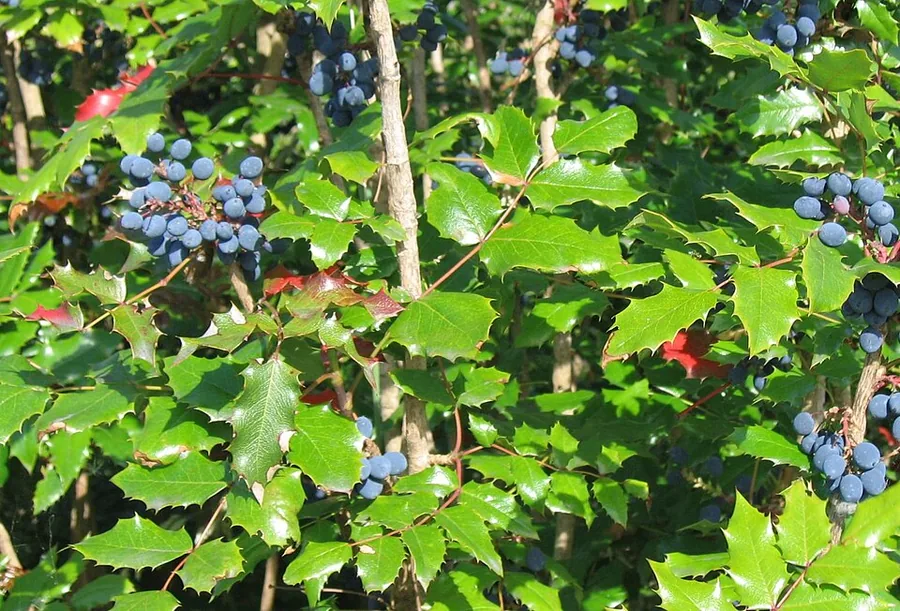
Oregon grape is an evergreen shrub from the Pacific Northwest with glossy, holly-like leaves that flush bronze in cold weather and turn deep green again in spring. It belongs to the barberry family, not the grape family, and earns its common name from the clusters of blue-black berries that ripen by late summer. Few shrubs hold their good looks through all four seasons the way this one does.
The plant runs slow and steady, reaching 3 to 6 feet tall over years rather than seasons. It spreads underground by stolons, sending up suckers that knit into a low, colonizing thicket. That habit makes it a fine groundcover on a shaded bank, though it does mean pulling stray shoots if you want it to stay in bounds.
Early spring brings dense racemes of bright yellow flowers that feed early bees, followed by the tart berries that birds strip and people cook into jelly. Tough down to -20°F (-29°C), it handles hard winters as long as it sits out of drying wind.
Care
The short version: plant it in partial shade with shelter from winter wind, in moist, acidic, well-drained soil, and keep it watered until it settles in. After that it asks for little beyond a spring tidy-up.
Light
Oregon grape does best in partial to full shade. It will take full sun, but the leaves tend to bleach and scorch there, especially in winter, so a spot with some overhead shelter keeps the foliage at its glossy best.
Water
Keep the soil evenly moist for the first season or two while the roots reach out. Once it's established the shrub shrugs off dry spells, so you can let the top inch dry and water only every 7 to 14 days. What it won't forgive is standing water.
Soil
Plant it in moist, rich, acidic, well-drained ground in the 5.0 to 7.0 pH range. It resents alkaline, compacted, or soggy soils, and lime is the quickest way to bring on the yellow leaves it's known for.
Temperature
This is a cold-hardy shrub, comfortable from about -20°F to 90°F (-29°C to 32°C). Hard winters don't faze it as long as it sits out of biting wind, which is what burns the leaves rather than the cold itself.
Humidity
Ordinary outdoor humidity suits it fine, so there's no target to hit. Air movement matters more than moisture in the air here, since crowded, still foliage is what invites leaf spot and rust.
Feeding
A spring feed is plenty. Use a balanced or acidifying shrub fertilizer, and switch to an acidic formula if the leaves start yellowing from high-pH chlorosis.
Pruning
Prune after flowering to shape the plant or to cut a leggy one back hard for fresh growth. Take out dead, damaged, or winter-burned stems at the same time, and pull unwanted suckers as they appear to keep the colony from wandering.
Repotting
Grown in the ground it never needs repotting, and in a container it's happy left alone for years. Move it up only when roots circle the pot or the soil dries out far too fast.
Size & spacing
Expect a mature plant 3 to 6 feet (91 to 183 cm) tall with a spread of 20 inches to 1.5 to 5 feet (51 to 152 cm) as the suckers fill in. Give it room to colonize, or be ready to trim the edges back each year.
When to plant
Oregon grape sets its own pace through the year. Plant it in spring or fall while the soil is workable, watch for yellow flowers in early spring, and wait for the blue-black berries to ripen from late summer into early fall.
Northern hemisphere
Southern hemisphere
Typical months for a temperate climate: start earlier in warm zones, later where spring frosts linger.
- Plant: Spring or fall
- Harvest: Yellow flowers in early spring; blue-black berries ripen by late summer to early fall
Hardiness
USDA hardiness zones: 5–8
Temperature: down to -29°C
Troubleshooting
Almost every problem with Oregon grape shows up on the leaves, and most trace back to where it's planted rather than to any pest. Read the foliage and you'll usually find the cause. Match what you see below, then fix the site before reaching for a spray.
Brown, scorched leaf edges that worsen over winter
This is winter leaf burn, and it hits hardest where winter sun and dry wind pull moisture from the leaves faster than frozen roots can replace it. Too much hot summer sun does the same on exposed sites. Plant in partial to full shade with shelter from wind, mulch and water well going into winter, then prune out the worst foliage in spring as fresh growth pushes through.
Fix:
- Site in partial to full shade with shelter from strong and drying winter wind
- Mulch and keep soil evenly moist going into winter
- Prune out badly burned foliage in spring as new growth emerges
Yellow leaves with veins that stay green
When the leaf turns yellow but the veins stay green, you are looking at iron chlorosis driven by soil that has crept too alkaline for the roots to take up iron. Test the soil first. Lower the pH with elemental sulfur or an acidifying fertilizer for the long haul, and reach for chelated iron when you need a fast fix.
Fix:
- Test soil pH
- Lower pH and acidify with elemental sulfur or an acidifying fertilizer
- Apply chelated iron for quick correction
Spots or orange rust pustules on the foliage
Discrete spots or orange-to-brown pustules point to leaf spot and rust fungi, which take hold on crowded plants in humid air. Pick off and bin the marked leaves, then open the plant up so air moves freely and the foliage dries quickly. A labeled fungicide is worth it only when an outbreak runs out of hand.
Fix:
- Remove and dispose of affected leaves
- Improve air circulation and avoid overhead watering
- Apply a labeled fungicide if infection is severe
Toxicity
This is a gentle plant to have around, but it isn't a free-for-all. The cooked berries are good to eat, while the roots and stems hold berberine, a bitter compound that can upset the stomach if a pet or person eats much of it. The spiny leaves do more day-to-day harm than the chemistry, so wear gloves when you handle it.
Toxic to
Cats · Dogs · Horses · Rabbits · Livestock
Safe for
People · Birds
Cats Mild
The roots and stems carry berberine, so a cat that gnaws on them may drool, vomit, or get loose stools. A nibble of a leaf rarely amounts to much; the upset comes when a curious cat eats a real mouthful.
Dogs Mild
Dogs that chew the stems or roots can end up with an upset stomach and a bout of diarrhea from the same berberine. The trouble scales with how much they swallow, and most cases settle on their own.
Horses Caution
Horses tend to leave the spiny foliage alone, but the berberine in the woody parts can still sour the gut if one grazes a quantity. Best to keep it out of reach where pastured horses browse.
Rabbits Caution
A rabbit is small enough that even a little of the bitter, berberine-laced foliage can throw off its digestion. Don't offer the plant as forage.
Livestock Caution
Cattle, goats, and sheep usually pass over the prickly leaves, yet eating much of the stem or root could bring on mild digestive upset. Stock seldom seek it out by choice.
Birds Safe
Wild birds feast on the ripe blue-black berries and spread the seed without harm. The fruit is part of how the shrub gets around.
People Berries safe when cooked
The tart berries are good to eat once cooked into jelly or wine, so the fruit is safe for people. Leave the roots and stems alone, since the berberine in them can upset the stomach if eaten in any quantity.
The glossy, holly-like compound leaflets have stiff spine-tipped teeth that can prick or scratch skin; wear gloves and use care when pruning or handling.
Helpline numbers

United States
ASPCA Animal Poison Control: (888) 426-4435 (fee applies)
Poison Control: (800) 222-1222



Canada
Poison Centres: 1-844-764-7669
Varieties
Most gardens grow the straight species, but a couple of named selections are worth seeking out when space or flower power matters.
'Compacta'
A dwarf form that tops out around 2 to 3 feet tall, which makes it handy for tight spots and for massing as a low groundcover.
'Apollo'
A low, spreading selection prized for its heavy show of yellow flowers over a dense, tidy habit.
How to propagate
Oregon grape gives you three ways in, from quick to slow. Dividing the rooted suckers is the simplest, while cuttings and seed both reward patience.
Stem cuttingsModerate
Late fall to winter, after some cold exposure · Several weeks to months to root
Take semi-hardwood cuttings in late fall or winter, once the wood has felt some cold, and dip the cut ends in rooting hormone. Stand them in a moist, well-drained medium and give them patience, since roots can take several weeks to a few months to form.
DivisionEasy
Spring or fall · One growing season
This is the easy route. The shrub spreads by stolons into colonizing clumps, so in spring or fall you can lift it, slice off the rooted suckers, and replant them. Each piece settles in over one growing season.
SeedModerate
Sow stratified seed in fall or after cold stratification · One or more years; seed is slow to germinate and reach size
Seed is the slow road. Clean the pulp from ripe berries and either sow in fall or give the seed a cold stratification first, since it won't sprout without that chill. Expect a year or more before the seedlings reach any real size.
Myths
Oregon grape berries are poisonous because they look like holly or barberry fruit.
Looks fool people here. The blue-black berries are too tart to enjoy raw, but cooked into jelly or wine they are good to eat, and the plant is listed as non-toxic to cats, dogs, and horses. The fruit is safe; only the bitter roots and stems are worth keeping out of mouths.