Houseplant · Araceae
Anthurium
Anthurium andraeanum
Give it warmth, steady moisture, and humid air, and the anthurium throws those glossy spathes for months.
Bright indirect
65–85°F · 18–29°C
USDA 11–12
12–18 in · 30–46 cm
Overview
The anthurium comes from the warm, wet forests of Colombia and Ecuador, where it grows as an epiphyte clinging to trees rather than rooting in the ground. That heritage tells you most of what it wants indoors: bright but filtered light, air that never dries out, and a pot that drains fast. It belongs to the same family as the peace lily and philodendron, and it carries the same calcium oxalate that makes those plants risky around pets.
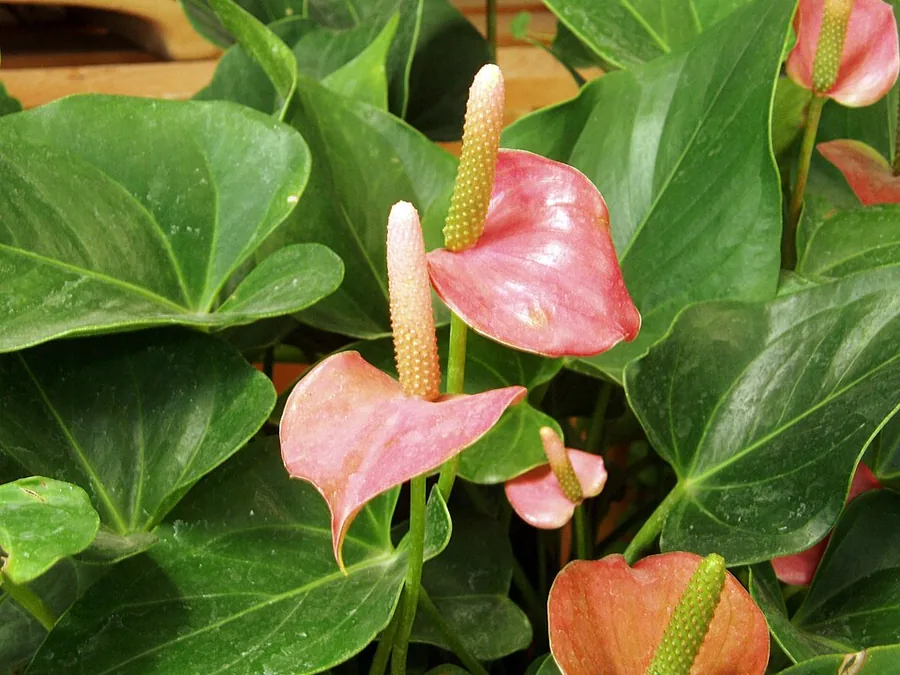
What most people call the flower isn't one. The waxy red, pink, orange, or white heart you see is a spathe, a modified leaf, and the real flowers are the tiny bumps packed onto the pale spadix that stands up from it. A happy plant keeps pushing out fresh spathes for much of the year, which is why it earns names like flamingo flower and painter's palette.
This is not a beginner's plant. It rewards a steady hand and punishes neglect, sulking in dry rooms and rotting in soggy pots. Get the light, water, and humidity right, though, and it stays glossy and in bloom far longer than most houseplants.
Care
The short version: bright indirect light, soil kept evenly moist but never soggy, warmth above 65°F (18°C), and humid air around 60% to 80%. Feed weekly through spring and summer and repot every couple of years.
Light
Give it bright, indirect light near a window but out of the sun's direct path. Direct rays scorch the leaves, while deep shade leaves you with foliage and no flowers, so somewhere bright and filtered is the sweet spot.
Water
Water when the top inch of soil dries out and keep the mix evenly moist year-round, never letting it bake dry or sit in water. Overwatering is the quickest way to kill one, since soggy soil rots the roots. Rainwater or filtered water suits it better than hard tap water.
Soil
Plant it in a light, peaty mix that drains freely, the kind of airy blend its epiphytic roots expect. Slightly acidic soil at a pH of 6.0 or just below works best, and sharp drainage is what keeps root rot at bay.
Temperature
Keep it warm, between 65°F and 85°F (18°C to 29°C), and never let it drop below 60°F (16°C) in winter. It has no tolerance for cold drafts or a chilly windowsill.
Humidity
This is the part most people miss. Anthurium wants high humidity, around 60% to 80%, far more than a typical heated room offers, and dry air browns the leaf tips fast. A pebble tray, a humidifier, or a steamy bathroom all help.
Feeding
Through spring and summer, feed it weekly with a liquid fertilizer. A high-phosphorus formula pushes more blooms. Ease off through the darker months when growth slows.
Pruning
Snip off spent blooms to nudge the plant toward making more, and wipe the broad leaves now and then so dust doesn't dull them. Wear gloves, since the sap can irritate skin.
Repotting
Repot every two years into a slightly larger pot. Fresh mix flushes out the mineral salts that build up from feeding, and it gives the roots room before they start circling the pot.
Size & spacing
Indoors it stays compact, reaching 12 to 18 inches (30 to 46 cm) tall and spreading 9 to 12 inches (23 to 30 cm) wide. That modest size makes it an easy fit for a shelf or tabletop.
Troubleshooting
Anthurium troubles read clearly once you know where to look. Dry air shows up on the leaf tips, too little light shows up in the lack of blooms, and overwatering shows up in the roots. Match what you see below, then fix the condition behind it.
Yellowing, wilting leaves over soggy soil
When the soil stays wet and the leaves yellow and droop, the roots are likely rotting. Overwatering and poor drainage are the cause, and the roots turn brown and mushy underground. Cut back on water, repot into a light, fast-draining mix in a pot with drainage holes, and trim away any rotted roots.
Fix:
- Reduce watering and allow excess water to drain
- Repot into a light, well-drained mix, removing rotted roots
- Use a pot with drainage
Sticky residue, webbing, or cottony specks on leaves
Anthuriums draw the usual indoor sap-suckers, including aphids, spider mites, mealybugs, scale, whitefly, and thrips. Watch for stippled leaves, sticky residue, fine webbing, or little cottony masses. Isolate an affected plant, wipe the pests off the leaves, and treat as needed before they spread.
Fix:
- Inspect plants regularly and isolate affected plants
- Wipe leaves and remove pests
- Treat with appropriate control measures
Spots, blighted patches, or rotted tissue on leaves
Spots and rotted patches on the foliage usually mean fungal or bacterial disease, which takes hold in stagnant, overly wet conditions. Open up the air around the plant, switch to a light, well-drained mix, and strip off the affected leaves.
Fix:
- Improve air circulation
- Use light, well-drained soil mixes
- Remove affected foliage
Plenty of leaves but few or no flowers
An anthurium that won't bloom is almost always one that's too short on light. Move it somewhere bright but out of direct sun, clip off any spent spathes, and switch to a high-phosphorus feed to coax fresh flowers along.
Fix:
- Move to a spot with bright, indirect light, out of direct sun
- Remove spent blooms
- Apply a high-phosphorus fertilizer to encourage flowering
Brown, crispy tips on otherwise green leaves
Brown tips on green leaves point straight to dry air, the most common anthurium complaint in a heated room. Raise the humidity around the plant and pull it back from heating vents and drafts, which dry the foliage and scorch the edges.
Fix:
- Raise humidity around the plant
- Move away from drafts and dry-air locations such as heating vents
Bleached or burned patches on sun-exposed leaves
Pale, burned patches mean the plant is catching direct sun, which anthurium leaves can't take. Shift it to a spot with bright but indirect light, and keep it clear of drafts and very dry corners that make the scorching worse.
Fix:
- Move out of direct sunlight to bright, indirect light
- Relocate away from drafts and very dry spots
Toxicity
This is a plant to keep out of reach. Every part holds sharp insoluble calcium oxalate crystals, the same irritant found across the arum family, and chewing any of it sets off burning and swelling in the mouth. The sap can irritate bare skin too, so wear gloves when you prune and keep the plant well away from pets and children.
Toxic to
Cats · Dogs · Horses · Rabbits · Livestock · Birds · People
Cats Moderate
A cat that bites a leaf feels it at once, with a burning mouth, drooling, and pawing at the face. Expect swelling of the lips and tongue, vomiting, and trouble swallowing.
Dogs Moderate
Dogs react the same way, drooling hard and refusing food after a chew. The mouth, tongue, and lips swell and turn painful, and vomiting often follows.
Horses Moderate
The crystals irritate a horse's mouth on contact, bringing pain, swelling, and heavy drooling that makes swallowing difficult. Horses can't vomit, so the upset stays in the mouth and throat.
Rabbits Toxic
The same oxalate crystals burn a rabbit's sensitive mouth and gut, so keep the plant well out of reach and never offer any part of it.
Livestock Toxic
Grazing animals that nibble the foliage get a mouthful of stinging crystals, leading to drooling, mouth pain, and stomach upset. Fence the plant off where stock can reach it.
Birds Toxic
A curious bird that pecks the leaves or sap meets the same irritant crystals, which inflame the mouth and crop. Best to keep it out of any room where birds roam free.
People Caution
No part of an anthurium is meant to be eaten, and a bite brings burning and swelling in the mouth. The sap can leave skin red and itchy too, so handle it with gloves and steer children clear.
Sap and tissue contain insoluble calcium oxalate crystals (raphides) that can cause skin/contact dermatitis; consider wearing gloves when handling or pruning
Helpline numbers

United States
ASPCA Animal Poison Control: (888) 426-4435 (fee applies)
Poison Control: (800) 222-1222



Canada
Poison Centres: 1-844-764-7669
Varieties
Anthurium andraeanum comes in a range of named cultivars, mostly sorted by spathe color. These are a few listed by NC State Extension.
'Acropolis'
A named cultivar of Anthurium andraeanum recognized by NC State Extension.
'Baron'
Another A. andraeanum selection on the NC State Extension list of named cultivars.
'Cheers'
A cultivar of Anthurium andraeanum documented by NC State Extension.
'Florida'
An A. andraeanum cultivar named in the NC State Extension records.
'Midori'
A named Anthurium andraeanum cultivar catalogued by NC State Extension.
'Rosee Choco'
One more A. andraeanum cultivar listed among NC State Extension's named selections.
How to propagate
Anthurium is multiplied by splitting an existing plant or rooting a cutting, both best attempted on an established specimen rather than a young one.
DivisionModerate
Best done at repotting (every 2 years) · Unknown
The simplest way to make more anthuriums is to divide a mature plant when you repot it, which works out to about every two years. Tease the clump apart so each piece keeps its own roots, then pot the divisions up separately.
Stem cuttingsModerate
During active growth · Unknown
You can also root a stem cutting taken while the plant is in active growth. NC State Extension lists this alongside seed as a way to propagate anthurium, though cuttings are the more practical route at home.
Myths
The colorful red part of an anthurium is its flower.
That glossy red, pink, orange, or white heart is a spathe, a modified leaf rather than a bloom. The real flowers are the tiny bumps crowded onto the spadix, the pale white or cream column standing up from the center of the spathe.